
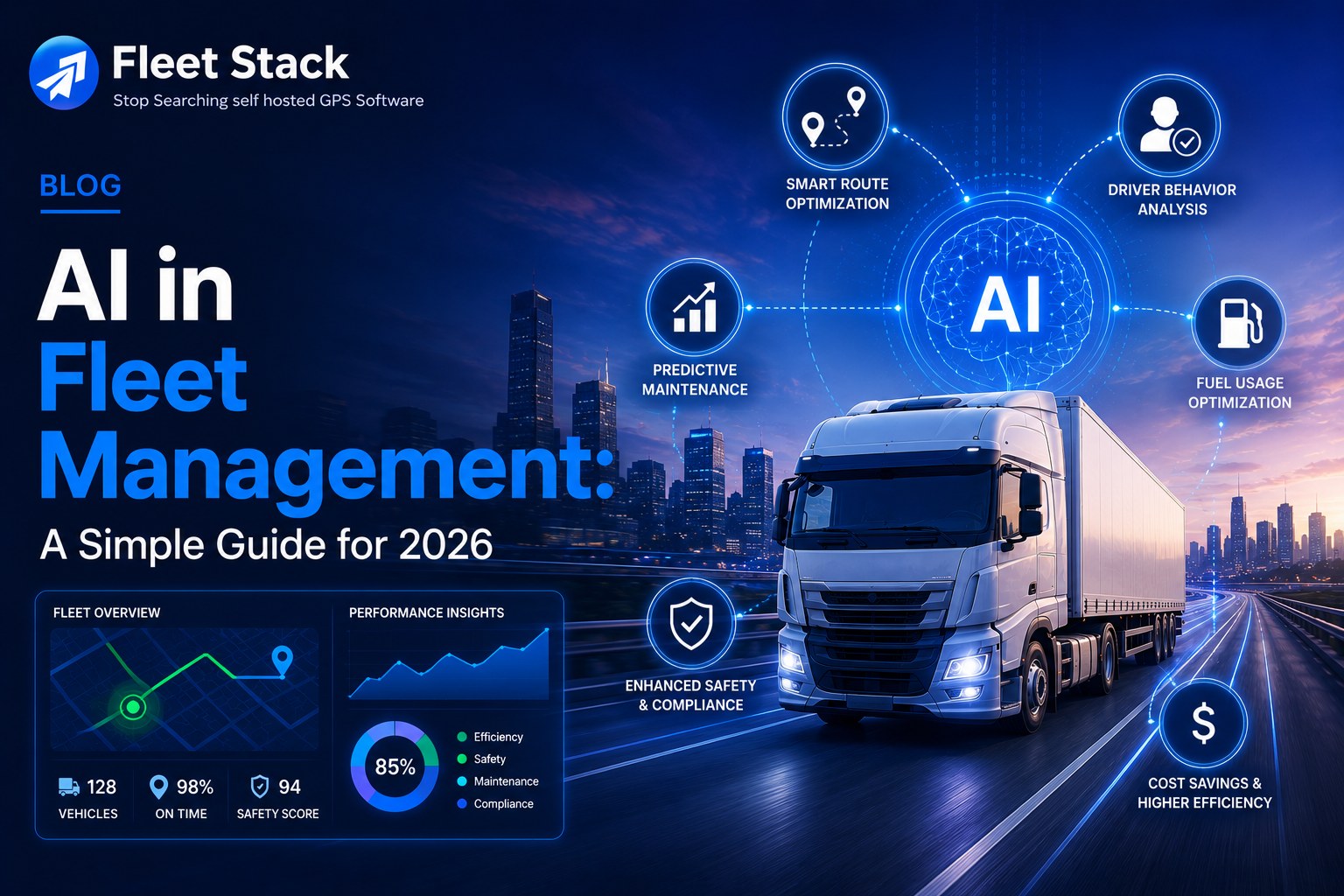
This simplified guide will help you understand how to unlock the potential of AI in fleet management in 2026. AI in fleet management is an emerging technology that revolutionizes the sector by improving efficiency, safety, and sustainability. This is a short, easily digestible explanation of how AI can minimize downtime and save on fuel and routing with real data, and when it matters most.
Fleet Management and AI: The Basics
AI interprets your fleet data and helps you make smart decisions. It identifies patterns in the information your vehicles already gather patterns a human wouldn't see, like where you are, how your engine is operating, how you're driving, and how you're using fuel. It then predicts potential failures before they happen, optimizes routes, detects fuel-usage inefficiencies, and detects unsafe driving. In effect, AI interprets raw fleet data to make it actionable, thereby cutting down on cost and potential problems.
It works based on a machine-learning algorithm that learns what is usual for each car and notifies you if it varies. The more it is used on your fleet, the more accurate it gets. The vast majority of fleets that leverage AI say they make quicker decisions, have reduced fuel costs and less downtime, and see a return on investment within six months or less. Early adopters will get a head start on later adopters.
Key Takeaways
- Predictive maintenance via AI analyses data and identifies potential issues before they occur within your fleet.
- Fleets have seen their breakdowns cut by 45% and costs by 25% with AI predictive maintenance.
- Currently, only 27% of fleets already use AI, and 65% expect to by the end of 2026.
- The first movers have a 12–18 month lead over the others.
How AI Works: A Simple 4-Step Process
It's a much simpler concept than it sounds. Here is the 4-step process of AI.
- It collects data from GPS, engine sensors, fuel records, and driver inputs.
- It finds patterns. Machine learning discovers patterns and irregularities that humans may not be able to spot.
- It takes action, it warns you, schedules work orders, or suggests an alternate path.
- It keeps learning. The greater the amount of data it processes, the more accurate its predictions will be.
This is based on the same fleet telematics infrastructure that collects your vehicle data. It's the AI layer that provides the substance. Today's systems are based on machine learning and predictive analytics, and many now incorporate computer vision for safety cameras.
What AI Can Do for Your Fleet (2026 Applications)
AI is not one tool. There are a number of them, and each one solves a problem of the real fleet. Let's take a look at the primary applications for 2026.
| Use of AI | What it's used for | Typical outcome |
| Predictive maintenance | Predicts breakdowns early | 45% fewer breakdowns |
| Route optimization | Plans and recalculates routes | 10–20% fewer miles |
| Fuel monitoring | Identifies waste and theft | 5–15% fuel recovered |
| Driver safety coaching | Uses camera and sensor data | Up to 52% fewer accidents |
| Natural-language reports | Answers simple questions about your fleet | Saves hours of admin |
Prevent problems before they arise
This is the best usage. Whenever the engine is sending in data, AI can alert you 20–45 days prior to part failure. Fleets that use it claim 45% fewer breakdowns and 25% reduced maintenance expenses. See predictive fleet maintenance in action.
Plan smarter routes
AI factors in traffic, weather, delivery time, and driver availability to develop the best route and adapt it as conditions change. This cuts overall miles by 10–20% and improves on-time delivery to more than 97%.
Cut fuel waste
AI creates a baseline of typical fuel consumption for each car. It will notify you if fuel goes missing through theft, or if there is a mechanical problem. This saves 5–15% of fuel consumption that was lost to unnoticed waste. See fuel management.
Keep drivers safe
AI safety systems rely on cameras and sensors to detect unsafe driving behavior and provide feedback to the driver. After 90 days of comprehensive AI safety solutions, fleets have seen accidents decrease by as much as 52%, and distracted driving by as much as 80%.
Why AI in Fleet Management Matters in 2026
Not everything has been plain sailing, but a few forces have made this feel like the year AI has gone from 'nice to have' to 'need to have.'
- The numbers are substantiated. This is no longer a promise, it's a reality. Fleets report real, repeat results; ROI can be as high as 200–500% and payback can be as short as six months.
- The number of drivers is too low. The US is short more than 80,000 truck drivers. For existing drivers, AI can do more, with 15–20% more optimized deliveries per driver.
- The data already exists in most fleets. More than 90% of vehicles in 2026 will come equipped with telematics. The data is there, AI is what reads it.
- Those who move first get the advantage. Currently, less than one-quarter (27%) of fleets are utilizing AI, with 65% expected to do so by 2026. The early adopters have a 12–18 month lead, and the rest are beginning to catch up.
Is AI Only for Big Fleets?
No, this is not true. AI tools that previously cost millions of dollars are now far more affordable to run. Small and mid-size fleets can reap the greatest benefit per vehicle, as each saved route or each avoided breakdown counts for more. The biggest adoption of AI is currently among SMBs.
How to Get Started: A Simple Roadmap
It's not necessary to make all of the changes at once. Here is a simple roadmap.
- Be sure to have data flowing. There is a lot of data already collected by your vehicles. Connect it using one platform.
- Begin with predictive maintenance. It is the most profitable and breaks even the quickest.
- Add route and fuel tools next. These are computed using the same data as earlier.
- Let it learn. The longer it has been in use in your fleet, the better the predictions.
The first and most important step is to establish your database now, and have something for the AI to learn from.
Frequently Asked Questions
What is AI in fleet management?
It's AI-driven fleet data analysis and action. AI anticipates breakdowns, optimizes routes, identifies fuel wastage, and identifies unsafe driving, which translates into cost reductions.
How can AI help reduce the expenses of a fleet?
AI saves money in a number of ways: by preventing breakdowns through predictive maintenance, by cutting down on mileage through route optimization, by cutting down on fuel waste, and by decreasing the number of accidents. All of this frequently adds up to around 200–500% ROI.
What is the accuracy of AI in predicting breakdowns?
The best-performing systems can reach 90% or more accuracy at predicting component failures within a fleet after six months or less of training, while giving 20–45 days of advance warning.
Will small fleets benefit from AI fleet management?
Yes. Modern AI tools are cost-effective, and they make the most significant per-vehicle difference for a small fleet.
Do you need to buy new equipment to run AI?
Usually not much. More than 90% of new vehicles today already include telematics. The data you link to the platform is handled by a platform that understands and learns from it.
Will AI take the place of fleet managers and drivers?
No. AI carries out routine monitoring and prediction, allowing managers to focus on other decision-making, and helps drivers operate more safely. It enhances a team it is not meant to replace one.
The Bottom Line
The use of AI in fleet management is not something that should be feared, but welcomed. It taps into data your cars are already collecting, proactively identifies potential problems before they happen, and turns uncertainty into action. It learns over time, and the fleets that use it are building an advantage, month after month.
It's easy to start. Bring all your fleet information into one place, begin with predictive maintenance, and let it go from there.
Want to understand the ways you can use AI tools in your fleet? Unite predictive maintenance, fuel insights, and smart tracking into one platform with FleetStack.
Start a free trial today!
Read other articles on the same topic: GPS fleet tracking systems, predictive fleet maintenance, fleet fuel management, and what is fleet telematics?.
Data was sourced from the 2026 Fleet Benchmark Report, industry adoption surveys (AI adoption 27%, 65% planning), Global Market Insights and other 2026 fleet market reports (market size and growth), and fleet operator deployment data 2026–2026 (breakdown, fuel, safety, and ROI figures). The figures are a range for the industry and will vary from fleet to fleet, vehicle to vehicle, and conditions to conditions.
0 Comments
No comments yet. Be the first to comment!
Please to post a comment