
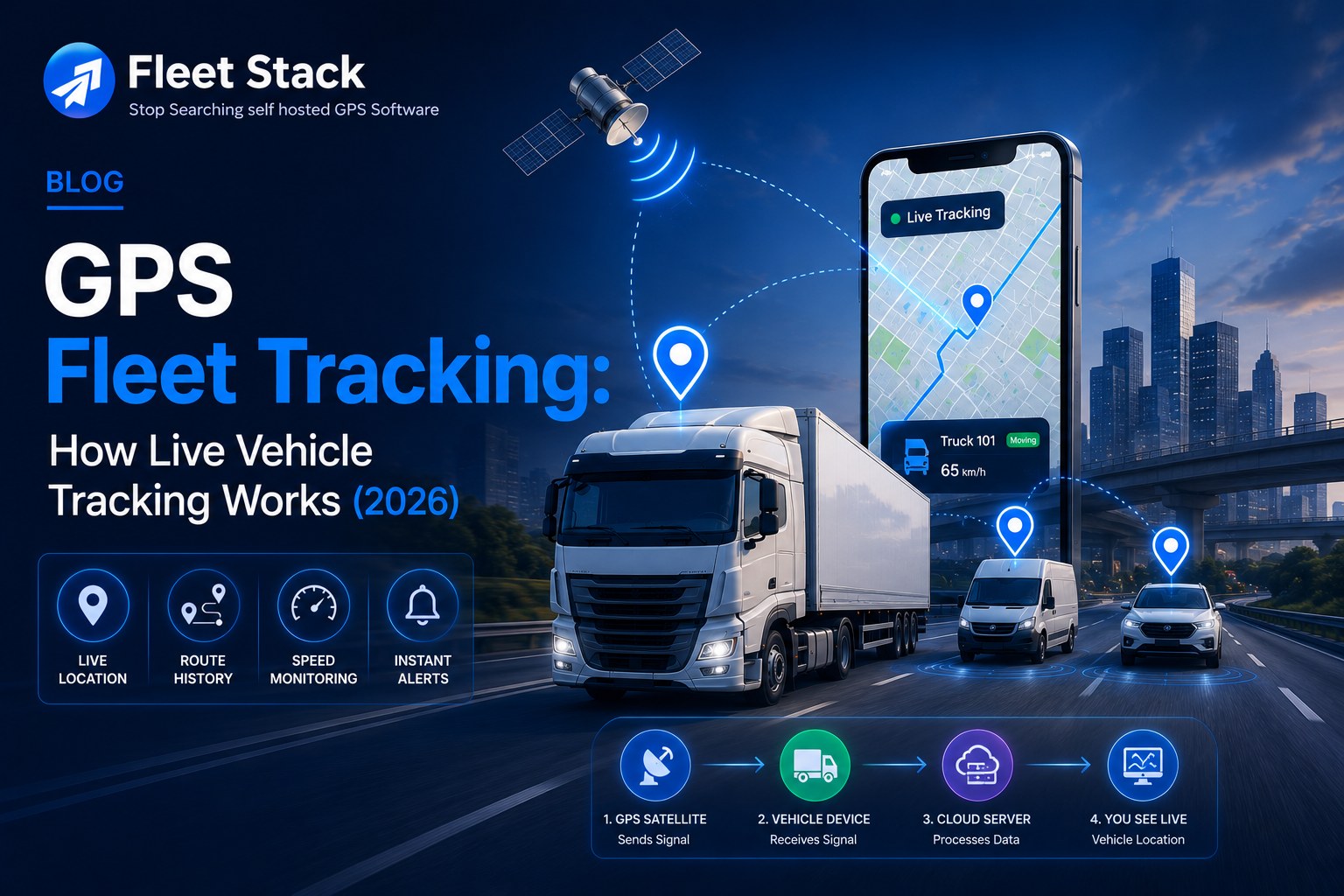
GPS fleet tracking shows you where every vehicle is, in real time. Below is a clear explanation of how live vehicle tracking works its parts, benefits, costs, and update rates based on real statistics and sources.
GPS Fleet Tracking: What Is It?
GPS fleet tracking is software that shows you real-time tracking of your vehicles on a map. In each vehicle, a small device captures signals from GPS satellites to determine the vehicle's exact location, speed, and direction. It then passes that to software you connect to, where you can view your entire fleet in one place. The map updates almost in real time new systems refresh every 10–30 seconds. Live location, playback history, zone alerts, and the ability to quickly locate a stolen vehicle are among the other features of GPS tracking. It's the essential layer of fleet management: routes can't be planned, mileage can't be checked, and vehicles can't be dispatched efficiently without knowing where each one is. In 2026, 4 out of 5 fleets track with GPS, and most pay off their GPS within a few months of purchase.
Key Takeaways
- Real-time vehicle tracking shows a vehicle's live location and can update every 10–30 seconds.
- 80% of fleets are deploying GPS right now, up 11% from a year ago.
- 85% report that it improved productivity.
- The system typically pays for itself in 60–90 days, often on fuel savings alone.
How Does GPS Fleet Tracking Work?
It's easy four steps.
- A device sits in each vehicle. It plugs into the OBD-II port or is hardwired in.
- It reads GPS satellites. It measures the distance to several satellites at once and calculates the vehicle's exact location. This is called trilateration.
- It transmits the information over the mobile network, every 10–30 seconds.
- It's placed on a map. All of your vehicles are shown in real time, along with their history, in the software.
Under normal conditions, modern GPS receivers deliver an accuracy of 5 to 15 feet. That's more than enough to prove a delivery, verify mileage, or settle a dispute. GPS tracking works very well outdoors, though accuracy can dip briefly indoors near tall city buildings, in underground parking, or in tunnels. Modern systems correct this automatically once a clear signal returns. The GPS tracking part of any fleet telematics system is the location layer.
How Often Does GPS Tracking Update?
This matters more than many people realize. Here's the simple explanation.
- City delivery and dispatch: 10–30 seconds keeps busy, stop-and-go work accurate.
- Long-haul: when the exact location between stops matters less, 60-second updates are enough and use less data.
Why the gap matters: at highway speed, a vehicle that reports only once every 2 minutes leaves more than 2 miles of its route unrecorded. A map that refreshes every 10 seconds stays as close to real time as possible. The best systems let you tune the update frequency for each vehicle category.
What Are the Benefits of GPS Fleet Tracking?
GPS tracking offers a number of clear benefits. Here are the major ones, with figures for 2026.
| Benefit | Typical result |
| Greater productivity | 85% of managers report improved productivity |
| Lower fuel costs | 10–15% reduction |
| Less idle time | 13% reduction in the first year |
| Theft recovery | Vehicles recovered within hours |
| More jobs per driver | Dispatch more work to each driver, faster |
| Better ETAs | On-time delivery up 15–20% |
The biggest win is simple: you stop guessing. You know where each vehicle is, where it has been, and how long each job took. That's the end of status calls and dispatcher guesswork.
Save fuel
Live tracking and route history cut idle time and wasted miles. First-year fuel savings for fleets are in the 10–15% range, and idle time drops by about 13%. It pairs well with fuel management.
Recover stolen vehicles
If a vehicle enters a geofence it shouldn't, you get a geofence alert. Because you have live location, a stolen vehicle can usually be found in hours, not weeks preventing $25,000 to $65,000 in losses.
Better customer service
Real-time location means accurate arrival times and proof of delivery. On-time delivery is up 15–20% for fleets, which drives repeat business.
Who Benefits from GPS Fleet Tracking?
GPS fleet tracking helps any organization with vehicles or mobile assets. It's best suited to:
- Delivery fleets for accurate ETAs and proof of delivery.
- Logistics companies for live visibility across many vehicles.
- Construction companies to monitor equipment and prevent theft on job sites.
- Service fleets to dispatch the nearest technician.
- Rental fleets to track usage and quickly find vehicles.
- Government fleets to stay accountable and keep costs in check.
If your work depends on knowing where vehicles are, GPS tracking is extremely helpful.
How Much Does GPS Fleet Tracking Cost?
GPS tracking is the least expensive entry point to a fleet-management program. Choose a per-vehicle, per-month option:
| Plan | Cost per vehicle / month |
| Basic GPS tracking | $10 to $25 |
| Tracking plus telematics | $25 to $45 |
| Full platform | $45 to $70+ |
Many basic plans don't require a long-term contract and use plug-in devices that take seconds to set up. Most fleets see a return on investment in 60 to 90 days or less sometimes on fuel savings alone. For a 30-vehicle fleet spending $300,000 a year on fuel, even a small reduction recoups the platform cost in weeks.
Look at the provider's total cost, not just the monthly rate that includes hardware and installation, plus subscription, support, and contract terms.
Is GPS Tracking Just Location, or More?
Plain GPS tracking tells you where vehicles are, and for some fleets that's all they need. Most, though, soon want more: driver behavior, engine health, and fuel data. On top of location sits the telematics layer, with predictive maintenance and fuel insight.
The best move is to choose a platform that can do both. Start with tracking, get comfortable, then turn on the deeper tools as you're ready.
Frequently Asked Questions
What is GPS fleet tracking?
Each vehicle carries a device that receives signals from GPS satellites to pinpoint its location, then relays that over the mobile network to software you log into showing the real-time location, speed, and path of all your vehicles, with updates every 10–30 seconds.
How accurate is GPS tracking?
Today's GPS technology provides a range of plus or minus 5 to 15 feet, adequate for verifying deliveries, mileage accuracy, and dispute resolution.
How often does GPS tracking refresh?
Most fleets use 10–30 second updates for city and dispatch jobs, and 60-second updates for long-haul to preserve data.
How much does GPS fleet tracking cost?
Typical GPS tracking runs $10 to $25 per vehicle per month, often contract-free and self-install. Fuller telematics systems cost more.
Should small fleet owners use GPS tracking?
Yes. Even the smallest fleets can recoup the purchase price in just 30–60 days, and theft protection can save tens of thousands of dollars from a single theft.
Will drivers accept GPS monitoring?
Most do, once they see it protects them from wrongful claims and cuts repeated status calls. When it's introduced openly as an operations tool rather than surveillance, there's little resistance.
The Bottom Line
GPS fleet tracking is the foundation of any fleet solution. You can't plan routes, check mileage, or dispatch well if you can't see your vehicles. Live tracking removes the guesswork, lowers fuel use, protects against theft, and improves customer service.
It's already used by 4 out of 5 fleets, and most pay off the investment within a few months. If you're just starting out, getting tracking right is essential.
Want to experience live tracking? With FleetStack, you can see a real-time map of your whole fleet plus your fuel, maintenance, and driver tools, right there when you need them. Start your free trial today.
This is part of our series on the advantages of fleet telematics.
Data from: Verizon Connect 2026 Fleet Technology Trends Report (80% GPS adoption, productivity gains, cost decreases); Spytec GPS 2026 Fleet Management Statistics (adoption, ROI, theft recovery); and industry GPS tracking data 2026 (update intervals, accuracy, fuel and idle savings). Figures are indicative only and can vary depending on the fleet, region, and conditions.
0 Comments
No comments yet. Be the first to comment!
Please to post a comment