
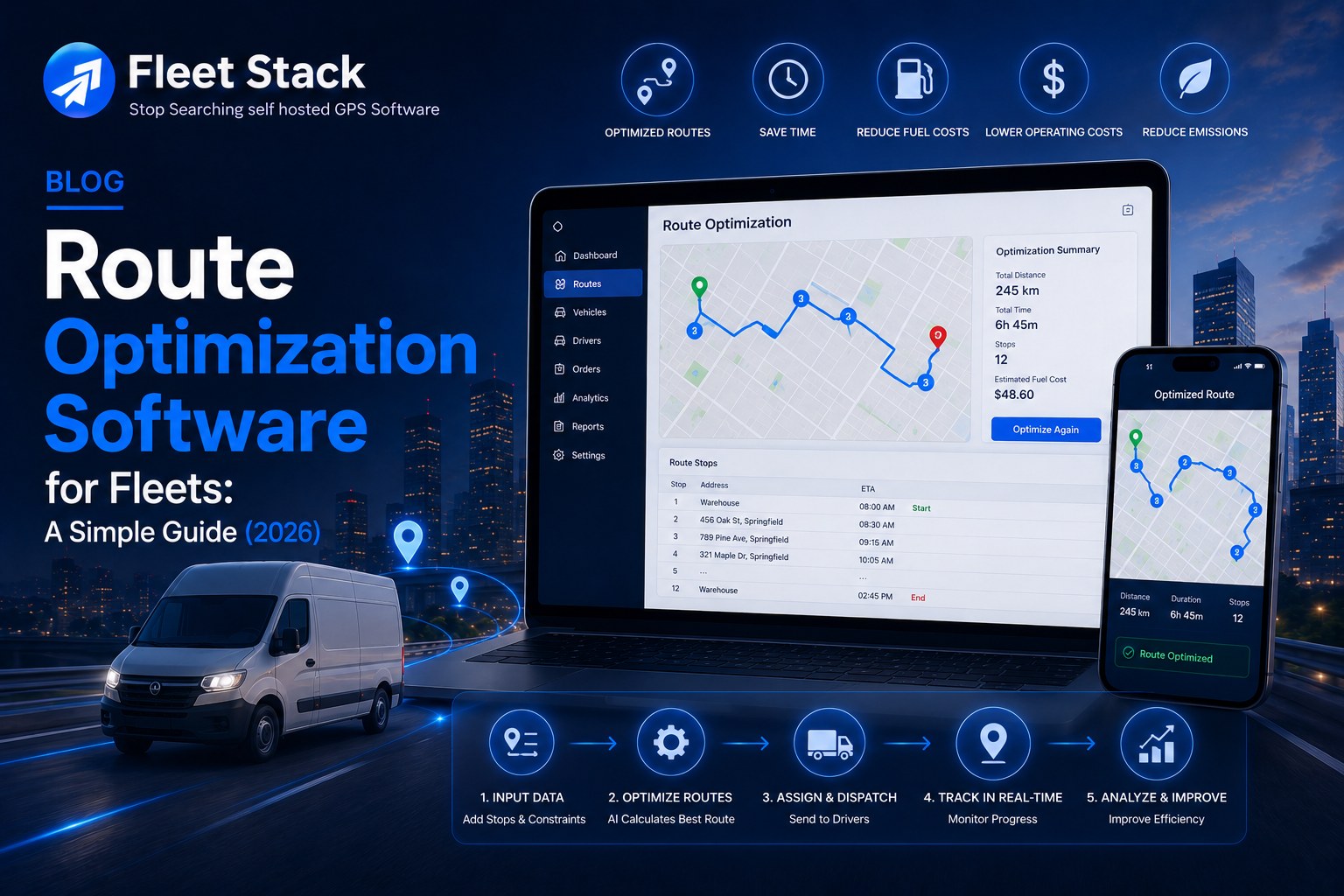
What is Route Optimization Software?
The software for route optimization determines the most effective route that your vehicles can take so they will consume less fuel and drive less distance. It takes into account all the stops that you are making, traffic, delivery windows, vehicles and calculates the best way to visit all the stops. It's not like a consumer mapping app. A mapping application is utilized to discover the briefest way between two points. The problem of route optimization software is a much more difficult one: which is the best order for many stops in many vehicles at once. They do this automatically in seconds with the help of AI and update the route in real time in case of a traffic change in 2026. The payoff is real. Typical fleets save 12-20% on miles driven, 15-25% on fuel costs and recoup their investment in 3-6 months. Less wear, less emissions and happy driving translates to fewer miles.
Key takeaways
- Optimization of routes: not the shortest, but the best way of travelling.
- 12 – 20% reduction in fleet miles and 15 – 25% reduction in fuel consumption.
- It has a payback period of 3-6 months.
- AI adjusts itself according to traffic updates, weather and more and new stops can be added.
What is the Route optimization?
The software allows the use of the knowledge you have of what a day's work should look like to form the best plan. It is in four stages.
- Add the stops. Restrictions on delivery time and addresses (if applicable) and vehicle restrictions.
- The AI executes the route. Calculates the optimum sequence of stops between vehicles.
- Routes are distributed to drivers. Turn-by-turn directions are directly opened in the driver app.
- It updates live. It updates if the traffic changes or if the stop is moving, and it relays the update.
This should be used preferably in combination with real-time GPS data that can give the system the actual position of each vehicle. All the features are found in the FleetStack route management page.
Why Is It a Dispatcher Can't Plan Routes by Hand?
There are many who will be surprised, but let's cut to the chase. A human is not capable of solving the mathematical challenge.
It would take longer to count them all than to count the number of possible routes for a single route with 25 stops. A dispatcher may have a number of options to consider. When it comes to measuring by seconds, software can weigh in at millions of pounds. This is why manually driven routes typically are 12-20% longer than they should be.
It's not like dispatchers are incompetent. This is because no man can solve this problem. Software takes away that limitation.
What are the benefits of Route Optimization?
The rise is rapid and at several sites. From industry data, here are the 2026 fleets' reports.
| Benefit | Typical result |
| Fewer miles | 12–20% cut |
| Fuel savings | 15 to 25% |
| More stops per day | 12–18% |
| On-time delivery | from ~85% to 95%+ |
| Planning time | more time to prepare and collaborate |
| Payback | 3 to 6 months |
Cut Miles and Fuel
Shorter and Smarter routes are fuel-efficient. Reducing the miles reduces idle time in traffic and unnecessary backtracking. Much like fuel management, in which fuel costs can be anywhere from 25-60 percent of fleet expenses, this is very similar.
Do more with the same fleet
More stops per day: Better Routes. Fleets report an increase in the number of stops per driver of 12-18%, which means they can grow without adding trucks.
Save Planning Time
A dispatcher's job is to manually create routes and it takes 2 hours per day. Software does in minutes and can save your team time when it comes to real issues and not puzzles.
Make good on promises to customers
Live rerouting and enhanced ETAs mean that over 95 per cent of deliveries are on time. This is what makes repeat business.
What will be the Return on Investment of route optimization?
I believe it's very easy to figure out the savings. First, do the miles that you have to do.
Consider a 50 vehicle fleet that drives 60,000 miles per year. This translates to 15 per cent of miles that are unnecessary which, in other words, are 450,000 miles per annum. Based on the average cost of fuel, tyres and wear is 55 cents per mile that is about 247,000 dollars saved a year. Include the hours you recover and the total amount for many fleets of 50 vehicles or more is between $350,000 and $500,000 per year.
This is one number that can be observed in the market. The benefits of route optimization are actually proven, and they are expected to grow from $8 billion dollars in 2026 to $16 billion dollars in 2030.
What is the difference between Route Optimization and GPS Tracking?
It's easy to tell the difference between these and people often mix them up.
With GPS tracking, you can find out where a vehicle is. Route optimization will inform you of all the vehicles' locations, routes to follow and route adjustments throughout the day. The location layer is GPS. Route optimisation is the planning layer which is placed on top of it. Most fleets want both, and ideally, in the same platform to have a single set of data.
Who can use Route optimization Software?
Of course, it's much easier for any fleet that has multiple stops a day. It is best for:
- For dense routes that have multiple stops, delivery and courier fleets.
- Optimized technician assignment for service companies including HVAC, plumbing and pest control.
- Distribution and delivery plans, for load balancing and delivery windows.
- Any fleet that is expanding rapidly, to add work without adding vehicles.
Frequently Asked Questions
Route Optimisation software – What is it?
It's a system that helps you plan the best path of your vehicles, and thus minimize the kilometres and amount of gasoline your vehicles will consume. It considers traffic, delivery timings, numbers of vehicles and pushes the route to the drivers and updates it in real time.
What is the difference between GPS map application?
A map application is a program that can be used for shifting from one place to another in shortest route. Optimizing a route for a large number of vehicles with many stops (and modifying it when changes occur) is the more challenging problem of "route optimization".
How much does the optimisation of the route cost?
Most fleets can see a 12-20% reduction in the number of miles driven and 15-25% in fuel savings. If a 50 vehicle fleet saves direct cost of $247,000 or more per year, they are saving money.
What is the time period for payback?
Most fleets get a return on investment in as little time as 3-6 months and in some cases within a week of use.
Can it be used by small fleet?
Yes. They enjoy less planning time and smarter stop order – even if they have only a handful of vehicles. The savings scale is based on the number of stops, rather than the number of vehicles.
Will my drivers agree to this?
Most do, once they've witnessed this, it means less time in traffic and cleaner stop lists. If they consider it a tool that helps their day, rather than a surveillance, then they'll accept it.
The Bottom Line
The problem that route optimization software is supposed to solve is that it is impossible to write it out by hand when many vehicles are traveling to many different stops, all of which are changing throughout the day. This equates to fewer miles, fewer fueling stops, more stops per day and more on-time delivery.
Most fleets can recover the cost of the software in months by the savings in miles and fuel. One of the quickest methods to reduce costs without reducing services if you make multiple stops throughout the day.
Want to better route and cut down on miles? Optimize and update the most efficient routing for all your vehicles in real time with FleetStack route management. Give it a try today for free.
GPS fleet tracking systems, trip management software, and fleet fuel management, are all highly related topics when it comes to route management, as is FleetStack's route management solution.
2026 fleet route optimization industry guides and deployment data (12 – 20 percent avoidable miles, 15 – 25 percent fuel savings, 3 – 6-month payback, $0.45 – $0.65 per mile variable cost); 2026 – 2030 fleet route optimization market size industry forecasts. Figures are based on industry averages and subject to change based on fleet, region and conditions.
0 Comments
No comments yet. Be the first to comment!
Please to post a comment