
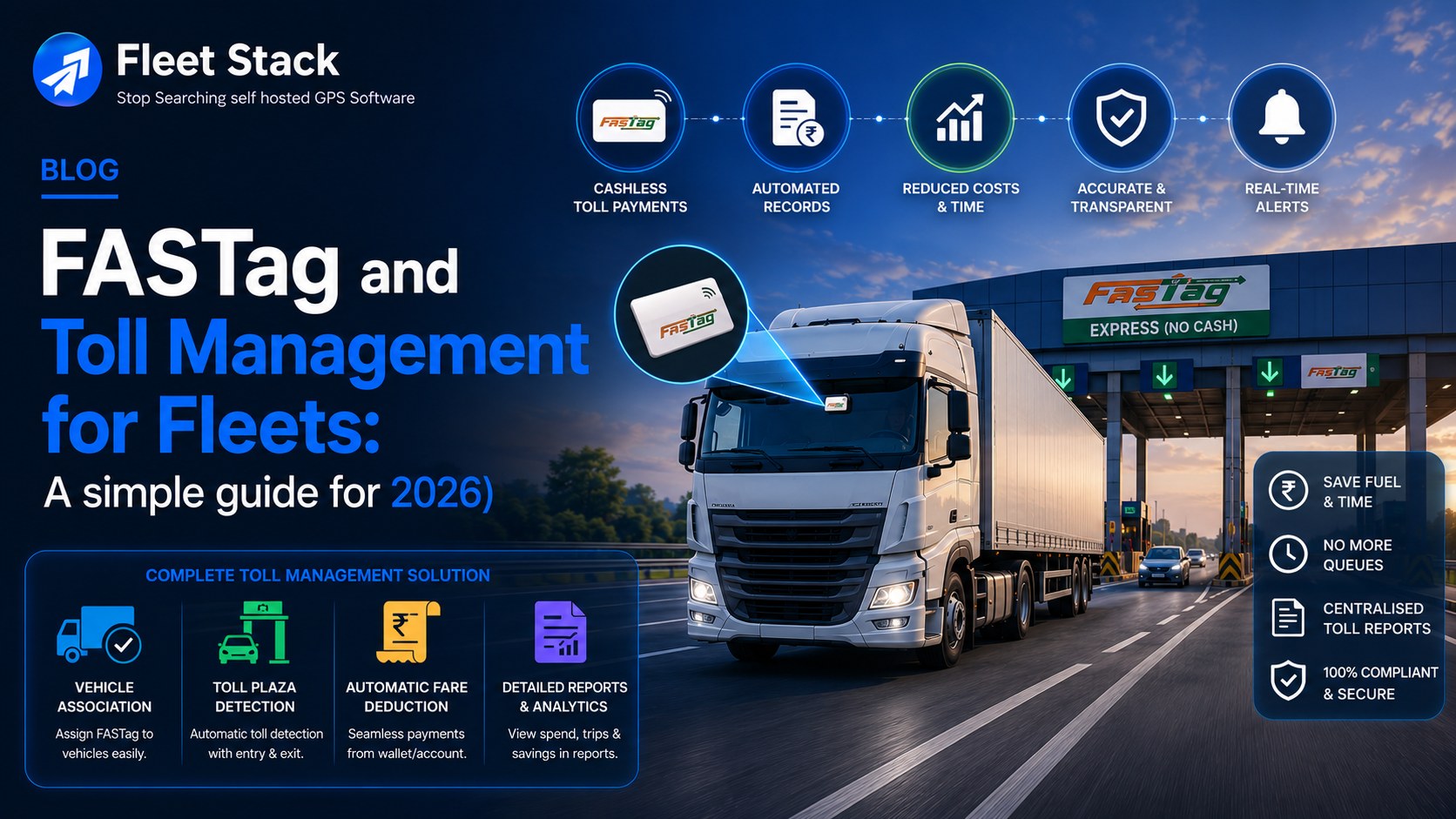
FASTag and Toll Management for fleets: What is it?
A fleet pays, tracks and controls its toll in many vehicles with the help of two systems – FASTag and toll management. FASTag is a prepaid account linked small RFID tag on windscreen installed on each vehicle. As the truck drives through a toll plaza, the reader above validates and subtracts the toll from the tag in seconds without stopping at the toll booth and without paying anything with cash. The problem for an entire fleet is that it's not one tag, but many: ensuring that all tags are funded, monitoring how much a fleet is spending on tolls per truck, and righting each toll to the correct trip. With good toll management, it all comes together. You deposit tags into a central account, establish a limit on how much your tags can spend per truck, receive low-balance notifications before your tag is declined, and retrieve tolls by vehicle or route for billing. With FASTag being obligatory for commercial vehicles in India and a non-functional or blocked tag leading to double tolls, the effective management of FASTags can save substantial funds and ensure uninterrupted truck operations.
Last updated: June 2026.
Key takeaways
- The FASTag will be compulsory for commercial vehicles, with no tag, the commercial vehicle owner will have to pay double toll.
- Tags are centralized and paid by fleet level, with trip limits set and monitored by fleet, and the tolls are reported by trip.
- Low-balance alerts avoid blocking and stopping a truck.
- UPI and cash penalties, One Vehicle One FASTag and GNSS tolling trials are all on the list for 2026.
How Does FASTag Work?
It is an idea that is simple, and it is based on RFID technology.
- Tag is attached to the windscreen. Each tag is associated with a prepaid wallet/bank account.
- It is scanned at the plaza by a reader. As the vehicle approaches the overhead reader can read the tag.
- Toll is taken off. That class of vehicle pays that right rate in seconds.
- You receive a record. An SMS or digital log for all transactions which is helpful in keeping a track of spending.
Since the charge is automatically logged, FASTag also makes toll expense tracking much easier, than ever could be done with cash. Toll is another of the higher operating expenses for a fleet besides fuel.
Do commercial vehicles need to have FASTag?
Yes. That translates to commercial vehicles such as trucks, tankers, trailers and buses being covered by the implementation of FASTag on the national highways since 2026.
Fleets must adhere to the rules. If the FASTag is not working in an electronic toll lane, the vehicle will be charged twice the toll and no appeal will be allowed at the plaza. A blocked or blacklisted tag is no different—you're paid double in cash, and you'll be provided with reconciliation work at a later date. For fleets with multiple trucks, that can be costly, and maintaining the availability of all of the tags is a day to day responsibility.
What is the New FASTag Rules 2026?
In 2026, the toll system was rationalised and modernised. Fleets need to be aware of these changes.
- UPI and cash fines. Any vehicle without FASTag and paying via UPI will be charged 1.25 times the tolls. No working tag is required for cash payment, which costs 2 times.
- One Vehicle, One FASTag. Only one tag per registration number is allowed to be active. Invalidation can occur if multiple tags are used.
- KYC compliance. Rules for FASTag account are stringent.
- GNSS tolling trials. India is conducting a pilot study on the satellite-based tolling system, where toll is based on the actual distance travelled by the vehicle and not on a fixed toll plaza rate. This is being implemented initially in the commercial vehicle sector that already uses GPS.
- 10-second and 100-metre rules. A square should clear a vehicle in less than 10 seconds and if the queue length grows to be over 100 metres long vehicles can pass freely until the line moves on.
The message is loud and clear: tolling is becoming fully electronic, fully distance-based, and is closely related to the GPS units that, under AIS-140 rules, trucks are already required to carry.
What's Difficult for Fleets about Toll Management?
One tag is easy. The hundred tags is a serious job. Here's why fleet toll management is a challenge.
- A lot of tags to be funded. Even if one tag is depleted, that vehicle can be stopped or tagged twice.
- Spend is difficult to monitor. Without a system, tolls are allotted to many different accounts and cannot be correlated with trips.
- Misuse risk. The wrong vehicle or route may have a shared tag.
- Billing needs proof. You need clean, per-trip records in order to charge a client for tolls on their load.
How Fleet Software helps to manage FASTag and Tolls?
The toll management software consolidates all tags and charges in a single location. This is what a good system does.
- Central balancing – tag all tags from 1 company account
- Reduce the amount of money spent per truck and prevent misuse of the funds (set limits)
- Low balance alerts – SMS or e-mail warnings when a tag is about to be blocked
- Pull spend by truck/date for reporting and analysis.
- Match the trips with the toll charges.
- Integrate with APIs and get toll data directly into your fleet software.
The largest success is the matching of the tolls to the trips. If a toll is attached to a trip, you can see the actual cost of the trip, accurately bill the client, and identify any unauthorized charge. This is in conjunction with GPS tracking, which ensures that a vehicle actually went through that plaza.
FleetStack offers a toll and a FASTag module to synchronize toll information with your trips, tracking and billing in a single system.
Benefits of route planning using toll data.
Toll management is more than just about paying. It also aids you in planning better.
If the cost of tolls per route are visible, then it is possible to consider a highway route that is slower, but cheaper in total cost over a slower route that is less expensive. At high traffic volumes, it is a frequent decision that can result in actual savings. These tolls are just another number to add into the actual cost of the trip, besides fuel and time.
Consider using a practical example to track the costs of a single toll.
Below is an example of how toll tracking works in real-world scenarios. It's an example and not a particular customer.
There is a transport company that is transporting a truck from Delhi to Jaipur. On the trip, it goes through 3 toll plazas and collects 1850 rupees in FASTag tolls.
Each toll is captured, identified to that truck/trip, and compared to the GPS route of that truck. The fleet manager will then get the complete toll in addition to the fuel, distance and other trip costs, and the real cost of the trip will be evident.
In case the customer is supposed to be paying the tolls, the company also charges the verified tolls, i.e. 1850 Rs., on the invoice based on real records. If a towing charge occurs without notice, the manager will be able to look at the history of the tolls on the route and verify them before paying, not a charge that belongs to someone else. That's the difference between being accurate with tolls and just guessing!
Frequently Asked Questions
What is FASTag and how is toll management for fleets?
It is a way for a fleet to pay and monitor the tolls of numerous vehicles. All vehicles are equipped with a FASTag that automatically deducts tolls and the software in the fleet funds the tags centrally, records spend by each truck and matches the tolls with the trips.
Is FASTag compulsory for trucks and commercial vehicles?
Yes. All commercial vehicles like trucks, tankers, trailers and buses on national highways will have to use FASTag. If a vehicle is not equipped with a working tag, then it will be subject to a double toll.
What is the consequence of a fleet FASTag going negative?
It will be blocked and/or blacklisted, and the driver needs to pay double for it in cash at the plaza. Low-balance alerts will aid fleets in replenishment before that occurs.
What are the methods fleets use to monitor toll costs?
By using a toll management software that records each toll charge, associates it with the appropriate truck and trip, and generates reports per vehicle and/or route for invoice and expense tracking, the software guarantees proper tracking of tolls.
What are the 2026 FASTag Rules?
The key highlights of Key 2026 are as follows: UPI charged at 1.25x, Cash charged at 2x for non-FASTag cars, Introduction of the One Vehicle One FASTag policy, KYC amended with tougher procedure and trials of the GNSS satellite based distance tolling.
What is GNSS tolling?
GNSS tolling charges a toll on the distance a tolling vehicle travels – eliminating the need for toll plazas by using a satellite position sensor. It is being introduced for commercial vehicles equipped with GPS devices in India first.
The Bottom Line
While FASTag made the toll payment quick and cashless, for a fleet, the real challenge is keeping multiple tags in order – ensuring that each tag is funded, that the spend of each tag is tracked against each truck and that every payment is matched to a trip. That is correct and toll ceases to be a mess and becomes a quantifiable expense.
The 2026 rules take toll further into the digital and distance realm, which is already used by trucks. For any fleet transporting goods throughout India, managing FASTag and toll inside the fleet software, associated with trips and tracking, is the solution to control the cost and ensure that every truck is on the move.
Interested in seeing all toll and FASTag charges within your fleet software? With FleetStack, you'll always know what it costs for each route, with toll data linked to trips, tracking and billing, all in one place – Start a free trial.
With the E-way bill system entering its final phase, here are some articles that will help you with the system and its various aspects.
Official reference: NHAI, IHMCL and government toll notifications. Travel requirements may vary from the rules and charges listed above, so please check for up-to-date information prior to travel. This guide is intended as general information and is not a tax or legal opinion.
0 Comments
No comments yet. Be the first to comment!
Please to post a comment