
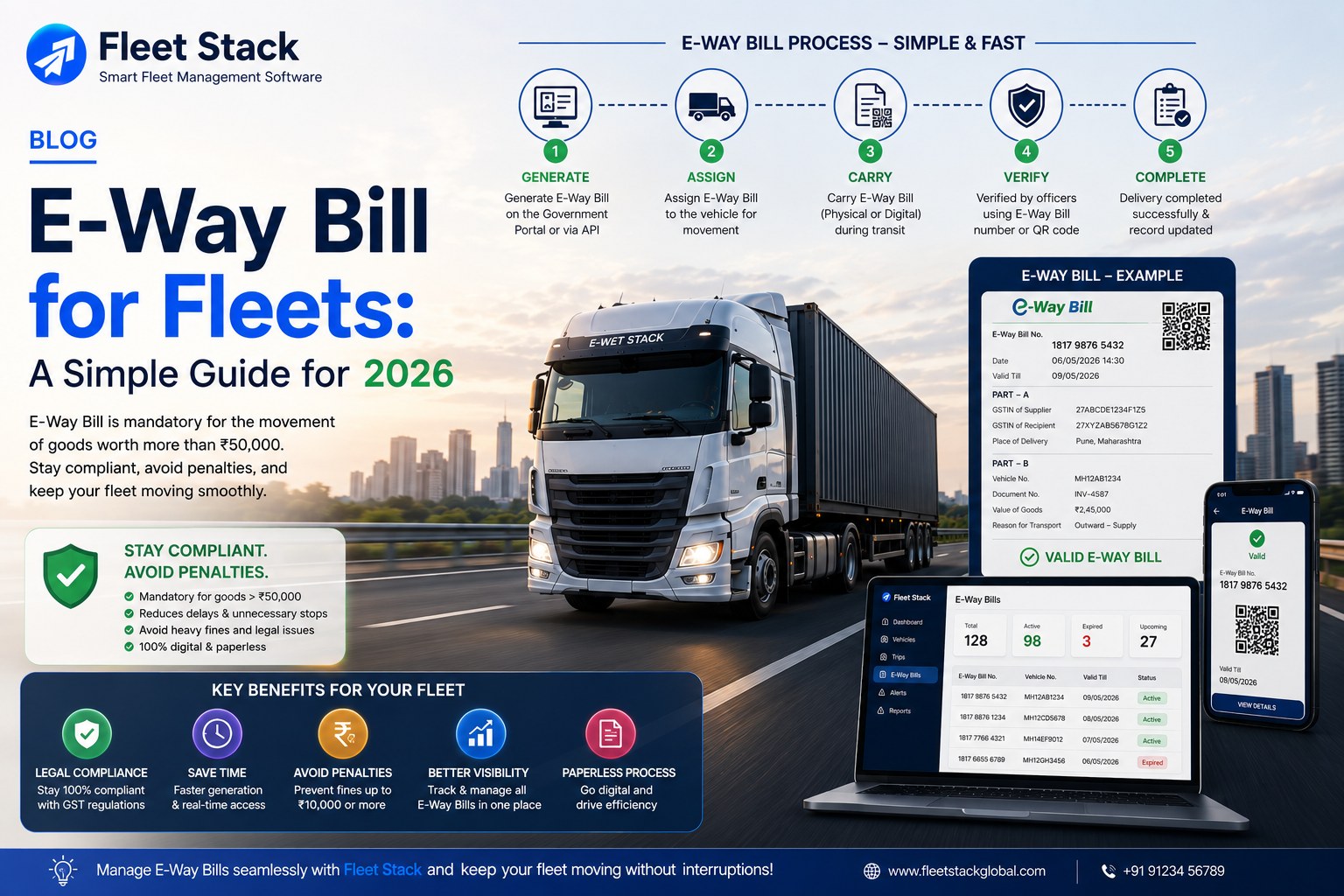
What is E Way Bill?
An e-way bill is an online document which needs to be generated before transporting goods worth over 50,000 rupees (INR) in India under the Goods and Services Tax (GST) regime. It records the object being transported, who is sending it to who and what is transporting it. It then gives you a 12 digit number called e-way bill number (EBN) that will be noted while transporting the goods. It is supposed to control the flow of goods, keep a record of it and impose taxes, and to help eliminate tax evasion. For a fleet, it is a regular practice, trucks are stopped and checked, goods are detained in the truck if the e-way bill is not handed over or if the e-way bill is expired or incorrect. The rules are there for the value limit, distance validity and there are severe consequences if you mess up. In this guide, we’ll explore the e-way bill limit, validity, e-way bill updates for 2026, penalties, and how fleets can generate e-way bills directly from their software. It's easy to read in plain language that you'll understand exactly what your fleet needs to do.
Key takeaways
- In the context of the Goods and Services Tax (GST) regime, an e-way bill is issued in case the value of goods exceeds 50,000 rupees.
- Regular cargo: 1 day per 200km (from generation).
- Penalties include a 200% of the taxes paid or Rs. 10,000 whichever is higher.
- 2026 features MFA login, 180 day invoice window, and auto-distance calculation.
Have a look at E-Way Bill Rules at a Glance.
| Rule | Value |
| Threshold | 50,000 rupees |
| Regular cargo validity | 1 day/200km |
| ODC validity | 1 day for every 20 km |
| Penalty | 10,000 rupees or tax payable as per specified cases whichever is more |
| Generate form | Form EWB-01 |
What is the date, on which E-Way Bill is Mandated?
Main is value. If the value of the goods is exceeding Rs. 50,000, then an e-way bill will be required (intra and inter).
It is not solely meant for sales alone. It is also essential for transfer of stocks, goods transferred for repairs or job work, goods sent for exhibitions and branch transfer. If there's more than the limit when goods are in transit, virtually always one of them is required! It is a essential element of any trip and developed as the trip starts by many fleets.
E-Way Bill Limit?
The default value of e-way bill is set to Rs. 50,000. In case the value of one consignment is above that, then an e-way bill is required. Keep in mind a few things about fleets:
- The limitation is for inter and intra state traffic.
- Some states impose a greater rate cut if an individual's money is received in a different part of the state. In 2026, a sum of Rs 1 lakh is applied to some intra Maharashtra transfers.
- The value of consignment is calculated as the cost amount and if it is above Rs. 50,000, then even free goods are included.
- Perhaps it's the sum of all the goods transported at once that would form the ceiling, not each invoice.
- Limits are different from state to state and a fleet driving throughout India has to check the limit for each route.
Is E-Way Bill valid?
This is where many fleets go wrong and here is the low tech version. The validity of e-way bill is based on distance travelled by the goods and not when the vehicle moves, starting from the generation of e-way bill.
| A valid type of cargo that is allowed | Validity rule |
| Regular cargo | 1 day every 200 km |
| Over dimensional cargo (ODC) | 1 day per 20km |
So, the regular cargo for the 500km trip will be valid for 3 days. Only valid for the day and until midnight.
There are two things to be aware of. It's possible to extend validity, for a short period of time around the expiration date. The movement will not be compliant if the goods are not delivered in time and it is not extended. Validation with real vehicle locations is a crucial part of a fleet's tracking system and GPS tracking and trip data can assist with that.
The steps to generate E-Way Bill are outlined below:
The e-way bill is split into two-parts. Both matter.
- Part A: The goods information. Invoices value, GST numbers, Goods and delivery PIN codes.
- Part B: the transport information. Registration number of the vehicle or transporter number. The validity is effective from the completion of Part B only.
It is created by the issuing department on e-way bill portal at ewaybillgst.gov.in without paying any tax to the government using Form EWB-01 on the e-way bill portal. Then you get a 12-digit EBN and QR code which will have to be used with the goods, either in print or via a phone.
It can be labour intensive and susceptible to error for fleets with many loads per day if you do it manually. That's why most fleets produce e-way bills immediately from their e-way bill software rather.
What changes are there in 2026 e Way Bill?
The regulations were tightened in 2026. It is important fleets are aware of these changes.
- MFA is mandatory. A multi-factor authentication is now required for logging on to the portal.
- 180-day invoice window. A no more than 180 day old invoice can be created into a bill.
- Ship-To GSTIN. New declarations for the party of entry to the ship.
- Auto-distance calculation. The portal is now able to automatically calculate distance from PIN code.
- API changes. Additionally, the API of the GSTN will be updated in mid-2026, which means that the billing and fleet software need to be updated accordingly.
The message is loud and clear: increase automation and increase the level of checks. With the right, up-to-date software, you can safeguard your fleet against unsuspecting downturn.
What happens if there are Errors in E-Way Bill?
They're strict and they're there, even if it's not a genuine error.
A fine of Rs. 10,000 or amount of tax whichever is higher shall be charged. Can be raised to maximum of 200 per cent of the tax amount in serious cases as mentioned in section 129 of CGST Act. The goods and vehicle can be impounded at time of the offence, as well as a fine.
The true cost for a fleet is those detentions. One held truck can cause hours of delay for a driver, irate customers and numerous deliveries. The main thing with correct e-way bills is not just to save on the fine but it's also about compliance. They help to keep your fleet moving.
How Fleets are handling E-Way Bills with Software
It is impossible to do e-way bills manually, as it does not scale. For a fleet that operates dozens of loads per day, the e-way bill management system must be able to generate e-way bills quickly and accurately, each time.
The e-way bill software automates the process of obtaining details of the invoice and vehicle by pulling them directly to the invoice, thereby minimizing the need to re-type and the risk of errors. It creates the EBN when initiating a trip, records the vehicle's validation against the time and location in real time and warns you if a bill is about to expire during a trip, and all bills are connected to the trip and the PoD for easy auditing.
What are the reasons why is FleetStack chosen for E-Way Bills?
FleetStack seamlessly integrates e-way bill compliance into your current fleet management software so that you can manage all your fleet tracking, trips and billing. It offers:
- Auto generation of e-way bill based on Invoice & Vehicle information.
- Is part of a trip workflow.
- Live validity alerts prior to the expiration of a bill while it's in transit.
- Compliance (GPS) tracking to ensure that the bill is in line with the actual route.
- Proven delivery through integration to ensure complete compliance trail.
- Bill Integration for synchronization of invoices with e-way bill.
- All drivers given trips and documented.
- Document History for all loads for audit.
You will have only one logistics compliance software to store all your GST transport compliance, driver management, e-way bill tracking etc., as opposed to multiple tools.
The E-Way Bill at Scale is an example.
This is an example of what they might look like. This is a sample and not a customer.
The logistics company reported over 600 e-way bills with the help of 85 trucks in a day. The dispatchers started using e-way bill generation in the fleet software, which cut down on manual data entry, notified them before vehicles departed from their document's validity period and kept a history of all documents related to each trip for audits. This resulted in a decrease in rejected bills, wait time in the portal and detentions of trucks.
Frequently Asked Questions
What is E-Way Bill?
It's an electronic document which must be submitted under the GST for sending goods valued over 50,000 rupees. It contains information regarding goods, parties, vehicle etc., and also generates a 12 digit e-way bill number which will be to be carried in conjunction with the goods.
How much is the greatest amount of e-way bill?
The standard rate for an inter-state and intra-state shipment is Rs 50,000 per shipment. Other states have a larger limit on state, refer to the state rule.
How e-way bill calculates for its validity?
Regular cargo: Validity = 1 day / 200 km; Over dimensional cargo: Validity = 1 day / 20 km. It starts at the time of its creation, and terminates at midnight on the last day.
Is it possible to extend e-way bill?
Yes, but the time frame before or after the expiration of this window will be very short. If it is not issued, if there is no delivery of goods, the movement will not be compliant and you might need to apply for a new e-way bill.
What will happen in case of e-way bill error?
The penalty in serious cases is up to two hundred per cent of the tax payable and the penalty is 10,000 rupees or the tax (whichever is higher). The vehicles and goods can also be detained in the field.
Do e-way bills get created from fleet software?
Yes. Fleet/billing software can automatically generate e-way bills using invoice and vehicle data, validate e-way bills in real-time with live vehicle location and save all e-way bills for audits, which is much more efficient and secure than manual entry.
What are the changes brought in E-way bill 2026?
Mandatory MFA login, 180-Day invoice window, Ship-To GSTIN declaration and auto-calculation of distance based on PIN code are the highlights of the enhancements in Key 2026.
The Bottom Line
In the country of India, any goods transport company that is engaged in goods movement has to deal with compliance issues every day – e-way bill. After the rules have been understood, they are quite clear: 50,000 rupees, 1 day for every 200km generated, and very severe penalties—such as being detained on the spot for any mistakes.
The enhancements in 2026 involve further automation and closer checks. When you have a lot of trips and loads moving in your fleet, it is better to proactively develop and keep track of e-way bills within your fleet software and connect with trips and POD. Once complied e-way bill becomes a non-risk process with proper implementation.
Interested in creating e-way bill, and tracking them within your fleet software? FleetStack also has an e-way bill module, which connects the compliance with compliance tracking and billing in one place. Try it free!
Logistics is a sector where transportation is an important factor in enhancing efficiencies.
The rules of the GST e-way bill, Indian guidelines of compliance and tax guides 2026 (1 day validity for every 200km, Section 129 penalties up to 200 percent of tax, MFA, 180-day window of invoice, Ship-To GSTIN, auto-distance calculation). Note that the rules are subject to change and please refer to the rules as well as limits applicable in your state on the official GST portal. This is a generic guidance document and not a tax or legal document.
0 Comments
No comments yet. Be the first to comment!
Please to post a comment