
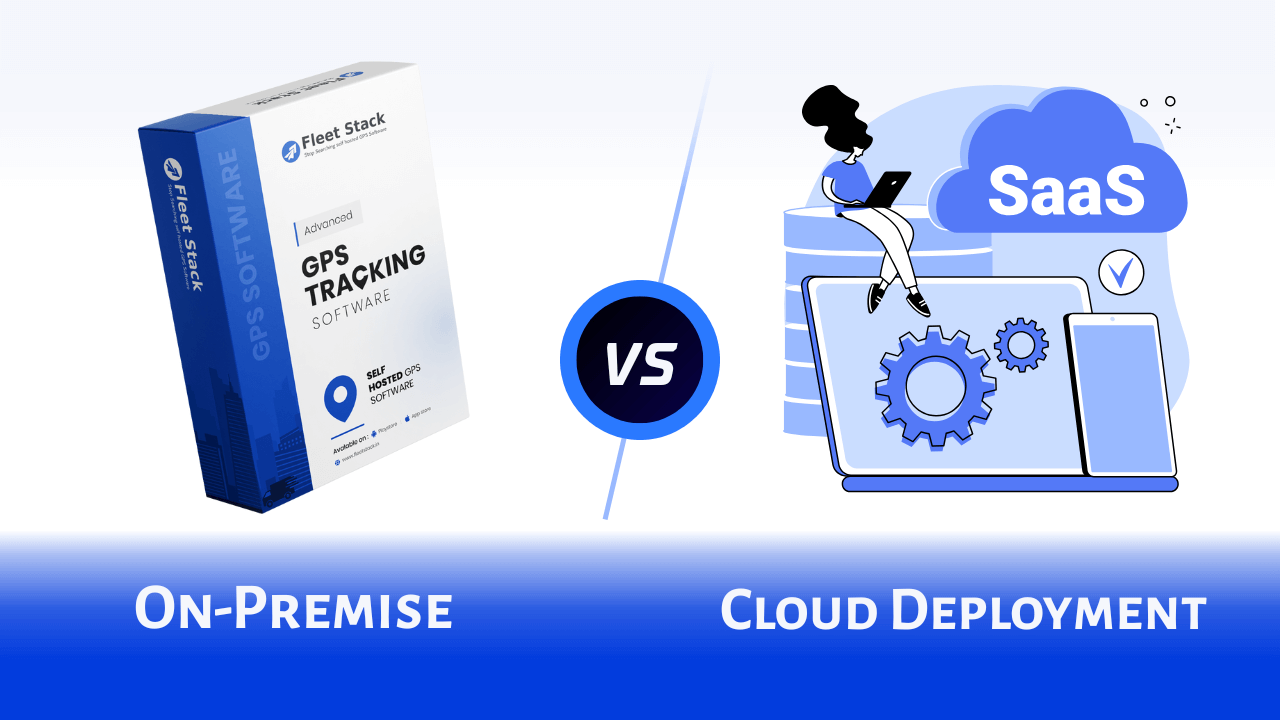
Choosing between an on-premise and cloud deployment for GPS tracking software can be a game-changer for your business. From small delivery startups to Fortune 500 logistics firms, the decision impacts cost, security, and how easily you can get your tracking system up and running. In this comparison, we’ll break down the differences in cost, security, control, scalability, customization, and installation time – all in easy-to-understand terms. By the end, you’ll see why a modern on-premise solution (like Fleet Stack’s self-hosted GPS software) might just give you the best of both worlds in convenience and control.
Understanding On-Premise vs Cloud GPS Tracking
Before diving into the details, let’s clarify what we mean by on-premise and cloud in the context of GPS tracking software:
- On-Premise (Self-Hosted): You run the GPS tracking software on your own server or infrastructure (this could be a physical server in your office or a private cloud server you control). The data and system are hosted by you. This offers high control and the ability to customize the software to your needs. Example: Fleet Stack’s self-hosted GPS platform allows you to install the software on your server, keeping all tracking data in-house.
- Cloud (Hosted SaaS): You use a GPS tracking service hosted by a third-party provider, accessed via the internet. There’s no software for you to install – you typically just log in through a website or app. This option is known for flexibility and a lower upfront cost (usually a monthly subscription). Example: GPS Gateway offers a cloud-based GPS tracking service where the provider manages the servers and you access your data online.
Both approaches will let you track vehicles, assets, or personnel in real-time. The difference lies in who hosts the system and how you pay for and manage it. Now, let’s compare them category by category.
Cost Considerations
Cost is often the first concern for businesses. How do on-premise and cloud GPS tracking solutions stack up?
On-Premise Costs:
Generally involves an upfront investment. You might need to purchase a software license and have a server (or cloud VM) to run it. However, ongoing costs are usually minimal – you avoid monthly per-device or per-user fees. Over the long run, on-premise can be more cost-effective, especially as your fleet grows. One industry analysis notes that while on-premise requires a larger initial spend, the ongoing costs can be lower than a cloud-based solution over time. In other words, the longer you use it, the more an owned system pays off. For example, Fleet Stack uses a one-time software license (with a free trial to start) instead of endless subscriptions, giving you a predictable cost structure. This means a small business can invest once and keep using the system without fearing ever-increasing fees. Large enterprises, on the other hand, often prefer capital expenditures that they amortize over years – which makes on-premise attractive in the long term.
Cloud Costs :
Typically operates on a subscription model. You’ll pay monthly or yearly based on the number of vehicles or features. Upfront costs are low (often just a setup fee or even $0 to start), which is friendly for cash flow. However, recurring fees add up. Over a few years, the total cost of a subscription can easily exceed the one-time cost of an on-premise system, especially for larger fleets. You are also subject to the provider’s pricing changes. While cloud services are often touted as cost-effective for small deployments, businesses with stable, long-term needs might find they end up paying more in the long haul if they stick with a subscription model. Another hidden cost factor is that if you need advanced features or more data storage, those often come at a premium with cloud plans.
Fleet Stack’s Perspective on Cost: Fleet Stack’s self-hosted solution is designed to be budget-friendly over time. There’s a one-touch installation and a one-time license, so you’re not locked into perpetual payments. This can save a growing company a lot of money compared to paying per vehicle every month. Fleet Stack’s philosophy is that owning your GPS tracking software shouldn’t break the bank for small businesses, and at the same time it offers the robustness that large companies need. By avoiding vendor lock-in and subscriptions, you maintain cost control in your hands.
Security and Data Privacy
For any GPS tracking system, security of data (like vehicle locations and routes) is crucial. Let’s compare how each deployment affects data security and privacy:
On-Premise Security:
With on-premise, your data stays with you. All tracking information is stored on your servers or cloud infrastructure that you control. This means you decide who accesses it, how it’s protected, and where it’s stored. Companies in highly sensitive or regulated industries often prefer this model so they have complete control over data security. There’s no third-party company in the middle holding your information. If you have strict data compliance requirements (for example, needing to keep data in a certain country or internal network), on-premise makes that easier. Of course, you do take on the responsibility to implement security measures (like firewalls, encryption, and backups), but with a good setup this results in strong privacy. Fleet Stack prioritizes security in its self-hosted platform – it’s built so that businesses retain control over their data and address privacy concerns up front. In fact, Fleet Stack was created after one business owner lost access to critical GPS data when a provider’s service went down; the mission was to ensure no one else would have to risk their data or operations in that way. With on-premise, your data won’t disappear because a vendor had an outage or shutdown.
Cloud Security:
Reputable cloud GPS tracking providers also invest heavily in security – they often have encryption, 24/7 monitoring, and dedicated security teams. Your data is hosted on the provider’s servers (usually in the cloud), so you must trust the vendor’s security practices. For many providers, security is shared: they secure the infrastructure, but you must secure your account (strong passwords, user access levels, etc.). One consideration is that your sensitive fleet data is stored off-site in a multi-tenant environment (alongside data from other companies), which could be a concern for some. While cloud providers may have certifications (like ISO, SOC 2, etc.) to give peace of mind, you are ultimately outsourcing your data security to them. If absolute privacy or compliance is a must, some companies feel more comfortable keeping it on-premise where they have full oversight.
Why Fleet Stack Shines in Security: Being an on-premise solution, Fleet Stack gives you the security advantage outright – your tracking database and logs reside on your own server. According to one review, Fleet Stack “prioritizes data security... ensuring that businesses retain control over their data”. That means no external party can mine your fleet’s information or suddenly revoke your access. For businesses dealing with sensitive routes (e.g., high-value asset transport or confidential field operations), this peace of mind is invaluable. Fleet Stack’s design ensures that even non-technical users can maintain a secure system without needing an entire IT security team.
Control and Reliability
Control goes hand-in-hand with security but extends to reliability and independence. How much control do you have over the system and uptime in each model?
On-Premise Control:
With on-premise deployment, you’re in the driver’s seat. You control when to perform updates or maintenance, and you aren’t forced into software changes on someone else’s schedule. The system can continue running as long as your server is running – no external decisions will turn it off. This also means if you want to stick with a certain version or customize something, you have the freedom to do so. Perhaps most importantly, on-premise avoids vendor lock-in. You’re not tied to a single provider’s ecosystem; you have the software running independently. If the software company changes policy or even goes out of business, your system remains operational. A real-world cautionary tale: a business that relied on a cloud GPS service lost their tracking capabilities overnight when the provider abruptly shut down, which even led to the closure of their business. That incident was a catalyst for Fleet Stack’s founding – to prevent others from losing control over a mission-critical service due to a third-party’s fate. With an on-premise setup like Fleet Stack, that scenario is avoided because you own the software. You decide your uptime and aren’t at the mercy of an outside platform’s outages. As long as you have your server running, your tracking stays live.
Cloud Control:
In a cloud service, the provider has the ultimate control of the environment. They might schedule maintenance windows where the service is temporarily unavailable, or they might push new updates that change the interface or features (sometimes with little notice). If the cloud service experiences downtime or technical issues, your tracking capability is impacted and you have to wait for them to fix it. There’s also the dependency on an internet connection: if your connection goes down, you can’t access your cloud tracking system, whereas an on-premise system on a local network might still be reachable by local users. Vendor lock-in is another consideration – moving from one cloud provider to another can be challenging (you’d need to migrate all your tracking data, devices, and retrain on a new system). An expert discussion on cloud deployments notes that dependence on a single provider can limit flexibility and introduce switching costs down the line. In short, with cloud you trade some control for convenience. Many businesses are okay with that, but it does carry risks if the provider has issues or if you ever need to leave their platform.
Fleet Stack’s Promise of Control: Fleet Stack’s mission has been to make GPS tracking accessible without giving up control. By being self-hosted, Fleet Stack ensures you maintain full control and ownership of your tracking system. You can back up your data anytime, move it to a different server if needed, and integrate it with other in-house systems freely. The platform is reliable because it runs on standard technology that you manage – effectively, your GPS tracking will never be yanked away due to an external company’s decisions. This level of control resonates with both small business owners (who never want to be left in the lurch by a service provider) and large enterprises (who have policies about owning critical infrastructure). Fleet Stack was literally born from the understanding that control is key to peace of mind in fleet management.
Scalability and Performance
What happens if your business grows or your tracking needs change? Scalability is about how easily you can expand (or reduce) the system, and how it performs as demands increase.
On-Premise Scalability:
Traditionally, scaling an on-premise system meant buying more hardware or upgrading servers – a process that requires planning but yields great performance when done. You have to anticipate your needs (number of devices, frequency of updates, etc.) and provision enough computing power and storage. If your fleet doubles in size, you might need to allocate more resources or another server. This can take time (to purchase and set up new hardware), but once in place, the performance is robust since everything is running locally. The good news is that with modern cloud infrastructure, even a self-hosted solution can be made highly scalable. For example, you could deploy Fleet Stack on a scalable cloud server (AWS, Azure, etc. under your control) and increase the instance size or add more instances when needed. It’s not as instant as a true SaaS plan toggle, but it’s very doable. On-premise setups also don’t incur extra license fees when you scale – you’re typically allowed to add as many devices as your hardware can handle. So scalability with on-premise is in your hands: you decide when and how to scale up. Performance-wise, on-premise can be extremely fast because data is processed locally (no internet latency). Well-optimized on-premise software can handle thousands of devices with the right server specs. It’s worth noting that many businesses have relatively steady fleet sizes and tracking needs; they might scale gradually, which on-prem handles well by periodic upgrades.
Cloud Scalability:
This is often cited as a big advantage of cloud services. Need to track more devices? Upgrade your subscription or click a button – the provider allocates more resources behind the scenes. Cloud solutions are built to elastically scale, meaning they can handle sudden increases in usage without you needing to do much. This elasticity is great for businesses that experience seasonal spikes or rapid growth. However, remember that scaling in the cloud usually means your costs scale up too (every additional device or user might increase your monthly bill). There’s also an upper limit based on what plans the provider offers; truly massive operations might have to negotiate enterprise plans. Performance on cloud can be very good, but it depends on internet connectivity and the provider’s infrastructure. If you have fast internet, accessing a cloud service can feel just as snappy as a local one for moderate workloads. For extremely data-intensive operations, on-premise might still win in raw performance because the data doesn’t have to travel over the internet. But for most typical fleet tracking uses, cloud platforms ensure they have enough server power to keep things responsive.
Fleet Stack’s Scalability Angle: Fleet Stack is built on modern tech, meaning you can run it on modest hardware for a small fleet or beefier hardware for a large fleet. You’re not constrained by a vendor’s pricing tiers – you scale on your terms. If you’re a small business, you might start with Fleet Stack on a basic server (even a low-cost cloud VM or a spare PC). If you grow, you can move to a more powerful server or distributed setup; no need to switch software. This is ideal for a growing company because you won’t hit an artificial “paywall” for adding more devices – you just expand your infrastructure as needed. For large enterprises, Fleet Stack can be deployed in a high-availability cluster or on enterprise-grade servers to handle thousands of trackers. In essence, Fleet Stack lets you scale like a cloud solution, but under your own control. You get flexibility without surrendering control or predictability of cost.
Customization and Flexibility
Every business has unique needs. Maybe you want to integrate GPS data into your custom ERP, or you need specific reports and branding. How do on-premise and cloud compare in terms of customization?
On-Premise Customization:
This is where on-premise often wins by a landslide. When you host the software yourself, you typically have far more leeway to customize it. You can configure the software to match your workflows, tweak settings at a deep level, and even modify the code or add plugins (depending on the software’s support for it). On-premise solutions offer extensive customization options, letting organizations tailor the software to their needs. Want a new report format? You can likely create it or have a developer do so. Need the system to integrate with an in-house application or devices? You can use APIs or direct database access to achieve that. You can also often white-label an on-premise system – meaning you can brand it as your own. This is great for companies that offer tracking services to clients or just want their internal system branded. Keep in mind, heavy customization might require technical expertise or hiring a developer, but the option is there – you’re not boxed in. In fact, research suggests that when extensive customization is required, on-premises solutions can be more flexible and cost-effective in the long term (since you’re not paying a vendor big bucks to build special features, you or a hired expert can do it directly). Fleet Stack was designed with flexibility in mind; it’s a self-hosted platform that you can customize to meet the unique needs of your business . Whether it’s custom fleet alerts, specialized analytics, or integrating with your dispatch system, an on-premise setup like Fleet Stack gives you the freedom to make it happen.
Cloud Customization:
Cloud-based GPS tracking services tend to be more one-size-fits-all. They might offer some configuration options (like you can choose which alerts to receive, or define your geofences), but you are limited to the features they provide. If you need a feature that isn’t offered, you often cannot just add it yourself – you might have to request it and hope the provider adds it in the future. Some cloud providers do offer certain customizations or integrations, especially at higher pricing tiers or enterprise plans (for example, they might integrate with your business software via API, or allow some branding on reports). However, you likely won’t get the level of deep customization possible with an on-premise solution. Also, cloud services may restrict access to the raw database or backend for security and multi-tenant reasons, which means less flexibility to create tailor-made queries or extensions. In summary, with cloud you trade customization for convenience and simplicity. If your needs are straightforward, this is fine. But if you foresee wanting very specific functionalities or to adapt the software as your processes evolve, cloud could feel limiting. It’s worth noting that some cloud providers (like GPS Gateway and others) market themselves as white-label platforms – they do allow you to put your logo on the software and maybe have your own mobile app, but this usually comes with extra costs and still ties you to their platform capabilities.
Fleet Stack’s Customizability: One of Fleet Stack’s unique selling points is its high customizability for a self-hosted system. According to Fleet Stack, their GPS tracking software can be tailored to meet the unique needs of your business. In practical terms, this means you can customize everything from the user interface (branding it with your company’s look) to the reports and alerts that matter most to you. Fleet Stack even provides tools (like APIs and a mobile app builder) to extend the platform. And you don’t have to be a coding wizard to benefit – out-of-the-box, it comes with flexible settings that a non-technical person can adjust. This level of personalization is part of Fleet Stack’s mission to make GPS tracking accessible and useful to everyone. By contrast, while alternatives like GPS Gateway are known in the industry, they may require more technical work or support for similar custom tweaks. Fleet Stack strives to be the user-friendly choice, where you get control without complexity. As one guide noted, “Fleet Stack offers a robust GPS tracking software solution that can be customized to meet the unique needs of your business” – essentially empowering you to mold the platform as you see fit.
Installation Time and Ease of Deployment
Time is money, and no one wants a complicated, weeks-long software deployment. This is a category where on-premise solutions historically had a bad rap – but new solutions like Fleet Stack are changing the game.
On-Premise Installation:
Traditional on-premise software installation could be quite involved – setting up servers, installing software dependencies, configuring databases, etc., often taking days or requiring specialized IT staff. Not anymore. Fleet Stack, for example, has revolutionized on-premise deployment with a one-touch installation that gets you up and running in minutes. In fact, Fleet Stack advertises “Start Using For Free in less than 5 Minutes. No Technical Skill required..! Just download, install and start using”. This is a game-changer: even if you’re not tech-savvy, you can have a full GPS tracking system live in the time it takes to grab a coffee. The installation process is streamlined and automated – essentially click a setup file and follow a couple of prompts. There’s no need to write code or configure a complex environment. One review calls Fleet Stack “the world’s easiest ready-to-deploy GPS software”, and with good reason. This ease-of-deployment approach eliminates the long-standing barrier that on-premise = slow or difficult. Now, beyond Fleet Stack, generally on-premise will involve at least a bit of setup (like ensuring you have a server with the right OS and hardware). But with modern packaging (installers, Docker containers, virtual appliances), many self-hosted solutions are much quicker to deploy than in the past. The key benefit is once it’s set up, you’re done – you won’t need to rely on outside networks to keep it running. Plus, if you ever need to migrate it (say to a new server), you can do so on your own schedule.
Cloud Setup:
Cloud deployments are known for being quick to start: you typically just sign up online and within minutes you can log in and start tracking. There’s no software installation on your part – the provider has done all that behind the scenes. This instant access is indeed a plus. If you’re in a real hurry, a cloud service might get you going slightly faster initially (since you skip any server setup). However, consider the full picture: even with cloud, you might spend time configuring the system for your use (adding your vehicles, setting preferences) – which is equally required on on-premise software. The real difference is just the initial software install. Cloud edges out by removing installation entirely, but only by a small margin now that on-premise can be deployed in minutes. Another aspect is if you need to roll out the solution to multiple branches or locations: a cloud service is accessible anywhere by design, whereas an on-premise solution might need a bit of networking setup for remote access (unless you host it on a cloud server accessible globally, which is also an option). Overall though, both models can be up and running quickly if the on-premise software is built to be user-friendly. In the past, cloud was the go-to for quick deployment; today, solutions like Fleet Stack prove on-premise can be just as swift.
Fleet Stack’s 5-Minute Deployment: It’s worth emphasizing how Fleet Stack has removed the complexity from on-premise installation. They provide a one-touch installer that handles everything for you – database, web server, application – all configured in one go. Non-technical users have reported getting Fleet Stack running in under 5 minutes, without needing any IT department assistance. This is a stark contrast to some other self-hosted platforms that might require hours of configuration. Fleet Stack essentially brings the plug-and-play feel of cloud to a self-hosted environment. High customizability doesn’t come at the expense of ease of setup. Additionally, Fleet Stack offers plenty of support (tutorials, documentation, even one-on-one assistance if needed) to ensure that installation isn’t a barrier for anyone. The result: you get full ownership of an on-premise system without spending days to deploy it. This fulfills Fleet Stack’s mission of making GPS tracking technology accessible to everyone, regardless of technical background
Which Setup is Right for You?
When comparing on-premise vs cloud deployment for GPS tracking software, it ultimately comes down to your business’s priorities:
- If you value control, data privacy, and long-term cost efficiency, an on-premise solution is highly advantageous. You won’t be sidelined by a provider’s outage or policy change, and your data remains yours. Over time, you could save money by avoiding recurring fees, especially as you scale up.
- If ease of initial setup and minimal IT involvement were your only concerns, cloud used to be the winner – but with solutions like Fleet Stack, on-premise is now just as easy to get started. You no longer need to be “techie” to self-host; Fleet Stack made sure of that with its quick install and user-friendly interface.
- In terms of security and compliance, on-premise gives peace of mind because you control the safeguards. Cloud providers do a great job too, but some organizations simply need that direct oversight of their data. On-premise shines here, and Fleet Stack’s approach of simplifying self-hosting means even a small business can handle their data security without a full IT team.
- For customization and integration, on-premise is the clear choice. If you have specific needs or want to integrate GPS tracking deeply into your business processes, a flexible platform like Fleet Stack will let you do that more freely than a fixed cloud service. Fleet Stack was built to be customizable and even white-label friendly, so you can truly make it your own.
In a nutshell, for most businesses – whether you’re a local fleet owner worried about staying within budget or a Fortune 500 operations manager concerned with data governance – a self-hosted on-premise deployment like Fleet Stack’s provides a robust, reliable, and accessible solution. It marries the strengths of on-premise (control, security, customization) with the user-friendliness traditionally associated with cloud. Fleet Stack’s very ethos is to make GPS tracking technology accessible to everyone, and it achieves this by removing the barriers that once made on-premise daunting.
On-premise vs cloud doesn’t have to be a tough choice. If you go with a modern on-premise solution like Fleet Stack, you’re not really sacrificing ease-of-use for control – you get both. You get the confidence that your GPS tracking software will always be there, tuned to your needs, and growing with you. Meanwhile, you still enjoy a quick start, intuitive interface, and top-notch support. In the debate of on-premise vs cloud, Fleet Stack tilts the balance, proving that self-hosted GPS tracking can be just as accessible as the cloud, and even more empowering.
Ultimately, the right setup is the one that gives you peace of mind. For many, that means taking the wheel with on-premise deployment. With solutions like Fleet Stack, doing so is now easier and more beneficial than ever. Your fleet, your data, your control – with no compromises.
0 Comments
No comments yet. Be the first to comment!
Please to post a comment