
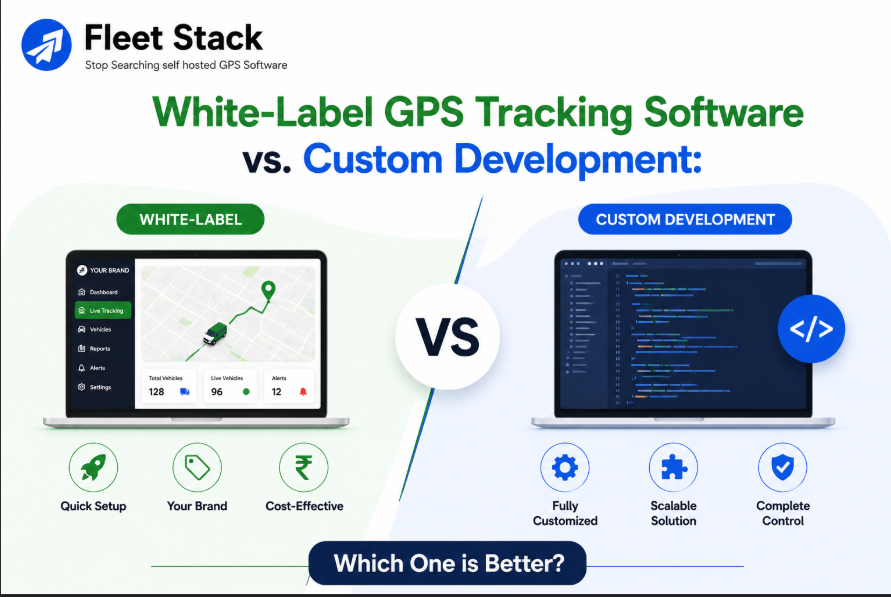
The true value of most GPS tracking service providers, resellers, and operators is that they often are better suited to implementing a White Label solution – you simply re-brand a working solution and are up and running in weeks rather than months – saving development time, upfront engineering expense and technical risk. Custom development is preferable in certain situations: If the requirements truly are unique, if software is the product, not a resale service, or if you want the source code exclusively for strategic purposes. The real question is, are you a software company or a tracking-service business? When it's the latter, then white-label is likely to be the better option for time, cost, and risk; when it's the former, then custom development might be worth it for cost.
At a Glance
| White-Label | Custom Development | |
| What is it? | Rebranding an existing successful platform as your own | creating a tracking platform from scratch |
| Who maintains it? | The platform provider | You, for an unlimited period of time. |
| Best for | Operators and resellers that sell an application service | Companies that are primarily a software business |
| Ownership | Your brand on licensed technology | 100% ownership of the codebase |
- Main risk - less control over core roadmap, cost, delays, owning all bugs.
The Two Approaches, briefly,
White label GPS tracking software is a combination of all tracking functions — live tracking, geofencing, reporting, alerts, mobile apps — developed by one company and given a different name for another company to rebrand, sell and use as their own. You add your name, logo, domain and pricing - the engine is already built and provided by the other company. Your contribution is to branding, selling and servicing.
Custom development involves writing the device-communication layer, the mapping and database, the dashboards, the reporting engine, and the mobile apps, then testing, deploying and maintaining it all. You have all your lines of code, all your decisions — and all your bugs, updates and servers.
It's not "buy versus build a little. It's a basic divide between operating a service enterprise with a tried and tested technology versus a software-engineering project. All this and more is a consequence of that difference.
Head-to-Head Comparison
The number of factors can be considerable.
| White-Label | Custom Development | |
| Platform support | Cloud (provider-hosted) or self-hosted (depending on the product) | Any platform you build and host on. |
| Integration flexibility/API | Platform-independent — rich on platforms with an open API | Limitless, you build each integration |
| Maintenance burden | Provider's responsibility for core tasks | Your responsibility for core tasks (forever) |
| Time to first customer | Fast | Slow — no sales until it is working |
- Time to market: Weeks, configuration and branding: Months to years (full build and test cycle).
- Time of investment Low — license/subscription, high — engineering salaries, testing, infrastructure (core dev)
- Acquire the software and pay for ongoing costs for maintenance, updates, bug fixes, DevOps etc.
- Technical risk: Low — platform proven in production; High — unproven, until built and battle-tested.
- The details of the product are highly flexible and the development resources are also available, provided there is enough technical capability, budget, and dev resources.
- Data & infrastructure control Depends on deployment model — self-hosted means it belongs to you, cloud means it belongs to the cloud provider! Full control, as it is run by you!
- Whether you're building and maintaining each device integration, or if you're relying on Device support by Provider to handle it, the message is the same: Device integration is a key component of your strategy.
- Ownership of the source code You get the source code, and are the owner of the branding, customers, and (if self-hosted) data.
- This team needed an engineering team with minimal technical staff and a full engineering and QA team.
The Key Dimensions are broken down into the following:
Cost
White-label takes a significant and unpredictable capital investment, and turns it into something predictable that is just a licence or subscription. A large budget is spent in custom development (engineering salaries, QA, infrastructure, project management), with no customer paying for the writing, but it doesn't end there: someone has to maintain that code indefinitely after the launch. The catch of "build it once" is not quite true, software is continuously maintained.
Time to market
This is the key element most often. A white-label platform has the ability to be re-branded and go live within a few weeks, whereas a custom project may be still in development. However, building a product from the ground up will take months to years for you to have something to sell, and every month that passes will be a month of opportunity and money that will go to the quicker competitors.
Control and customisation
The goal of custom development is that it has a true and honest edge here. When you own the codebase, you are able to create anything possible with code — things that you can fund, that are out of the roadmap of any provider, unusual workflows, proprietary algorithms, deep integrations. White-label gives you complete control of the branding, and configuration-level control of the features: you do what the platform can do, and what can be done via the API, if one is provided. If the operator's differentiation is based on unique software behaviour, then this one is too little; if it's not, then it's just as much. It's not 'flexible vs rigid', but it's who is building it and how quickly.
Ownership of data and infrastructure.
It's a dimension that is sometimes overlooked and is dependent on the deployment model, not necessarily on the white-label versus custom model. With a cloud (provider-hosted) white-label platform, your customer's data and infrastructure are on the provider's servers, but you control the data privacy and infrastructure. With a self-hosted white-label platform, you can have your customer's data and infrastructure on your servers, but you are still licensing the core software. If you're developing something on your own you get the full control of the infrastructure, by definition. The concept is that you don't need to build from scratch to control your data – a self-hosted white label platform does that without the build. Note that ownership of means nothing to infrastructure control: you might be running the software, not that you own the source.
Technical risk
There are other operators already using a white label platform in production, so the hard problems involving device protocols, scale and reliability are solved. Unless you've built it, you can't be sure that the custom build would be successful; much of the risk of delays, defects and integration surprises falls on your shoulders. This is a surprisingly complex and challenging engineering project: having to maintain support for various tracker models and each with its own protocol.
Maintenance and updates
In the white label, the provider keeps all the core issues and ships updates and ensures keeping them updated with device compatibility. All of that is your responsibility with custom development, whether you're patching security vulnerabilities, keeping your OS, maps, and device support up-to-date, or fixing bugs — and it's a guarantee that you'll have to do the work long after the initial launch. The cost item that they tend to underestimate the most is maintenance.
Scalability
It's easy to grow because a white-label platform has already been developed and matured for other customers. A custom platform can only scale as you design it to – whether it's to accommodate more vehicles, more data, more concurrent users – that's your challenge to meet, and one that demands infrastructure engineering experience.
This is the Total Cost of Ownership View.
The most common costing error is to compare just the initial cost. The straight comparison is total cost of ownership over a number of years, and they are constructed with different parts.
White-label TCO components: Platform licence or subscription; GPS hardware for your customers; SIM/connectivity per device; implementation and onboarding; ongoing support; and you sales/service. You never have to pay anything for the core platform's engineering cost that is spread across the provider's entire customer base.
Initial development (engineering salaries, QA, infra, PM); mobile app development for Android and iOS, all device integration, security and DevOps, and — and this is just the beginning — maintenance, updates, bug fixes and so much more. In addition to these two costs there are two other costs that are readily missed: the opportunity cost of the months leading up to launch; and the risk cost of delays and defects.
These components are not a price quote; actual prices will vary depending on scope, region, team and vendor — treat any number you are given as a check as opposed to a benchmark. Ongoing maintenance and staffing needs typically far exceed the initial costs of custom development over 3-5 years, while white-label's spread cost model generally result in low, predictable total cost to most operators during this period. A company at scale or requirements for which the software has an adequate strategic value to justify full LTC is the exception (not the norm).
While a white label platform is basically identical to a SaaS offering, there are a few subtle distinctions worth noting.
These two terms are frequently used interchangeably; however they mean different. SaaS (Software as a Service) is a term for the delivery of software – software that is delivered via the internet and is generally operated and maintained by the software vendor. White label is the aspects of branding and reselling rights, meaning that you can put your name on someone else's software and sell it as a product of your own. He is not the opposite of her and he's not the same axis.
That's double the amount of combinations for the two –
- Hosted SaaS (non-white-label): You run the vendor's software, which is branded by the vendor.
- White label SaaS: You resell the vendor's hosted software with your own brand, but it will always be on the vendor's infrastructure.
- Self-hosted white-label: You resell the software under your own brand and manage infrastructure (cloud or not) instead of the vendor's infrastructure.
The real-world difference between the two: white-label isn't necessarily hosted-by-someone-else, and it isn't necessarily self-hosted, either—it depends on the product. For data residency, infrastructure control, or avoiding costs for each vehicle in the cloud, check each product to see if it supports self-hosted deployment, as not all do. Please don't take anything for granted such as a white-label platform being self-hosted, or a SaaS-based platform being able to be self-hosted.
In some cases, the only option is to seek out the services of a custom development company.
White-label is not always right and it's ok to be honest when a building is appropriate:
- Tracking Software is your product. If you're a software firm whose business is based on the platform, not some fleet or reseller, then your value is in building, and your ownership of the code is the point.
- No one can ever replace you. If your workflow, algorithms, or integrations are not something you can configure for a platform, and if this uniqueness is your competitive advantage, you may need more that can be achieved with configuration level control.
- You must have 100% of the sources to have a strategic advantage. Other organisations need to have an absolute ownership of the codebase for intellectual property, security, contractual or acquisition considerations that are more important than cost and time.
- You've got the crew, and the stage. Developing a good building demands experienced engineers, QA and infrastructure skills, as well as the financial runway to develop it for months before the revenue comes in. Once those are in place then custom becomes possible; otherwise, it is extremely risky doing so.
If you have a number of these attributes, then custom development is worth a serious consideration. If not, they're a very good indicator of the rational route – white-label.
In cases where White-Label is the better option
For most of the entrants, the white-label fits as it is the opposite scenario to the above:
- You aren't creating a software product, you're creating a service! Your value is not the engineering under the hood, it's sales, local service, support and your brand.
- Speed matters. You don't want to invest a long build only to get to the market in time.
- You need to know what you're paying for and minimal technical risk. Having a licence or subscription with a maintained core is easier to plan around than an engineering project that is open-ended.
- You don't have an engineering team — or one that you don't want to develop. Small, non-technical operation can compete with a fully branded and capable product with the help of white label.
Remember, however, that white-label does not necessarily mean you must lose control of your business: You control your brand, customers, pricing, and — with a self-hosted platform — your data and infrastructure. You lose control of the heart of the engineering - the very part that operators would not ordinarily have any reason to own.
Is there a way of doing things in between?
Yes, and that's where a lot of operators end up! Much of both sides is captured in a self-hosted, white-label platform, which you then go live quickly enough (the white label benefit), but use infrastructure that you own, rather than a vendor's cloud (an ownership benefit), and extend through integrations and APIs for the custom behaviour your customers need (some of the advantages of building). You don't have to build a tracking platform from the ground up, but you also don't have to put yourself in a position of being trapped in a closed SaaS. This hybrid is a good middle-ground for operators looking for a compromise in terms of speed and cost control, and at the same time, some degree of control of data and extensibility, and it's the model Fleet Stack is built around.
A Simple Decision Framework is provided for the reader's reference.
Answer these questions in a sincere manner:
- 1. Is tracking software a primary product, or a service that you sell? Core product means a product that is tailored to individual needs and service means a white label service.
- 3. Is it possible to configure a platform to meet the needs? If yes, white-label. If truly not, then take into account custom.
- 3. How many feet per second do you need to shoot? Weeks → white-label. Can take months to years to absorb → custom is possible.
- Can you assemble an engineering team and have the runway to make a build? No → white-label. Yes -> customize is possible.
- 5. Is the source code to be owned for strategic reasons? Yes → custom. No → white-label.
- 7. What is the impact of data and infrastructure control? Use a lot - self-hosted white label captures without full build.
If you have a group of answers on the white label side – most operators do – your answer is on the white label side. If they're on the custom end, don't just assume the cost of the build, because they can add up over the course of their life.
Each time you have to make a decision, you need to ask yourself, which model is right for you?
If you need to quickly reference the situation as being probably in the fit, map it to the likely fit:
| If this matches your description… | Probably fit |
| I want to start offering GPS tracking services as soon as possible | White-Label |
| I don't need to set up a sizable engineering group | White-Label |
| I need a standard fleet/ GPS tracking functionality | White-Label |
| More control over hosting and infrastructure | Self Hosted White Label (if available) |
| I must maintain my own infrastructure, and provide customers with their data on my infrastructure too | Self-Hosted White-Label, if supported |
| GPS software is my main technology product | Custom Development |
| I have engineering resources and long development runway | Custom Development |
- I would like to have my own brand and customer experience.
- With proprietary algorithms or workflows - My differentiation.
- I require that the source code be given in its entirety.
A lot of operators discover that several rows of white-label describe them and no custom rows do — which is the sign to go white-label, and to see if a self-hosted choice provides you with the data and infrastructure control you desire.
Before choosing a white-label GPS software, there are 10 things that you should keep in mind.
If you are going the white-label route, these 10 checks will help you figure out whether you have a platform that you'll be able to build a business on or one that you will have to fight or outgrow. Try out them with any provider first:
- 2. Limit access to specific devices and/or protocols. What GPS tracker(s) and protocol(s) does it support, and can you obtain and service them in the area? Check the supported devices list.
- 2. Branding & Custom Domain. Is it possible to rebrand completely — logo, colours and your own domain — not just put a logo on some other interface?
- 3. Mobile app options. Are there mobile apps that are “brandable” for both the Android and iOS platforms, and how are they delivered?
- 4. API and integration features. Has an API that can be used to extend the platform and integrate with other systems? It is dependent upon the provider and essential if needs might increase.
- 5. Multi-tenant / customer management. Do you have the ability to clean multiple customers without any problems and under your brand? Search for an integrated customer management system.
- 6. Hosting and deployment model. The question is, cloud or self-hosted? This will affect your data control, your cost structure.
- 7. Ownership and access to data. Where is the customer data stored, who has access to that data and can it be exported?
- 8. Scalability and performance. Have you attempted to run it at the scale you want?
- 9. Similar characteristics to your market. Reporting, alerts, geofencing and other fleet features your customers need — present and adequate, not merely on a list.
- 10. Support, updates and security, and roadmap. Is the support responsive and how frequently is the platform being updated and what is its direction? The reliability of the provider is incorporated into your service.
If one platform answers all ten well, it's a safe bet that you can call it your own, as operator-customer relationships fail to develop there later.
The most frequent errors made while making this decision.
- Only comparing the initial costs. The true comparison is over the long term TCO including maintenance; the long term cost of custom is where budgets fall apart.
- Underestimating maintenance. This "build it once" concept doesn't take into consideration software being maintained for the long haul, from device updates to security fixes to bug fixes.
- Undervaluing standardisation you will need. Having unlimited flexibility with the building features you get with the platform you're paying for is a waste of money and time.
- Ignoring device-integration complexity. Many of the trackers are supported by mature platforms with the reliability that is required for a large scale engineering task.
- Coping with the loss of control when it comes to white label. A self hosted, branded platform gives you control of your brand, your customers, your data and your infrastructure — just the core of the engineering.
FAQs
Which is better, white label GPS software or building my own GPS software?
Yes, for most operators, it is a faster, cheaper and less risky option since you are rebranding and using a proven platform, rather than building and maintaining one. The advantages of custom development lie primarily when software tracking is the foundation of your business, your requirements are specifically one-of-a-kind or you need full source ownership.
How much less expensive is the white-label as compared to custom development?
There is no one number, but the differences are typically big over time. The money spent on a big upfront build and ongoing maintenance costs are replaced with a predictable licence or subscription fee in white-label. Most of the difference is actually the continuing expense of custom development over the long-term, rather than initially.
Is white label software my property?
You have your brand, your customer relationships, your pricing and — with a self-hosted platform — your data and infrastructure. You are not a license holder of the source code, however, of the underlying core platform. Custom development is what is responsible for having full control of the code base.
So, when is custom development appropriate?
If you are a software company and your product is the platform, if your needs are really different from what you can get from an existing platform, if ownership of the entire platform is strategically important to you, and if you have the engineering squad and the financial resources to design and operate the platform.
Can white-label software be customised?
Yes, as much as the platform allows, in terms of branding, features (configurable), and APIs and integrations (if available on the platform). It doesn't provide unlimited source-level change, though, which requires custom development or an extensible platform via its application programming interface (API).
How can the fastest way to start a GPS tracking company?
White-label, clearly. A platform using a brand can be up and running in a few weeks – you can get customers coming in while a custom build is still being created. One of the greatest benefits of white label is the ability to reach revenue faster.
Is it acceptable to opt for self-hosted white label?
Yes, for many operators. It's fast, cheap and offers more control over data and infrastructure — and, when an API is available, the ability to expand the platform. It's an approach that encapsulates a lot of people's desires in construction without reinventing the wheel.
What's the difference between a white label GPS software and a SaaS GPS software?
SaaS is defined as the delivery method of software - hosted and accessible via the internet. The term white-label applies to rights of branding/ reselling someone else's software. They are distinct axes: a white label product might be provided as an hosted SaaS product, or provided self-hosted, according to its product. While the term white label often implies self-hosted, the term SaaS doesn't necessarily mean self-hosted, and the other way around is equally true.
Do I need to buy my own brand & domain for my GPS software?
Yes — that's the essence of the model. A white-label platform allows you to position the service as your own, with your own name, logo and custom domain, so that customers will recognize you instead of the service provider. Check the depth of branding (that includes a mobile app if they have one) with the provider, as it's not consistent.
Is there a possibility to use white label GPS with my ERP or CRM?
It relies on the API and integration of the platform used. An open API platform is likely to feed tracking data into an ERP or CRM or customer app, while a closed API platform may not. When integration is a concern, consider the availability of APIs and review technical documentation provided by the API vendor.
Is there any way to self-host white-label GPS software without hosting?
No, the white label does not require self-hosting, just one of the deployment options. Some white label products are cloud based by the provider, some on the customer's infrastructure, and some are both. Use on a basis of whether it is beneficial to you if data residency, infrastructure control and cost structure deems it worthwhile to host yourself.
Further Reading
The cost, time, risk and maintenance considerations in general industry are compared in this article, not by specific vendor statistics, and are of a structural nature, not citations of numbers. The white-label GPS tracking overview software and the developer documentation provide technical details on the API and integration questions listed above, while the supported-devices list contains information about the various devices and protocols supported — all of these are linked at the bottom of this section.
A decision of the Practical Path With Fleet Stack
Fleet Stack is a white label, self-hosted GPS tracking and fleet ERP platform designed to give operators just the right amount of power to brand it your own and quickly get it off the ground, without having to build the tracking engine themselves, or invest in a multi-year build, or run it on a vendor's cloud. When considering white label vs custom development, that's the entire equation.
Consider the options: White label options that show the branding and deployment model, devices supported list and developer documentation to see how far the platform goes, and partner program if you are developing a tracking-service business. Product capabilities change and improve – check with the up-to-date documentation for requirements. Then you'll have to choose the track that suits the creation of the tracking service or a software company.
The information in this guide is intended for general information only for a build-versus-buy decision and should not be considered a recommendation for a particular situation. Determine the capabilities and pricing models of products with each provider and ensure they are accurate before committing them to use.
0 Comments
No comments yet. Be the first to comment!
Please to post a comment