
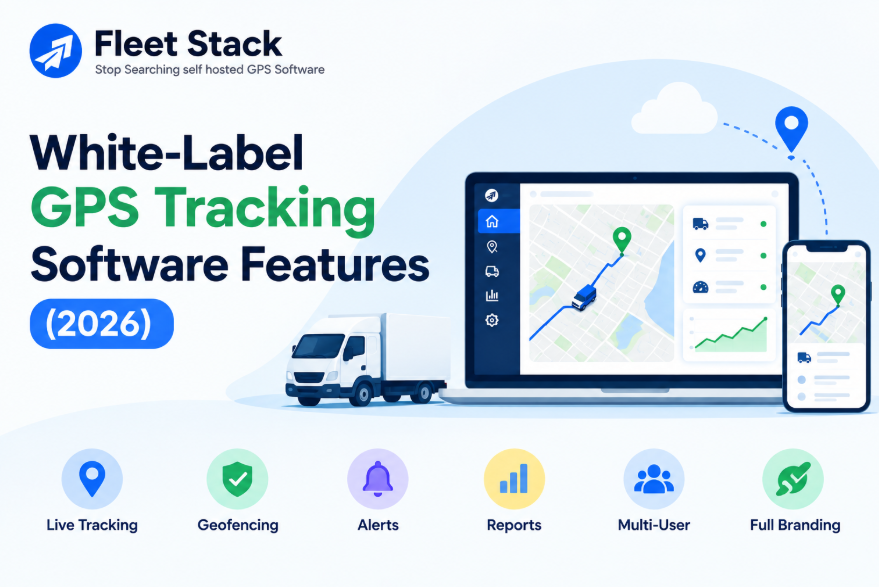
The bottom layer of features is what Direct Answer call “the heart of the software.” First the reseller layer that you own to sell: you have full rebranding (your logo, colours, your domain), a brandable mobile app, multi-tenancy to manage many customers under your brand, per customer management/billing, and API to integrate/exend. Second, the heart of the tracking system that your customers are using every day – real time tracking, geofencing, trip reports, alerts, driver behaviour, and mobile access. For a white-label operator, a platform with top-notch tracking features is worthless if it can't be 100% branded and multi-tenanted — that's what makes the platform you can build a business on different than the one you can only use.
At a Glance
| Question | Quick Answer |
| What does it mean to be a "white-label" software? | There is a full rebranding + multi-tenancy (sell it as your own to many customers) |
| So, what are the most important reseller features? | The depth, brandable mobile app, multi-tenancy, per-customer management, billing and API are all brandable. |
| Should it have its standard tracking capabilities? | Yes — your customers are using real-time tracking, geofencing, reports, alerts, mobile |
| Which is the worst sin? | When you're only able to brand and/or multi-tenant it partially for tracking features and unable to brand and/or multi-tenant it entirely |
| Cloud or self-hosted? | Both exist, self-hosted adds in data control and one-time licensing, see the platforms guide |
| How do I evaluate? | Look in the reseller layer, then core tracking and then try with test customer. |
The reasons for white-label software to be considered separately.
When you're selecting GPS tracking software to employ with your own fleet, you consider the GPS tracking features. If you are trying to select a white label platform to re-brand and resell, you have another crucial set of requirements: The software should also be yours, branded to you, and should support multiple customers under a single name. A platform that is very well tracked but not well branded or has no multi-tenancy is okay to use, and can't be sold.
Hence this guide deals with both layers, yet starts with the features accessible for the reseller that the white-label buyer will likely be the first to underestimate, and the last to overlook. If you know your requirement and need to select a specific GPS tracking software (white label), read the guide to the best white label GPS platforms; if you are unsure about what features you need, then read the guide to essential GPS tracking software features. In this article, you will learn about the features that platform should possess.
The White-Label Layer (What Makes It Yours to Sell)
These are the characteristics that make someone else's software into your product. They're not an extra service for the reseller, they are what the reseller is in business for.
Full rebranding
The base line for white label is that you have to be able to serve the software all the way under your own name, your colours and importantly your domain (not the vendor's). Shallow “branding” – where a vendor's name is used in other ways but the logo is changed – does not constitute white-label. Seek complete branding control throughout the web platform for your customers to see your brand, not the web platform provider's.
A brandable mobile app that can be used for marketing purposes.
Your customers expect a mobile app, and it should be distributed in the app stores or under your name, with your icon. Many "white-label" platforms do not provide a web platform and the only app they provide is a generic "white-label" version. One of the most important features of a reseller's Android or iOS application is the ability to make it really brandable; and this is the app that your customer is likely to engage in most.
Multi-tenancy
This is the quality that permits you to conduct a business as opposed to just one account. Multi-Tenancy: Call on many different customers from a single platform, without them ever seeing the other customer's vehicles or data - under your brand. If not, you will not be able to serve several clients without messing up. It provides you with a platform that's scalable and each customer is isolated and managed independently. Multi-tenancy is as basic as tracking for a reseller.
Per-customer management
You don't only need to isolate customers, you have to administer them; create and manage customer accounts, put users and permissions in place, manage what they can see and do, and manage onboarding. What is essential to keep a small business from getting into chaos as it grows is strong, built-in customer management. This is the life-long core of a white label business.
Billing and subscription management
Being a reseller, those features that support billing, such as per-vehicle and per-customer plans, subscription tracking and account status, make running the commercial side a lot easier. Whether you are inviting customers to buy from outside or not, you should be able to view and manage the plans and status of each customer. It's easy to miss when assessing on tracking capabilities and painful when you start to have customers to bill.
Access to API/integration
An API will allow you to make your platform open and extendable, allowing you to share tracking information with your customers, add your own features or integrate with your own billing and CRM systems. Platform and API access can be a key differentiator for growing and enterprise customers for a reseller. Look at the developer documentation to see what is exposed before committing.
Core Tracking Layer (What Your Customers Use)
However, any white label platform must offer great tracking, as your customers are going to be using it under your name. These are all the key capabilities that any GPS tracking software will require – in this case they're explained briefly, but the depth of each is detailed in other locations.
- Real-Time Location Tracking — real-time vehicle positions on a map, frequent refreshes and many vehicles clearly. The fundamental tracking functionality that is the basis of your entire product.
- Geofencing — virtual boundaries with automatic entry/exit alerts (they are covered in detail in the geofencing guide).
- Historical trip & route reports — all trips recorded including route, stop, distance, time, for verification and analysis.
- Alerts and notifications — set up alerts for speeding, geofences, idling and device problems — on channels your customers use.
- Route planning — efficient multi-stop route management for customers who plan the journeys.
- Driver-behaviour monitoring — driver scoring based on speeding, harsh braking and acceleration for safety and fuel savings.
- Fuel monitoring; biggest expense in most fleets is fuel and monitoring fuel consumption, fuel theft and idling.
- Signature, photo and remarks capture for customers that are being delivered — evidence of delivery and acceleration of billing.
- Mobile access — a useful application (yours, branded) with live tracking, alerts and reports, for the mobile customer.
The level of depth customers require in each is dependent on the type of customer you have: delivery-focused reseller relies on proof of delivery and routing, asset-tracking reseller on geofencing and alerts.
You can't see this but you can feel it...
These technical aspects can make or break whether or not the platform will ever be able to support business as it expands — and these are even more often overlooked by resellers than end-users.
- Device compatibility. It's a platform that can support the GPS trackers your market can source and service – and as a reseller you may have a wide variety of customers with different device types, so the more the better. Check this first.
- Installation — manual or automated. Using Cloud is the fastest solution because the software runs in the cloud, the customer's data resides in your systems and your margins change when you scale up the business, usually in favor of the customer since you no longer have to pay a per-vehicle software fee. Weigh this deliberately.
- Scalability. Will it be able to accommodate thousands of vehicles and numerous customers as your book expands, without needing to be moved to a different platform or slowing down? Inquire if it has been executed at the scale you're after.
- Ownership and control of data. Who is responsible for your customers' data, and is it possible to export your data? This is important both from the perspective of customer relationships and to avoid being locked into a solution.
- Reliability and support. The response time and availability of the vendor become your service availability, as your customers' issues are your issues. Reliability is actually one of your product's characteristics, actually it's one of the provider's attributes.
- AI-assisted capabilities. Emerging AI features — such as surfacing insights and flagging exceptions — should be considered for where the product, and your offering, can go.
A summary of White-Label Feature Priorities.
The reseller's priority order is different to an end-user's. It comes in this form:
| Tier 1 | The ability to come to an agreement on the pricing model. |
| White-label layer | Branding, brandable app, multi-tenancy, customer management, billing, API — makes the software yours to sell — the initial motivation behind white-labeling |
- Customer experience – under your brand – Core tracking, real time tracking, geofencing, reports, alerts, routing, driver behaviour, fuel, POD, mobile.
- Platform Device support, deployment model, scalability, data control, support Is your business going to be supported by the platform as it grows?
The order isn't random, it's intentional: An end user can assess core tracking first, but the reseller can only assess the white-label layer first as an end-user who can't track the layer no matter how good it is can't make it a business. Once you have the white label layer sorted, and it's truly a robust core tracking layer, you want to test the platform layer to see if it can scale with you.
How to Evaluate a White-Label Platform's Features
Perform the evaluation in reseller order. First, is there a full white-label layer that allows for a web platform and mobile app to be fully rebranded, full multi-tenancy, customer and billing management, and an API? If one or more of these is lacking or shallow, then it's difficult to build a business on that platform, even if it does track. Secondly, make sure that the core tracking is actually robust — not only listed on the feature sheet, but robust for your customers as it is your product. Thirdly, evaluate the platform layer: device support of your market, deployment model that suits your margins, and a track record of scalability. Lastly, test it correctly — create a test buyer, brand it and put the features your clients will use on a daily basis to the test. Once you've selected a platform, the next step is to evaluate particular platforms against these criteria, while the guide to starting a GPS tracking business will explain the GPS tracking business launch procedure.
FAQs
What features should white-label GPS tracking software have?
Two layers: reseller features that appear as your own to sell — full rebranding, brandable mobile app, multi-tenancy, per-customer management, billing and an API, and your core tracking features your customers rely on — real-time tracking, geofencing, trip reports and alerts, driver behaviour, routing, fuel monitoring, proof of delivery, and mobile access.
What features do you have in white label GPS tracking software versus normal GPS tracking software?
A typical GPS software requires tracking capabilities for you. White label software requires all of those features and in addition an extra layer of a reseller: re-branding, multi-tenancy, customer management and billing, which enable you to sell your software as your own to numerous customers. It is white label because of the reseller layer.
Multi-tenancy is a term that refers to the practice of sharing resources and infrastructure, and what it means for GPS software that is used as a white label?
With multi-tenancy, you can control numerous separate customers from a single platform with only their own data visible to them, and your brand on their user interface. It's essential for any reseller to operate in case you do not, you cannot serve multiple clients cleanly; if you do, you'll have a platform that is scalable and each client is separate and manageable.
Should I have a custom branded GPS tracking mobile app?
Yes, in most cases. Your customers want a mobile app and for it to be truly white labeled it should be yours, not the vendor's. Some platforms claim to have a fully branded web app but neglect to do the same on mobile — which is why it's essential that the mobile app is fully branded, too.
Which option is the most crucial feature of white label GPS tracker software?
For a reseller, the whole package – even the multi-tenancy, let alone the full branding – of the white-label layer, as otherwise the software cannot become your product, no matter how good the tracking is. Individual features like true multi-tenancy can be the difference-maker; it's the feature that enables you to satisfy multiple customers when operating as a business.
Cloud vs. Self Hosted GPS Software – What is the Best Choice for White Labels?
Both models exist. Cloud is quickest to deploy with low maintenance; you host customer data on your systems; you run on a one-time licence as opposed to per-car basis; and margins improve at scale. The selection of the correct one will depend on the technical competency and the importance of data control and cost predictability.
How to compare the functionality of white-label GPS platform?
In reseller order: Make sure that the white-label layer is really good (branding, mobile app, multi-tenancy, customer management, billing, API); be sure the core tracking is solid; ensure that the device support, deployment model, scalability and data control make sense; and test it out with a test customer using the features that your reseller clients will use everyday.
Use White-Label Features that are Built In With Fleet Stack.
The Fleet Stack platform is self-hosted, white label GPS tracking and fleet ERP software designed to be your product: Fully rebrand the web platform and create a brandable mobile app, Multi-tenancy with customer management built in, Real-time tracking, Geofencing, Reports, Alerts, Routing, Driver behaviour, Fuel monitoring, Proof of delivery. Self hosted means you can run it on infrastructure that you own and control, and aren't charged per vehicle software fees. Compare to the feature layers above by looking at the supported devices and developer documentation, reviewing the partner program and testing with a test customer under your brand.
0 Comments
No comments yet. Be the first to comment!
Please to post a comment