
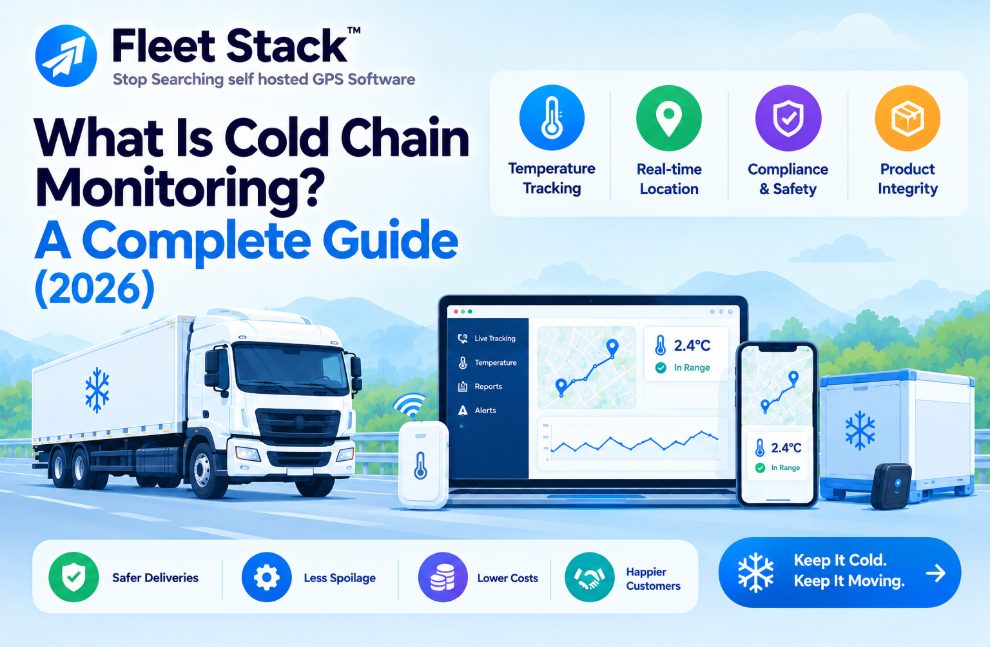
Cold chain monitoring involves the real-time monitoring of temperature (and sometimes humidity and location) throughout all phases of a temperature-sensitive product's life cycle, from production to storage and transport to use. It is designed to demonstrate that the temperature of food, vaccines and medicines remained within the required temperature limits throughout the trip; and to alert the driver to the temperature change when it is outside the limits, so that the excursion can be assessed and responded to before the product is in danger.
At a Glance
| Question | Quick answer |
| What is cold chain monitoring? | Continuous tracking of temperature and conditions across a product's whole journey to keep it within safe limits |
| What does it monitor? | Temperature mainly, plus humidity, door openings, and location, depending on the cargo |
| What is the "cold chain"? | The unbroken sequence of refrigerated storage and transport that keeps a product cold from source to destination |
| What temperature range is typical? | Varies by product: 2 to 8 degrees Celsius for many vaccines and medicines, frozen or deep-frozen for others, chilled or ambient for different foods |
| Which industries need it? | Pharmaceuticals, food and beverage, dairy, seafood, floriculture, chemicals, and diagnostics |
| What standards apply? | WHO cold chain guidance, EU and WHO Good Distribution Practice (GDP), HACCP, US FSMA, and national rules such as India's FSSAI |
| Why do fleets rely on it? | A reefer vehicle is a moving cold store; monitoring proves the cargo stayed safe and creates an audit record |
What is Cold Chain Monitoring?
Cold chain monitoring involves measuring and recording the conditions a temperature-sensitive product encounters, throughout its entire cold chain from production to use or sale. Monitoring is the layer that watches the “cold chain” and provides proof that it is unbroken; the “cold chain” is the unbroken sequence of refrigerated handling, storage, and transport that keep that product within a safe range at all times.
A sensor records the temperature of a refrigerated truck, cold store or shipping container every set time, and alerts a central system when the temperature exceeds a set limit. The fundamental principle is that a perishable is only as safe as its last chance of survival and you can't manage what you can't measure.
What Is a Cold Chain Monitoring System Track?
A complete system typically monitors more than just temperature, since there are many factors to consider when choosing the best packaging solution for delicate cargo.
- Temperature. The central reading continuously recorded with a specified minimum and maximum value for that product.
- Humidity. Produce, flowers and certain pharmaceuticals – moisture has an impact on shelf life and quality.
- Location. Each reading has GPS position date and time, so an excursion can be followed to a specific leg of the way.
- Events related to doors or lids. Openings are found to be a cause of temperature variations and can indicate unauthorised access.
- Time out of range. The duration of time that a product was outside its limits - more significant than one short spike.
The results provide a continuous output which answers the questions all auditors and customers ask: did this product remain in its safe limits throughout, and if not, for how long and where?
How is Cold Chain Monitoring done?
A cold chain monitoring system is a system that involves setting up cold chain sensors in the field, and software that can be read and acted upon. Each setup varies in hardware, connections, and the location of the data, but most consist of five steps.
- 1. Sensing. Inside the refrigerated space (reefer truck, cold room, container, or packaged shipment) are temperature sensors and, if required, humidity sensors and/or door sensors.
- 2. Capture and transmission. A device takes a reading from each sensor at regular intervals, and transmits the data over a network. This is typically a cellular unit, a GPS unit or a combination of both in a moving vehicle, or wired or wireless in a stationary store.
- 3. Storage and processing. Readings are received at a central platform (either cloud-based or self-hosted) with a time-stamp, vehicle or location specific data, and stored in the platform for an everlasting record.
- 4. Alerting. The platform performs a comparison of each reading with the limits in relation to the cargo. When a reading exceeds a limit, an alert is sent via the app, SMS or e-mail, to a person to respond.
- 5. Reporting. The system transforms the logged data into trip reports, compliance logs and exportable logs that show the chain held—or where the chain failed to hold.
The distinction between monitoring and basic logging is alert and response loop. The basic data logger merely makes a note of a breach, and then you find out about it at a later time – possibly after the product is already compromised. A monitoring system will inform you when the cargo is still on the move, before it's too late to reroute, repair the unit, or move the load.
In what temperature range does the Cold Chain operate?
There are no specific cold chain temperatures. The figures below are representative and not compulsory limits, as each product has its own acceptable range that is determined by the manufacturer and what a product is licensed to do. It's not a single number that is monitored, it's each product's approved range.
| Product category | Typical range | Notes |
| Refrigerated medicines and many vaccines | 2 to 8 degrees Celsius | The traditional vaccine cold chain range used by the World Health Organization and national health agencies |
| Frozen vaccines (for example varicella) | At or below minus 15 degrees Celsius | Kept continuously frozen with no freeze-thaw cycles |
| Ultra-cold / deep-frozen products | Much colder, down to around minus 70 degrees Celsius for some biologics | Some mRNA vaccines and biological samples need specialised ultra-low storage |
| Chilled food, dairy, fresh meat | Around 0 to 5 degrees Celsius | Varies by product and local food-safety rules |
| Frozen food | Around minus 18 degrees Celsius or below | A widely used frozen-food benchmark |
| Controlled ambient pharmaceuticals | Around 15 to 25 degrees Celsius | "Room temperature" products still have an upper limit that heat can breach |
- The WHO/NHPMC "standard" vaccine cold chain range, 2 to 8 degrees Celsius (C)
- Frozen vaccines (e.g., varicella) Stable when frozen, with no freeze-thaw cycles (at or below minus 15 degrees Celsius)
- Specialised ultra low storage products Products that are very cold, as low as minus 70 degrees Celsius for some biologics.
- Frozen food Below minus 18°C "A good frozen food reference temperature"
Products that require “room temperature” control (controlled ambient pharmaceuticals) still have a ceiling temperature that can be exceeded by heat.
The traditional vaccine cold chain is defined to be between 2 and 8 degrees Celsius by the World Health Organisation, while most refrigerated vaccines are stored in the band 2-8 degrees Celsius (or 35-46 degrees Fahrenheit) by health agencies like the US CDC. Frozen and ultra-cold products are much lower. For a vehicle transporting a combination of product types, the practical lesson is that thresholds must be customized for each product type based on approved conditions for that particular product; and that this vehicle might require more than one monitored zone.
Why is Cold Chain Monitoring Important?
The importance of cold chain monitoring is that losses, resulting from the failure of the cold chain, are significant, often not detected until too late and in some industries health threatening. The causes of food loss in the world are among others inadequate storage and handling, which accounts for around 14 per cent of the world's food loss, according to the State of Food and Agriculture 2019 report by Food and Agriculture Organization. A Healthcare excursion could affect the potency of a vaccine or medicine, without there being any visible evidence of the event; therefore an excursion is not assumed to be harmless or a total loss, instead it is assessed based on the manufacturer's stability data for the product.
Monitoring tackles multiple issues simultaneously. It helps ensure product safety and quality by detecting an excursion early and taking action. It promotes compliance with regulations, as food and pharmaceutical regulations dictate that temperature-sensitive items must be stored under specific conditions and documented. It minimises the costs of load losses and rejected deliveries. And it creates accountability – if a problem does develop about a damaged load, a continuous record will provide a history of what or even when the chain snapped.
Which Standards and Regulations Apply?
Cold chain monitoring is part of a global and national of rules. Whether it's a country or a product, the main idea is the same: not get certain products out of their "prescribed environment" and not forget to record it.
- WHO cold chain guidance and PQS. The World Health Organization prescribes widely recommended standards for storage and transportation, including its Performance, Quality and Safety (PQS) standards for cold chain equipment.
- Good Distribution Practice (GDP). The distribution and storage of medicines is regulated by the EU GDP guidelines for medicines, as well as by WHO's GDP guidance. They require temperature mapping of storage areas, monitoring in the most critical areas, calibration of the equipment, testing of the alarm(s) and documentation of investigations related to excursions and keeping records.
- HACCP. Hazard Analysis and Critical Control Points is a world wide recognized food-safety system of which temperature is one of the critical control points to be monitored and documented.
- US FSMA. The Food Safety Modernization Act (FSMA), with its Sanitary Transportation rule, prescribes the requirements for maintaining the safety of food during transportation within the United States.
- National food authorities. Each country has their own regulations. Food businesses have been advised by the food regulator of India (FSSAI) to ensure food temperature control for perishables like paneer, meat and fish from the point of their procurement till delivery, based on the food hygiene requirements in the licensing and registration regulations.
This article should not be taken as legal advice and rules vary per product and country, please verify the rules with the relevant authority. All of them have the same design principle: constant monitoring, adjustable alert levels, calibrated sensors and an audit trail that is maintained.
What purposes do fleets use cold chain monitoring for?
In the eyes of a transport / logistics operator, a cold store that moves is a refrigerated vehicle, and there's the connection between cold chain monitoring and fleet management. The same telematics system that keeps track of a vehicle's position can also monitor its temperature, making the monitoring of the cargo part of fleet monitoring.
Cold chain monitoring is useful for a number of everyday tasks in a fleet environment:
- Live temperature with live location. The readings are linked to the vehicle's location, letting a dispatcher view the location and condition of all cargo.
- Transit alerts for threshold. An alert is sent to the team when a reefer gets out of range while the load is moving, and can still be retrieved.
- Proof for customers and auditors. Temperature logs associated with each of these trips are then the evidence that a delivery was compliant.
- Decide on routes, schedules. Understanding conditions along various routes and at various times assists in planning, such as not waiting for hours with heat sensitive loads during midday.
- Third-party/mixed hardware. If the platform supports external devices, operators can import data from temperature sensors of various manufacturers along with their native data.
That is why the cold chain monitoring is frequently seen as a component of fleet telematics as opposed to a separate solution: the vehicle, the route and the cold chain temperature are a single process.
How can Cold Chain Monitoring be reliable?
Any monitoring system is only as reliable as its weakest element: there are some practices that help distinguish between a reliable monitoring system and one that provides false confidence:
- Calibrated sensors. If the sensor is not accurate, then the readings are meaningless. In the case of EU GDP, for instance, there is a requirement to calibrate the monitoring equipment at specific intervals, with transport temperature monitors every year. Other regimes dictate their own intervals – use the one that applies to you.
- Sensible sampling intervals. Readings need to be at least as frequent as to capture a genuine excursion but they should not be arbitrary, but determined by the nature of the cargo.
- Thoughtful sensor placement. Sensors should be placed where the temperature changes the most, not where it's convenient.
- An alert path that has been tested. But if nobody gets the alarm, then it's useless. All after hours escalation should be tested routinely.
- Secure, retained records. Wood should be stored securely and retained for as long as necessary by the applicable regulation. This is dependent on jurisdiction and product; for example, EU GDP requires that some records be retained for at least five years.
- Data control. Whether data is stored in a third-party cloud or on infrastructure that is under the regulated operator's control is a genuine choice for regulated operators, as cold chain data will be evidence in audits and disputes.
What's the difference between Cold Chain Monitoring and Cold Chain Logging?
Both terms are used interchangeably but there is an important difference.
| Temperature logging | Cold chain monitoring | |
| What it does | Records temperature for later review | Records temperature and acts on it in real time |
| When you learn of a breach | After the trip, when data is downloaded | While the cargo is still in transit |
| Alerts | Usually none | Threshold alerts by app, SMS, or email |
| Typical use | Basic compliance records | Active protection of the load plus compliance |
| Outcome | You document the loss | You get the chance to prevent the loss |
- Temperature recording used to track the cold chain.Cold chain tracing: temperature recording to monitor the cold chain.
- In the event of a breach, you will be notified afterwards, when the data is downloaded after the trip has completed, and during the cargo's transit.
- Typical use Basic compliance records: Normal operation of the load plus record of compliance
- Outcome You write a report of the loss off the record, you have an opportunity to avoid the loss.
A basic record-keeping function such as a plain data logger might meet a minimum requirement for record-keeping, but since the data doesn't show the breach until after it has occurred, the product will be breached at the time of reading. Monitoring provides the real time alert that converts a record into an opportunity to take action.
FAQs
What is cold chain monitoring?
Continuously monitoring the temperature of perishables (food or medicine or similar goods) from their manufacturing site to their use site and alerting if the temperature falls outside of the safe range, so that the problem can be corrected in time.
What is the difference between the cold chain and the cold chain monitoring?
Cold chain refers to the uninterrupted refrigerated storage and transportation chain which maintains the product at a cold condition. Cold chain monitoring is the system that is responsible for monitoring that chain, recording the conditions, and notifying you if it fails.
What is the temperature of the cold chain?
It varies from product to product. Many vaccines and refrigerated medicines are held at temperatures between 2 and 8 degrees Centigrade (2 to 8 degrees Celsius), as defined by the World Health Organization (WHO), and frozen and ultra cold products are kept even lower, while chilled and frozen foods have their own temperature ranges.
What are the advantages of GPS in cold chain monitoring?
Each temperature reading is identified with a location and a time (GPS). This enables a dispatcher to view the state of the cargo and position of the vehicle simultaneously, and to identify, from a trip log, where a trip is in a truck when it was inside a customer's range of sight.
What are the rules and regulations for cold-chain monitoring?
Healthcare organizations often use WHO cold chain guidance, EU and WHO Good Distribution Practice for medicines, HACCP for food safety, and US FSMA and national rules like FSSAI of India. This may differ from product to product and from country to country so please check with the appropriate authority.
So, is a temperature data logger the same as cold chain monitoring?
No. The temperature is noted by a logger for review later, and you are usually only made aware of a breach after the product has arrived, when you no longer have time to do anything about it. A monitoring system can offer live alerts, meaning that you will be able to take action as the cargo moves.
How do fleets do cold chain monitoring?
A refrigerated vehicle is equipped with temperature sensors linked to the same telematics system that can be used to report the vehicle's location. The fleet platform records the reading for a vehicle and route, alerts the user if a threshold is breached and generates the temperature records required for adherence.
So how does a fleet operator know what to look for in cold chain monitoring software?
The following features are helpful to inspect: per-product temperature thresholds, real-time alerts via over one channel, support of the already installed sensors on your vehicles, exportable records for audits and transparency of where the data is saved. Pair up your software with your cargo, your hardware, and your rules that you report on.
Cold Chain Monitoring is a component of Your Fleet Platform.
One of the benefits of Fleet Stack is that it is self-hosted, which means that cold chain monitoring can be incorporated within the platform you use to manage the fleet, instead of as a standalone application. It's supposed to work that way: temperature information will coexist with live GPS tracking, alerts based on those thresholds, and trip information, and the data will be stored on infrastructure that you control, and that's important when you're called upon to prove it in an audit or a dispute. Explore the list of supported devices for trackers and temperature sensors, or discover how external devices work with your fleet management platform, by starting with the list of supported devices.
0 Comments
No comments yet. Be the first to comment!
Please to post a comment