
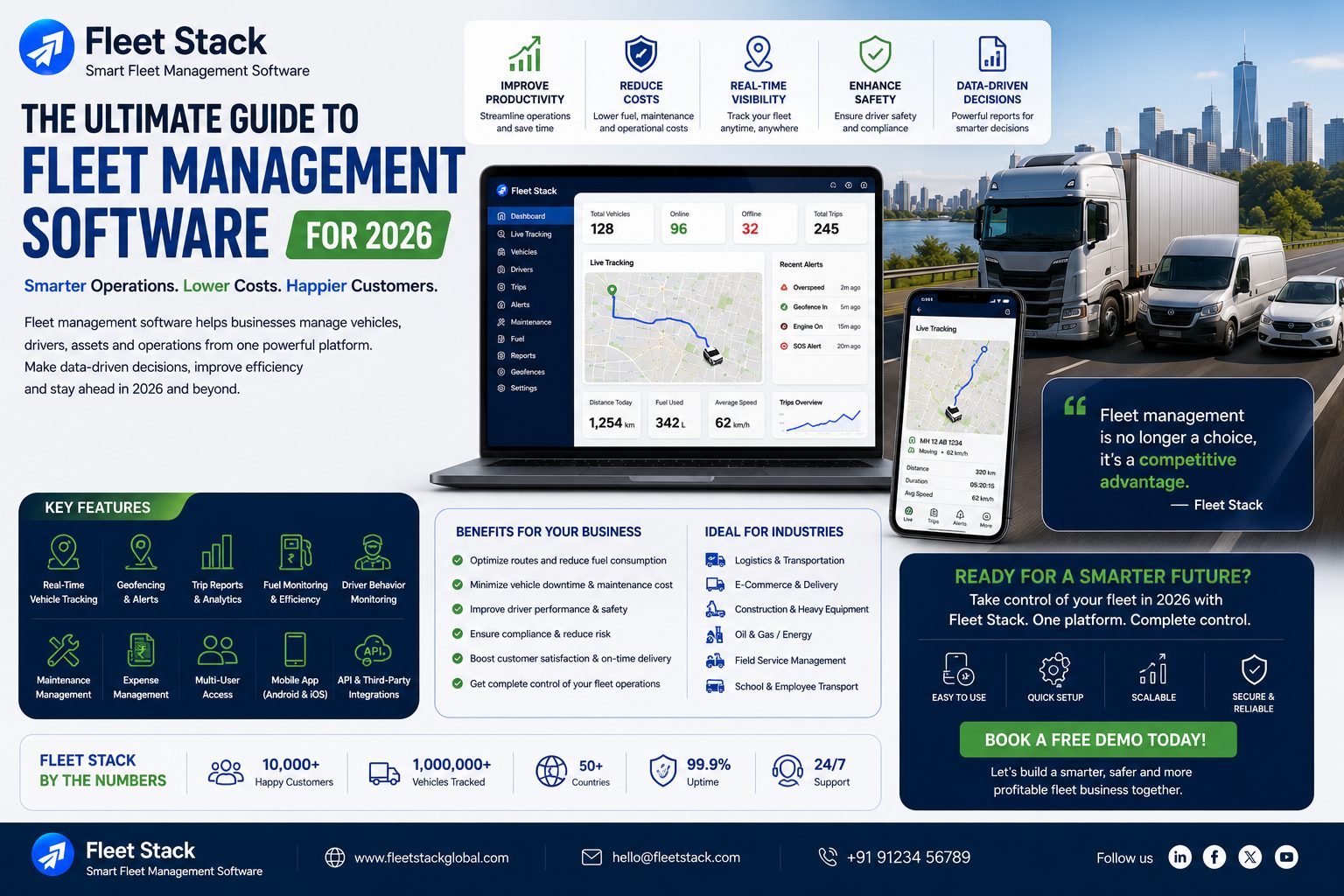
So, what is Fleet Management Software?
One piece of software that can help a business keep track of, manage, and optimize their vehicles, drivers and daily operations in one screen is fleet management software. It integrates live GPS location, fuel usage, driver behaviours, maintenance, trips, compliance, and costs to empower a manager to see all that and act on it from a single place. It can help companies remove the need for several spreadsheets, paper records and telephone trees from their operation and obtain the answers to two questions: Where is each vehicle? What was the cost of each vehicle? It additionally arranges plans, notifies, predicts maintenance and confirms deliveries and handles billing. By 2026, most fleets will find it's no longer a luxury but a necessity.
Key takeaways
- Fleet management software is an all-in-one solution that combines tracking, maintenance, safety and compliance.
- It's bigger than GPS tracking that usually answers the question: "Where is my vehicle?
- Independent market research estimates the value of the sector in 2026 in the tens of billions of dollars with a double-digit increase.
- Good ROI is reported, but will vary based on fleet and therefore is a range and not a guarantee.
- The most useful part of the modules will be when they are used in conjunction, rather than one by itself.
What is the workings of the fleet management software?
In short: Your car transmits data, and the platform converts that data to information and you do something with that information. It is repeated continuously, 4 steps.
- 1. Devices collect data. A GPS (Global Positioning System) system is installed in each vehicle to determine location, speed and route. Fuel level, temperature and engine data (Optional).
- 3. The platform transmits information to the people. Accessed over mobile in real time to a software you sign-in via Web or mobile.
- 3. The site is helpful. It creates live maps, reports, driver scores and alerts, converting the signals into information.
- 4. You act. Send a driver, coach a risky driver, book a service or bill a trip; all on one screen!
The base is GPS tracking which answers the question ‘where is it?’. Then all other modules are created which are more in-depth on the topic of cost, safety and compliance.
Fleet Management Software Architecture and Data Flow
It may be helpful to visualize the software as being four separate layers. Each and every one of them passes along values to the following.
| Layer | What it does |
| Hardware layer | GPS devices and sensors in each vehicle collect location and vehicle data. |
| Data layer | The network carries that data to a database, on the vendor's cloud or your own server |
| Application layer | Software utilizes data to create maps, reports, scores, alerts, and documents. |
| User layer | Managers and drivers view and respond to it via web and mobile apps |
The key concept is that the data layer is able to reside in the vendor's cloud or your own server, if you prefer. This one decision impacts cost, data ownership and control, which we will discuss next. Everything else on top of that; tracking, billing, etc.
Fleet Management Software vs GPS Tracking Software.
Both of these words can be interchanged. It's important to choose a tool that doesn't —
The main function of a GPS tracking software is to discover where is the vehicle, and its history. That's not all; there are operational tools around fleet management software – maintenance, fuel, drivers, trips, compliance and billing.
It's now time to embrace GPS tracking and fleet management software solutions.
The question was replaced by a yes or no option in the course of the meeting.
| GPS Tracking Software | Fleet Management Software | |
| Search for routes in both directions | Yes | Yes |
| Geofencing | Yes | Yes |
| Maintenance | No | Yes |
| Fuel Management | Limited | Yes |
| Managing driver performance. | Limited | Yes |
| Not taking unnecessary journeys to and from work | No | Yes |
| Starts billing process once a month | No | Yes |
| A wider fleet operation is carried out | No | Yes |
However, GPS tracking is just one aspect. GPS tracking is a part of the fleet management software system. Often fleets begin with tracking and expand to fleet management.
Important features of Fleet Management Software.
Fleet Management Software is in fact comprised of several modules that are mutually dependent. The key groups followed by an in-depth consideration of each group.
| Feature group | Description |
| Traffic accidents | Traffic accidents, weather, and road conditions, weather alerts, road alerts |
| Assistance and awareness | Driver behaviour, alerts, AI, video telematics |
- Tracking and operations includes Live GPS, trips, routes, geo-fencing, proof of delivery.
- In Billing and compliance, E-way bill, FASTag, LR/bilty and freight billing are covered.
Tracking and Operations
Main working part. All the vehicles are displayed visually with GPS tracking. The trip management program is the program used from order to delivery which provides profit per trip. Route optimization (RO) is an approach for planning the smartest route of stops to minimize miles and fuel. Geofencing sets up virtual boundaries to alert you when a vehicle is entering or leaving them. Methods of proof of delivery include a signature, picture and date at each stop.
Assets and Maintenance
It is in this group where you protect your most expensive asset – your vehicles. Fuel management can track fuel consumption and help to prevent and record fuel theft – one of the most expensive ongoing costs. Predictive maintenance is a maintenance that is made based on the engine and usage information in order to solve the problems before it turns into a breakdown. They will have service reminders and document reminders that will keep all vehicles road legal and on time.
Safety and Insight
This group is responsible for drivers' safety and fleet compliance. Based on real data and coaching, driver management scores each driver. Fleet alerts: Alerts sent in real time when a rule is being violated. Then, AI in fleet management uses this data to make predictions and recommendations.
Billing and Compliance
In India, compliance is a habit for every fleet and it's a software solution that takes care of it in the same platform. This will include e-way bill for goods transport, FASTag and toll management, LR or bilty consignment note, freight billing with proper GST. When there is compliance to tracking and trips, each document is related to the shipment it is contained within.
The advantages of Fleet Management Software:
The benefits are known and depend on the fleet type, geographic location and software use. Don't take the following numbers as a guarantee.
| Benefit | Reported range |
| Managers with tracking report gains: Most productivity gains | Managers with no tracking report no gains: 38% at 20th percentile to 39% at 80th percentile |
| Reduced fuel consumption | “Typically” 10-15% reduction in fuel use |
| Route efficiency | Typically 15-20% less distance travelled |
| Fleet utilisation | Usually can be significantly increased. |
| Avoids customer complaints | Usually minimizes |
| Processing invoices | Typically quicker |
Why is that?
According to estimates by industry analysts like Fortune Business Insights, The Business Research Company, the market for fleet management software is valued at tens of billions of dollars, and is growing double digits annually. Telematics providers conducted Fleet ROI surveys that revealed a majority of fleets recoup their investment in one year, and in many cases, the investment is all they save on fuel.
The key number isn't the most important one. The return is from it is that nobody feature. Drivers' driving habits shift their gears in a few weeks when monitored with GPS. It saves running costs – Fuel & Maintenance and more! Compliance and billing will help you to get paid quicker. When used in combination the value is multiplied.
The cost and total cost of ownership for fleet management software is always a subject of discussion.
There's more to it than the sticker price. If you're using a tool fairly, then try the total cost of ownership over a period of 2-3 years, not the monthly cost.
The typical Total Cost of Ownership (TCO) factors typically involve:
- Software. The license is Cloud: a monthly charge for each vehicle or self-hosted: a one-off license.
- Hardware. The GPS devices and any sensors, which is usually a one off cost.
- Installation. Installation of equipment and platform.
- Hosting. A server that is included with cloud, cost you control with self-hosted.
- Support and updates. As a bonus, to go with the main course.
- Training. The time to get your team up and running in the system.
Cloud pricing will generally be charged monthly according to the number of automobiles. Easy to get started, but can add up and accumulate over the number of cars. No monthly per vehicle charges and one-off (self hosted or one-off). It will be more expensive over 2-3 years with an increasing fleet, but the server and server support will be there. There is a detailed Server setup (our GPS Software installation guide on your own server).
The simple answer is not only what does it cost, but what is it costing me not to have it? in terms of fuel, theft, downtime and admin time.
Self-hosted fleet management software vs cloud fleet management software.
This choice will impact the cost, management and ownership of data and must be considered carefully and with prudence. There is not much either of the two models has to offer. The one you select will rely upon your priorities.
| Factor | Cloud (SaaS) | Self-hosted |
| Data Storage Location | Vendor's Servers | Your Server |
| Conceptual data model | Vendor (I can't fault them, as this is standard practice) | You (sounds like my job, right?!) |
| Setup | Fast, plug and play | Requires a server and setup |
| Best against | It is a quick, easy beginning | Control, ownership, long-term value |
- All prices are monthly per vehicle (unless otherwise indicated, monthly = one-time license).
- The brand will be limited subject to full white label.
- Update and Back up – You fix them, they fix you)
Cloud is suitable for fast startups, smaller teams, who would like to let the vendor handle hosting and updates, or smaller fleets for smaller monthly commitments. The most popular model on the market today is cloud.
Self-hosted is a better choice when you want to use white label branding, require complete control over your data, have a larger fleet with per-vehicle charges or have specific privacy or control requirements. It is based on this model, but this is not a "free-win" as you need to keep the server up and running.
Several factors come into play when choosing fleet management software, such as:
There are hundreds of products available and it can be difficult to decide on the one to purchase. This structure eliminates all that.
- Get the most critical problem done first. When it comes to theft, it's all about tracking and geofencing. If the fuel is bleeding you, start at that point. Purchasing for the issue you'll have, not any of the features offered.
- Choose software that is modular in nature. The ideal sites will permit you to begin small and grow your business. Beware of a vendor who offers an Enterprise package right away.
- Take the stairs on an intelligent ladder. If using GPS tracking, geofencing and simple alerts are a good start, fuel sensors, maintenance reminders, and document alerts can be added after a month or two, and driver scorecards, route analytics and accounting integration can be added as usage increases.
- Match the software with your industry. The highest value vary from sector to sector so take into consideration features relating to the operation you run.
- Make a choice early of cloud or self-hosted. This can impact costs and data control over several years, so place it at the beginning.
In general, if you have 5 vehicles or more and don't know where each of your vehicles is and how much you spent on them last month within a minute, then you will likely have some software that will help you save money.
What users are there for fleet management software?
It can be used in almost every industry that uses vehicles for a multitude of reasons: Logistics and Trucking for tracking and compliance; Construction for asset and theft protection; Delivery and Courier for proof of delivery and ETAs; Mining and energy for safety across remote sites; Agriculture and FMCG – route and cost control; Passenger Transport and school transport – driver safety; Government vehicles – accountability and cost control.
Industry-Specific Use Cases
The platform can be used to handle different problems depending on the fleet type.
- Leans on trips and route optimization, as well as compliance, for logistics and trucking. A victory is being aware of the real expense and benefit of each trip, and to maintain a clean e-way bill and freight billing.
- Construction is based on geofencing and asset protection – an alert the moment an asset is offsite.
- Lean relies on sensors and proof of delivery, for cold chain and pharmaceuticals, a temperature record and a clean chain of custody.
- The overspeeding or deviation from the route is not a safety concern when the driver is under the control of a safety and/or an alert system for passenger or school transport.
A simple idea: One system and several different high-value modules as the industry develops.
It's now the time to think about the future of fleet management in 2026 and beyond.
The direction of the market indicates where to invest.
- In the era of experiment, the essentials of AI are being put in place in this case. AI is being utilized for predictive maintenance by more and more fleets, and even more fleets are planning to adopt predictive maintenance in the near future. We've discussed this in our guide to using AI in fleet management.
- All things are converging to form one interconnected ecosystem. Single applications are giving way to integrated systems connecting tracking, fuel and accounting and compliance. At the heart of all transport technology is software – the best fleets see it that way.
- New requirements like route and charging analytics are becoming part of the EV fleet family, and the number of EVs is growing.
- As AI dashcams and video telematics grow in popularity, customers are not just seeking recording capabilities but also the capability to get feedback to coach drivers.
- Compliance is going digital – paper records are becoming more difficult to manage, particularly internationally.
Why Consider Self-Hosted Fleet Management Software?
Most fleet software is cloud hosted, and is leased each month. For many fleets, the self-hosted flip is a good match, but is not the only viable option.
Self-hosted fleet management software is hosted on own server. All data are your own. Payments one-off, not monthly. White Label may be provided to provide a brand to the entire system. You can also determine its scale, as long as your server will allow it. That ownership is a wonderful thing to have over access for resellers, larger fleets and businesses who are taking a long-term view. The downside is that you're responsible for hosting, updates and security and this is more suited to teams who value control over convenience.
Based on that, FleetStack is an all-in-one fleet management solution hosted, licensed once, for any number of vehicles, and white labelled.
Lessons learnt from actual deployments by FleetStack.
With self hosted fleets, there are some patterns that do emerge.
- It is not necessary that all fleets need to convert at the same time. Very few people turn on all the modules on day 1. The successful teams begin tracking and a couple of alerts and learn to become at ease with that before incrementally stacking on fuel, maintenance, and compliance in the following months. The “one size fits all” software products will achieve nothing more than a team being overwhelmed.
- Once the data is created there is more significance in who owns the data. Cost is typically the reason fleets choose to self-host, but they find it's the bigger cost: control, where their location history, client records, and compliance documents are stored is significant for privacy and audits.
- The modules are there for a reason and are linked. It's more effective to use a toll charge in conjunction with a trip. E-way bill becomes more secure as it is correlated with a lorry receipt. When it comes to fleets, components are best when communicating with each other—not when they're working alone.
- For a mid-size logistics fleet, it can start with GPS tracking & geofencing so as to prevent after hours driving, proceed to fuel management if they find out where fuel is being lost, and lastly add e-way bill & freight billing which would speed up the payment process. This is a pattern and not a finished customer.
Challenges and Limitations
Being honest about fleet management software capabilities and the boundaries is good!
- It needs good data. Data is compromised if the device is not well fitted or if the drivers are not connected by the device. The system will be bad if the hardware that feeds the system is bad.
- It requires adoption. Software doesn't do anything. The fleets that reap the benefits also mix it in with coaching, clear rules and follow through.
- Self-hosting adds responsibility. Ownership of the server translates to updates, backups and security. It's a good compromise for control, but it's really work.
- Accuracy has limits. In some instances GPS will lose signal on the city, tunnels and underground; then GPS is located. No system is prefect every second.
- Results vary. The following statistics of the industry are general ranges. The results you get are dependent on your fleet, the discipline and how much you utilise the tools.
The definition of these limits is not justification for not using the software. It's about having sensible goals and achieving a great outcome.
Frequently Asked Questions
Therefore, what is fleet management software?
It's one platform solution that allows a business to keep track of their vehicles, drivers and business operations from one screen. It includes GPS tracking and maintenance, fuel, driver safety, compliance, and a manager's view and action.
How does fleet management software work?
The devices collect location and sensor data, and send them to the platform – in real-time – through the mobile network. This information is mapped out in real-time, reported, driver scored and in the software to respond to alerts.
But what are the difference between fleet management software and GPS tracking software?
GPS tracking software is used to track the location and movement of a vehicle or persons. Fleet management software encompasses that and more, such as maintenance, fuel, driver management, trips, compliance and billing. Tracking is one aspect, fleet management is the whole picture.
What key elements do fleet management software have?
Key capabilities include GPS tracking, trip and route management, geofencing, proof of delivery, fuel management, predictive maintenance, driver scoring, alerts and billing and compliance tools.
What is the cost of fleet management software?
Typically, cloud software is offered on a per-vehicle monthly basis. Self-hosted software may be a single license that does not involve monthly fees per vehicle, and your server expenses. Not just like the monthly figure, look at the total cost over 2 - 3 years.
What are the differences between cloud and self-hosted fleet management software?
Cloud is hosted by the vendor on their servers, tons of money for a monthly per vehicle charge and is quick to get started. Self-hosted, means that you run it on your own server, you own your data and you typically pay for it once, but you maintain your own server and updates.
Small fleets: Worth of fleet management software?
Often, yes. If you own 5 vehicles or more, and don't know where they are and how much they are spending at the time, then most software will pay for itself.
How to pick the right fleet management software?
Do the biggest challenge first, choose a modularly scalable platform to use, add it on a step-per-step basis, and map the features to your industry and iron out any issues between cloud/self-hosted early on.
The Bottom Line
For any company that has vehicles on the road, fleet management software has become the nerve center of their operations. Not only does it track, maintain, keep safe and ensure compliance in a single platform, it will give you the peace of mind of knowing where each vehicle is and what each vehicle is going to cost. Results can be impressive, including reduced fuel expenses, quicker billing, but will vary based on your fleet and the extent to which you utilize the tools.
What's important to take away from this is that it's not the feature that is important, rather the concept. Our modules are the key to getting the return to work: GPS tracking at the bottom, compliance/billing at the top. Look for software that will start you off with your largest problem and continue to expand, choose between cloud and self-hosted options early, and think of the platform as the link between all aspects of your business.
Want to view everything in one centralized place? tracking, trips, fuel, maintenance and driver safety, compliance and more are all in one place in FleetStack that self-hosts on your own server and with a one-time license — try it free today!
Learn about GPS tracking in fleet, trip management, route optimization, geofencing, proof of delivery, fuel management, predictive maintenance, driver management, fleet alerts, AI in fleet, e-way bill, FASTag and toll, and freight billing.
Fortune Business Insights, The Business Research Company, GM Insights are some of the research firms that have provided data for the Fleet management software market size and growth. 2026 Fleet ROI and adoption figures based on telematics surveys and industry collations (e.g. Spytec and analyst surveys). Numbers are representative averages and may vary by fleet, geographic location and system. Where there is no authoritative figure, qualitative statistics are used.
0 Comments
No comments yet. Be the first to comment!
Please to post a comment