
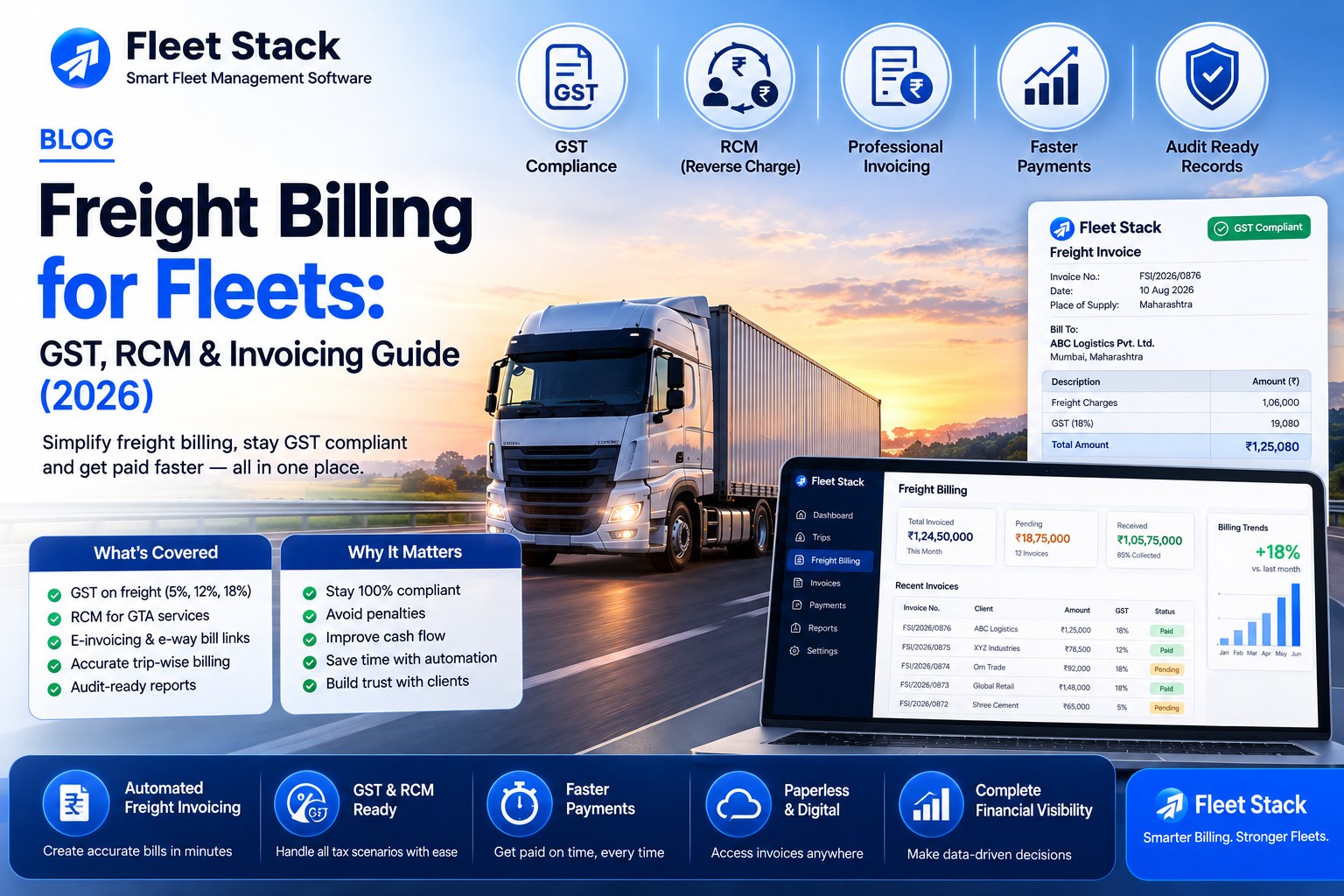
What is Freight Billing?
Freight billing is the procedure used by the transporter/fleet to bill the customer for transporting goods and to properly account for the charges for GST. It converts a completed journey into an invoice: freight value, any other charges (including loading, detention, etc.), the correct GST treatment and then the supporting documents. Freight billing is a little more complex than normal billing because there are different rules of GST for transportation. A goods transport agency or GTA may invoice in forward charge or reverse charge and there are different rates, some goods are exempt. If you get the rate or mechanism wrong, or a compliance risk or a loss of input tax credit is at stake. Good freight billing will ensure that every invoice will be linked to the lorry receipt and e-way bill of the shipment, automatically calculate the correct GST and provide your bill within a short period of time, ensuring timely payments. Clean freight billing for a fleet is a reduced number of disputes, no revenue leakage and compliance with GST per freight.
Last updated: June 2026.
Key takeaways
- Freight billing enables you to complete a trip and generate a GST-compliant freight bill.
- Forward charging (12% or 18% with ITC) of GTA freight is available as well as RCM (5%).
- The most of the GTAs (apart from the following) are operating on the reverse charge basis that is, the person receiving the services will pay the 5% GST.
- Software matches each bill with the LR and e-way bill, and credits the correct rate automatically.
Why FreightBilling is different from NormalBilling?
A transport company is a company that is not engaged in the selling of products. It sells movement. This impacts on the billing.
If you start using generic billing software, the same applies to businesses, that is, item out, invoice, GST on top. For a fleet, all expenses, however, are fuel, tolls, driver batta and maintenance, and all GST rules. Special rates, a reverse charge option and exempt categories are available for freight. It also depends on two papers which most of the businesses don't get in contact with at all such as lorry receipt and e-way bill.
This is why transport software should be created keeping the requirements of freight in mind and not a regular invoicing software.
So, what is the GST value of Freight?
Where most fleets go wrong and here is the simple explanation. For goods moved by road, there are two options for dealing with GST for a GTA.
| Mechanism | GST rate | Who pays |
| Reverse charge (RCM) | 5% | To be paid by the recipient of the services |
| Forward charge | 5% / 12% / 18% with ITC | transporter |
The most frequently used one is reverse charge (RCM). The freight is mentioned on the invoice by the transporter without including any GST and the customer has to pay the 5% GST directly to the Government. The customer can then avail input tax credit for the goods used for business.
Forward charge" is when the GTA pays the GST (with input tax credit) on the invoice and bills the customer at a higher rate, typically 12% or 18%. One of the options is chosen by each GTA and applied accordingly.
Exempted are: (a) food grains or relief materials for disaster relief transported by road by GTA; and (b) milk, Salt, fruits, vegetables. With these, the freight is not liable to GST.
Why is there a GTA and what does it do?
A goods transport agency (GTA) is any business that provides documentation of goods transport (consignment note or bilty) by road transport. There's one thing that decides all, and that is consignment note. A person who transports goods without a consignment note is not a GTA and different GST rules are applied.
This is important for the billing process as the GST treatment is determined by the GTA status. It also makes the freight bill directly equal to the LR (the documentation of the shipment), which also establishes that you are a GTA and that you should be taxed on the bill.
What Should Be on a Freight Invoice?
The transport information must be included in a freight invoice in addition to the needed tax fields. The core parts are:
- The parties. GSTIN of consignor, consignee and their name.
- The shipment. Linked to the LR number and the e-way bill.
- Freight charges. Starting point of the move.
- Extra charges. Charging, discharging, holding and similar.
- Payment terms. To pay or paid after or on account.
- GST treatment. Freight code (HSN 9965), rate and type (forward/backward charge).
Correctly obtaining the rates and HSN code is not only neat and tidy. Cleared Invoices make input tax credit claim and input tax credit justification easier.
Freight Payment Terms – Paid, To-Pay, On Account
There is a payment language for freight billing which fleets need to be clear on all bills.
- Paid: The freight is paid by consignor.
- To pay: to pay for the goods on delivery.
- On account - freight will be charged to a running account and will be paid later.
Disputes over invoices is one of the most frequent problems that arise in road transport invoices; this should be avoided by marking the invoice properly and also on the lorry receipt.
The accurate freight billing depends on the software.
There are programs that can help to ensure freight billing accuracy.
Manual processing of freight bills leaves you continually vulnerable to compliance problems. Someone must always be able to keep track of the correct GST rate, correct mechanism, correct HSN code and the person being billed when. A wrong rate can result in loss of credit or an IRS letter.
Freight billing software eliminates that risk. Applies the correct rate and method of calculation of GST on the service and the client automatically. It appends an HSN code. It associates each invoice with the trip, the LR and the e-way bill, thus the bill is supported by documents. It captures trip expenses such as fuel and toll, allows for accurate billing and knowledge of profit per trip.
Also, FleetStack has a freight billing section which automatically integrates the bills with your trips, LRs, e-way bills and tolls, ensuring that your bills are accurate, speedy and audit-ready.
Frequently Asked Questions
So, what is Freight Billing?It's how you are billing your customers and recording the amount of GST. Produces an invoice for a completed journey including freight, additional costs, appropriate GST treatment and supporting invoices.
What will be the cost of freight including the GST?
The usual rates of GST for freight are 5% (paid by the recipient of the service) or 12% or 18% (charged by the supplier and paid by the recipient). Exemptions apply.
What is the cost of the freight on the reverse side?
Reverse charge or RCM: When the GST is paid by the recipient of the transport service, not the transporter. The GTA's invoice includes freight without the GST, the 5% is paid directly by the customer.
What is the HSN code of goods being sold as freight?
Road goods transport, except by railway, air or water. It is clearly mentioned in the bill and it aids in input tax credit claims.
How freight billing is related to e-way bill and LR?
It should be ensured that lorry receipt and e-way bill are issued for every freight invoice for the load. The LR is used to prove receipt and is used to classify the GTA and the e-way bill is for consignment of over Rs 50,000.
Is it possible to use software to automatically process freight GST?
Yes. The freight billing software automatically determines the billable amount and process based on the service and client, automatically fills the HSN code, relates the bill to the trip as well as documents to eliminate manual errors.
The Bottom Line
Where your fleet's working hours become a revenue stream is freight billing and it's here you either lose or win with GST. There are rules of their own to play by: If the goods are GTA, the usual rule is reverse charge, the exception is forward charge and the exempt goods are to be looked out for.
Written in the hand it is a daily danger of picking the incorrect rate and shedding a credit or notice. Running in the software, every invoice is issued with the right GST, with link to LR and e-way bill, and is sent quickly. In a road freight business, a good cash flow is ensured by accurate freight billing.
Need a document to correctly invoice freight with the inclusion of the GST? Fleetstack integrates your trips, LRs, e-way bills and toll information and connects them to your freight bill, so there are no wrong invoices – even if there are many mistakes in your systems. Try 14 days for free!
Please read: Lorry receipt and bilty guide, E-way bill guide, FASTag and toll management, FleetStack freight billing.
Official reference: GST on Freight as per CGST act is based on the rules prescribed by GTA which include freight HSN code, freight options- forward charge/reverse charge. Rates, options and exemptions are subject to change, please refer to the latest rules of the official GST sources. All of the information provided in this guide is intended for general purposes only and should not be used to provide tax or legal counsel.
0 Comments
No comments yet. Be the first to comment!
Please to post a comment