
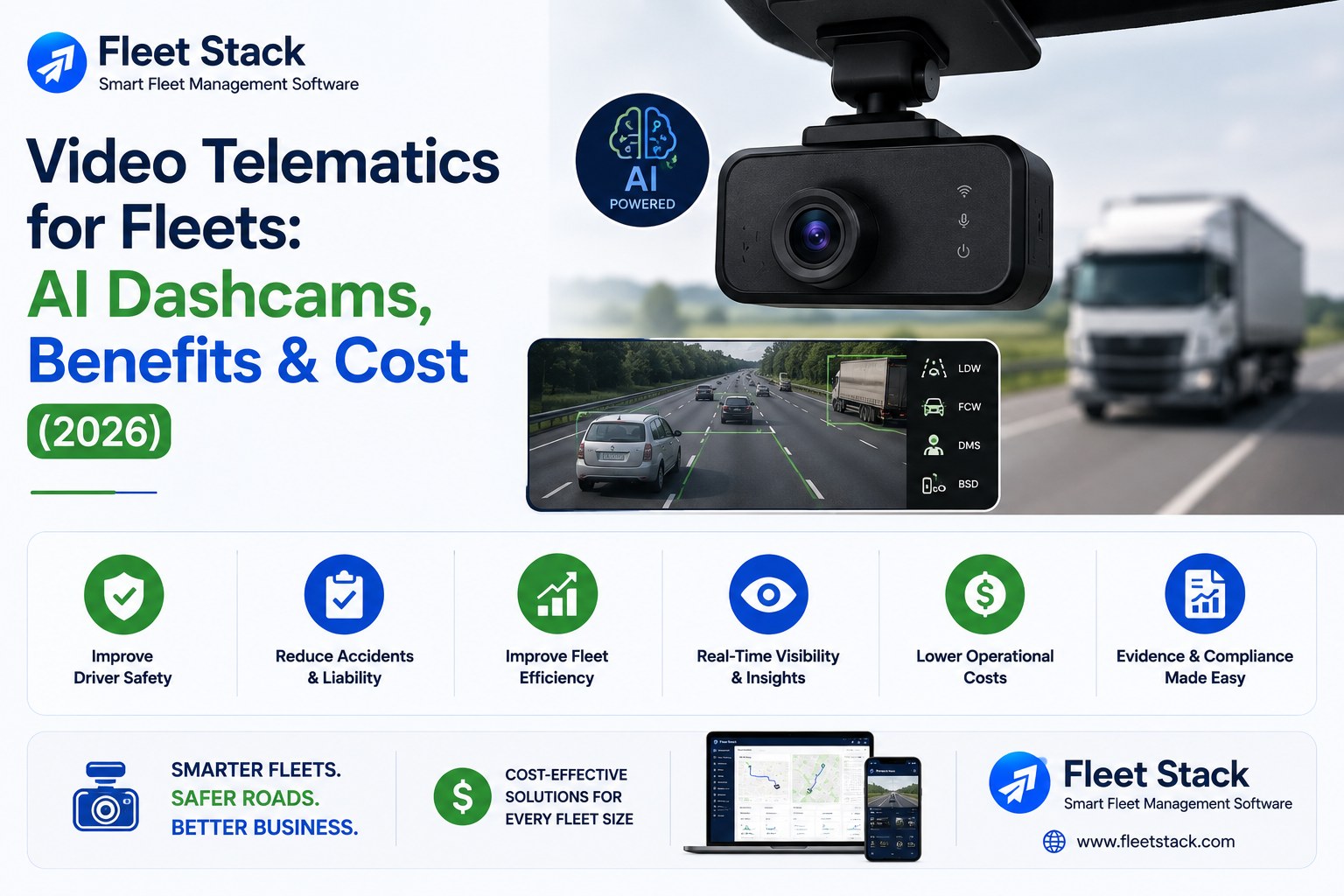
Video telemetrics is a fleet technology that leverages a combination of the vehicle camera, AI video analysis and telematics data to identify driving risks, warn a driver at the time, and provide video evidence for coaching, incident investigation and claims protection for a fleet manager. To put it simply, this transforms a camera into a safety device.
Key takeaways
- Video telematics involves connecting cameras to AI that can interpret the video and alert to risk.
- Unlike simple dashcams, AI dashcams detect and prevent.
- The driver is monitored by DMS and the road is monitored by ADAS. Best results are obtained with the use of both.
- Advantages are reduced accidents and insurance premiums, and proof against bogus claims but not all fleets will see a reduction.
What is Video Telemetrics?
A fleet technology that merges the power of video with AI software and telematics data quality to identify driving risks, alert the driver, and provide video to the manager for claims and coaching. It's not a regular dash cam, it can also interpret what the camera sees.
The simplest dash cam is a video that you can watch after the fact. A video telematics system captures the video in real time, associates each video event to location and speed and alerts the moments that count. The camera is able to point at the road, the driver, or both. This integrates with all your fleet management software and driver management, meaning a camera event is paired with everything else in your fleet.
What is Video Telemetrics?
Video telemetrics is based on taking video, using AI to analyse the footage and warn driver at the time of risk, and then upload it to a manager for review. Today, most of the analysis is done within the camera and the camera is fast enough to warn a driver BEFORE the incident.
An operation is performed in a step-by-step manner:
- The camera takes a picture of the scene. Road facing, driver facing or both.
- AI analyzes the text.
- AI generates a summary of the video. Sends alert for hazards such as tailgating, drifting, distraction, etc.
- It notifies at the moment. If the driver has detected a fault, an in-cab sound or voice alert will alert them immediately.
- Marks the event. The clip is uploaded, location and speed are included and uploaded for review.
- You prepare from authentic video footage. You explain to the driver what had occurred and not generalized instructions.
Edge processing, in which the AI functions in the dashcam itself instead of the cloud, is one of the major developments, says Verizon Connect. This is important because if they uploaded the footage to the cloud before, it would not be fast enough to alert the driver in time. A complete list of the FleetStack video telematics features is available on the FleetStack video telematics page.
The Pros and Cons of Video Telematics vs Traditional Dashcams.
A traditional dashcam is a camera that captures data for later use. A video telematics platform provides AI event detection, real-time driver alerts, location context and a fleet dashboard, all of which help prevent incidents, rather than just capture them. Let's see how the three levels are different.
The capabilities listed are the ones that were available at the time.
| Capability | Traditional Dashcam | AI Dashcam | Video Telematics Platform |
| Memories available (with recording) | Yes | Yes | Yes |
| AI event detection Platform | No | YES | YES |
| The correct spelling of words | No | Yes | Yes |
| GPS / location context | Limited | Some | Yes |
| Size of vehicle fleet (e.g., trucks) | No | Often | Yes |
| I would like to use ADAS (road-facing) | No | Often | Yes |
| Did you use fleet dashboard? | No | Basic | Yes |
| Whether the events were analyzed: | No | Some | Yes |
| Increase the number of driver coaching tools | No | Basic | Yes |
This is the kind of integration needed.
The manual is an assisted evidence and incident review.
It's obvious when you see it. Without any modifications, a basic camera simply tells you what happened. A video telematics platform can help you to stop it and to manage safety throughout the entire fleet.
What is an AI Dashcam?
An AI dashcam is a camera that evaluates the video in real time to identify risky driving, but doesn't just record it. It can also detect an incident such as distraction, drowsy driving, lane change, and so on, and warn the driver immediately, before a problem escalates into a collision.
The difference between a normal dashcam and a proactive dashcam is that of reactive versus proactive. A simple camera records an event, once it has occurred. An AI dash cam helps to prevent it. The biggest change for fleet cameras in 2026 is from record and review to detect and prevent.
AI Dashcams for Driving Risk Detection: How They Function
AI dashcams use computer vision algorithms on the video stream to identify potential risks by comparing the images with patterns of risks they have previously learnt, and then alert the driver. Road-facing AI: monitors traffic and lane position; driver-facing AI: monitors driver.
Some of the typical events that an AI dashcam can identify are:
- On the road: tailgating, lane departure, forward collision risk and pedestrian proximity.
- In the cab: distraction, using the cell phone, drowsy, and no seatbelt.
This analysis is typically performed at the edge, or within the camera, so the driver may only be alerted when it's happening. The system then uploads the flagged clip, the location, and the speed, which a manager can then go back and look at in detail and see what had happened. This seamlessly leads into fleet alerts and AI in fleet management.
But what are ADAS and DMS?
Video telematics is powered by two AI systems: ADAS and DMS. ADAS (Advanced Driver Assistance Systems) are road facing and alert the driver of hazards outside of the car such as lane departure and tail gating. DMS (Driver Monitoring Systems) are driver-facing and are able to identify in-cab behaviours such as distraction, using a phone and fatigue.
| System | Watches what? | Examples |
| ADAS (road-facing) | Pedestrian ahead | Pedestrian Information, Pedestrian Proximity, Forward Collision |
| DMS (driver-facing) | The driver in the rear cab | Distraction/phone use, drowsiness, no seat belt |
What fleet cameras can do, ADAS adds forward collision and lane departure warnings, says Geotab. The best safety programs combine ADAS and DMS—both for the road and for inside the cab.
The advantages of video telematics.
The major advantages of video telematics are reduced crashes, reduced insurance rates, less fraud, and less time reviewing video. Each benefit is determined by your fleet, your baseline safety and your insurance company, as well as the coaching you do.
In short, the advantages:
- Reduced number of accidents, by in-cab alerts to avoid risky moments.
- Reduce insurance costs – many insurance companies will reward video safety programs.
- Evidence and protection, as video can exonerate a driver and refute a false claim.
- Less review time, as AI brings to the fore the events that matter.
- Improved coaching, with actual video, rather than generic comments.
The next two sections discuss the two most frequently asked questions about benefits and accidents and insurance with attribution and caveats.
But is it possible to save lives with video telematics?
Yes, video telematics can help to reduce accidents, primarily because it gives drivers the instant warning to adjust their behaviors when they're doing something risky. The size of the reduction depends on the fleet, and on the extent of the use of the system and should be viewed as a range rather than a guaranteed value.
A 2026 analysis based on data from FleetRabbit revealed that fleets with full AI safety solutions, which featured driver monitoring, road-facing assistance, in-cab alerts, and coaching, reported a significantly reduced number of crashes over an extended period compared to fleets that only had a recording-only dashcam. The important factor for the customers is that the camera doesn't do it all, the reduction is due to detection, in-cab alerts, and consistent coaching. A fleet that has low baseline, and has strong coaching, will improve more than a fleet that is already safe.
Will Video Telematics Save Insurance Money?
Often, yes. Some insurers even now require video data and many offer premium discounts for fleets taking part in video safety programs. The discounts vary between insurers and by location so speak to your own insurer, don't take a number on faith.
Industry reporting for 2026 has average discounts of 15 to 30 percent for fleets that have the advanced video telematics, and a basic camera will not earn as much. In addition to the reduced claims, the insurance saving can also cover a large portion of the system cost. These figures are only rough estimates as the discount varies from insurer to insurer, based on your claims history and camera configuration, so check with your insurer before assuming it's correct.
How Much Does Video Telematics Cost?
The cost of video telematics varies due to the price of the cameras, software subscription, connectivity, storage and support. It's not a set price; it's more of a cost driver that you can understand, and then get a quote from your fleet.
The most significant cost factors are:
- Cameras and hardware. 1 per vehicle (either road facing or dual road and driver facing).
- Installation. Simple for plug units, more for hardwired dual cam.
- Connectivity. A SIM / data plan as flagged clips are uploaded via mobiles.
- Software subscription. The platform and the dashboard plus the analytics, typically per vehicle.
- Video storage. Flagged events stored in the cloud and the amount of time clips are stored.
- AI processing. Edge processing within the camera, cloud analysis or both.
- Integrations and support. Access to all of your other fleet tools as well as onboarding and support.
The higher it captures, the longer it stores and the more AI it runs, the more expensive it is. When comparing quotes be sure that they are all the same cameras, length of storage time and any features, as a low headline may represent a lower package.
If you're not sure how to determine video telematics ROI, use this method:
Video telematics ROI is derived by taking the annual benefits (primarily, benefits in reducing accidents and claims, insurance savings, and time saved reviewing footage) and subtracting the annual system cost and dividing that number by the annual system cost. This is dependent on the history of accidents and insurance coverage of the fleet.
A simple framework:
ROI = (Accident/claim savings + insurance savings + review time savings + claims protection − annual system cost) / annual system cost × 100
One of the most significant will typically be avoided accidents as one serious commercial vehicle accident can cost a lot of money. A fleet that has been proven to have at-fault crashes and expensive premiums has much more to gain than a fleet that is already safe and inexpensive to insure. As such, make sure you're basing your expectation of what you'll receive from your actual accident and insurance coverage, and not a headline expectation. Any number that is worked out should be considered as an assumption until tested with your data.
Is there privacy or is it privacy that is invaded?
Video telematics doesn't need to intrude on privacy, but it poses a legitimate governance question for fleets to tackle. Clear policies on when a camera is capturing footage, who will have access to the footage, and how long the footage will be retained are among the clear policies that need to be shared with drivers, especially with respect to drivers' facing cameras.
There are a number of points to consider to practice good practice. Event triggered recording: Many fleets use this type of recording, and the driver facing camera records clips of a safety event instead of the entire shift. Footage should be accessed only by named roles and kept for period of time deemed necessary. The goal should be to protect and coach, rather than punish, as video also exonerates drivers in not-at-fault accidents. And drivers need to be made clear on the cameras and why they are installed. Privacy legislation differs between countries or regions, so please check your regulations in your own country or region, and not by assumption. Video telematics is always accepted by drivers when viewed as a governance and communication tool but opposed when viewed as covert monitoring.
Who's the best customer for video telematics?
Video telematics is most beneficial to fleets that are exposed to the road a lot, have high liability to claims, or have passenger safety responsibilities. This includes trucking, delivery and logistics, or passenger or school transportation, and even any fleet with claims that have been disputed or an increase in insurance costs.
While the technology is suitable for many fleets, mid-size fleets (between about 50 and 1,000 vehicles) have been the leading adopters of the technology in 2026. What they all have in common is that the expense of an injurious event is significant enough to warrant the expense and effort of prevention and documentation.
Selecting the right video telematics system for your needs.
Select a video telematics system that aligns with the capabilities of detection, camera configuration, processing and privacy controls to address your fleet's risks and test if it can be integrated with existing tools. An ideal system for a fleet is the one that matches the fleet's greatest safety concerns.
Here are some of the questions you should ask before you buy a car:
- Detection. On road and in the cab does it address the risks you are concerned with?
- Camera configuration. Dedicated driver-facing or dual-facing with driver monitoring system?
- Real-time alerts. Does it alert driver at the time, or merely record the incident?
- Edge processing or cloud processing. Edge is faster at in-cab alerts, cloud provides context.
- Integrations. Is it integrated with your tracking, driver and alert systems?
- Dashboard usability. Do your team members have to review events in a timely fashion?
- Privacy controls. Access, retention and event triggered recording.
- Storage and support. Clips retained for how long; support provided.
Work from the most significant risk. If there is a fatigue problem, it's an indication of strong driver monitoring; if there is a tailgating problem, it's an indication of good ADAS.
Why FleetStack for Video Telematics
Video telematics is part of the FleetStack platform, meaning that camera events are not in a separate tool to track, but alongside your tracking, driver, and alert data. The connection is the key: When a flagged clip is added to the vehicle, its location, speed, and driver score accompany it, speeding up coaching and incident review.
Being self-hosted, FleetStack can be run on your own infrastructure which is useful for the privacy governance mentioned above, as you have control over where video data is stored and who has access to it. Before relying on these, check the exact camera support, storage and detection features against the current product information of the FleetStack.
Frequently Asked Questions
What is Video Telematics?
Video telematics, which integrates cameras, AI video analysis, and telematics data, is a fleet technology designed to identify driving risk, notify drivers and provide video evidence for coaching, incident investigation and claims protection for fleet managers.
How does video telematics work?
The camera records the road and driver, the AI compares the footage to a risk library, the driver is alerted in cab and marked footage is uploaded with location and speed for a coach to analyze and coach the driver.
So, what is an AI dashcam then?
An AI dashcam can monitor the video and send alerts to the driver on the spot, when they start to drive in a risky manner, such as being distracted or tailgating.
How an AI dash cam differs from a standard dash cam?
A standard dashcam is only able to capture video for post-incident review. An AI dashcam is able to recognize the video in real-time and alerts the driver when a risk is detected, potentially stopping an incident from occurring.
What is meant by ADAS and DMS?
Road facing – ADAS (Advanced Driver Assistance Systems): alert the driver of hazards such as a lane change or following too closely. DMS (Driver Monitoring Systems) are driver focused and designed to identify distraction, phone usage and fatigue.
Is it possible for video telematics to prevent accidents?
It can help. In-cab warnings help drivers make corrections when unsafe practices are occurring. Full systems (cameras and coaching) have shown statistically that they can achieve greater crash reductions than cameras alone, but this varies by fleet.
Is the use of video telematics a cost saver?
Often. Many insurance companies will provide discounts on advanced video programs, which range from 15-30 percent — and some companies are now requesting video data. Check with your insurance company, to ensure the discount is the same.
What is the price of Video based Telematics?
No fixed price. The pricing for the cost depends on the cameras, installation, connectivity, software subscription, storage space, AI processing, support, etc. Get the same cameras, storage time and features quotes.
Is an AI dashcam based on edge or cloud computing?
Many opt to incorporate edge processing, which means that the AI functions inside the camera, and is quick enough to alert the driver in the moment. Cloud analysis is also used for some to provide context for an event after the fact.
Does an AI dashcam have the ability to identify distracted driving and driver fatigue?
Yes. A Driver Monitoring System includes Driver-facing AI which can identify driver distraction, phone use, and drowsiness, and send an in-cab alert.
How long should videos in a fleet be kept and who should be able to view them?
No rules – keep clips as long as necessary for coaching, claims and compliance and restrict access to named roles. Check retention and privacy requirements for your area.
But does video telematics infringe on driver privacy?
Need not be. The use of event triggered recording, limited access, clear retention rules and open communication with drivers, as protection and coaching, are generally acceptable.
The Bottom Line
Video telematics makes video cameras into safety systems. AI transcribes the video, alerts the driver of danger at the moment and provides you with real videos and evidence to coach. The shift in 2026 will be from 'post-collision' cameras to 'pre-collision' systems, which will help to prevent the crash in the first place.
The benefits are tangible but not guaranteed – reduced accidents, lower insurance costs and a defence against bogus claims – depending on your fleet, your coaching, and your set-up. Video telematics is one of the higher return safety tools a fleet can add when the video is used openly as a tool for protection and coaching, not surveillance and if matched with the largest risk, it can be beneficial.
Looking to get video safety in your fleet? FleetStack video telemetrics integrates AI dashcams, tracking, driver and alert data in a single self-hosted platform, and is available for a free trial.
Source: Verizon Connect 2026 Fleet Technology Trends Report (edge processing, role of ADAS and DMS, driver-safety findings); Geotab video telematics guidance 2026 (ADAS forward collision, lane departure); FleetRabbit 2026 AI dashcam analysis (crash-reduction comparison between full AI systems and recording-only cameras); 2026 industry reporting on insurance discounts. All values are listed as ranges and depend on the fleet, insurance carrier, region, camera setup and coaching.
0 Comments
No comments yet. Be the first to comment!
Please to post a comment