
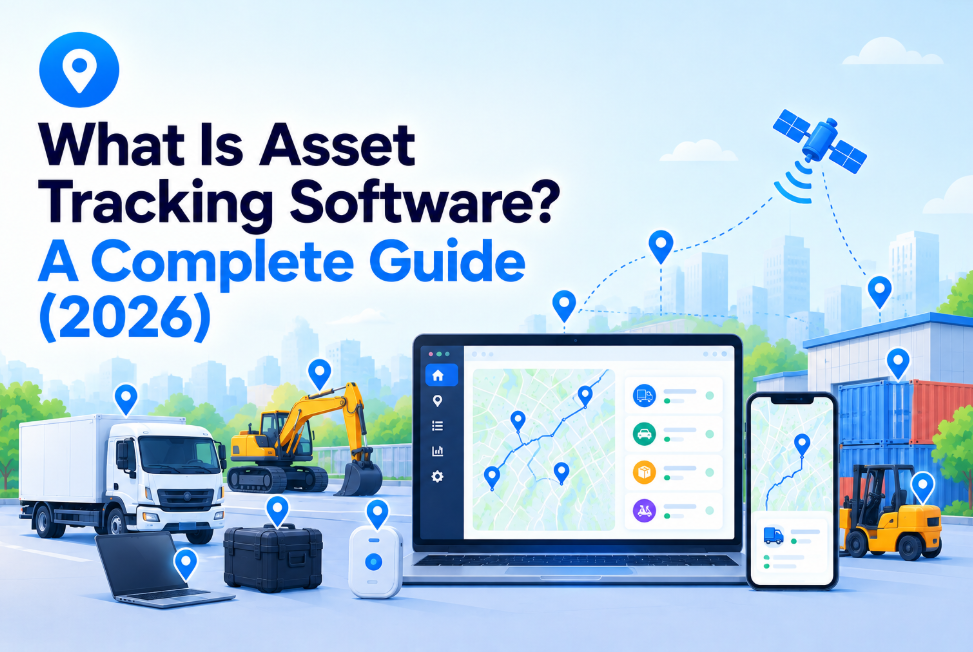
Asset tracking software is a system that keeps track of where a business asset is located, its status, and how it is being used, ranging from vehicles and trailers to tools and equipment, containers, and IT equipment. It gathers information from tags or devices which are attached to every asset and displays this information in one place, allowing a team to see what assets they own, where they are, what condition they are in and whether they are being used, all by technologies like GPS, RFID, barcode, QR codes, or Bluetooth.
At a Glance
| Question | Quick answer |
| What is asset tracking software? | A system that records where physical assets are, their condition, and how they are used, in one place |
| What assets can it track? | Vehicles, trailers, tools, machinery, containers, equipment, and IT hardware, powered or not |
| What technologies does it use? | GPS, RFID, barcodes and QR codes, Bluetooth (BLE), and wireless networks such as Wi-Fi and LoRa |
| How is it different from fleet tracking? | Fleet tracking is asset tracking focused on vehicles; asset tracking also covers non-vehicle and non-powered items |
| What are the main benefits? | Fewer lost or stolen assets, better utilisation, simpler audits, and planned maintenance |
| Does every asset need GPS? | No. GPS suits mobile outdoor assets; indoor or low-cost items often use RFID, barcodes, or BLE |
| Who uses it? | Logistics, construction, healthcare, manufacturing, rental, utilities, and IT teams |
What is an Asset Tracking Software?
Asset tracking software refers to the systematic process of tracking the location, status and use of physical assets in a single system which can be read and responded to by a team. Anything that costs money and is of value to a business that must be accounted for is an asset: A delivery van, a shipping container, a generator, a set of power tools, a hospital infusion pump or a laptop. The software's task is to respond at any time to four questions regarding any one – what, where, what state, and is it being used.
It does this by linking a tag or device onto the asset to a central platform. The tag reports or is scanned, and the platform logs the reading with the corresponding asset and people see it as a list, map or dashboard. The key element is visibility. Having everything in view enables a business to recuperate or mark down the assets that are lost, to relocate your idle equipment where it is required, and to spend less time looking for stuff.
What is Asset Tracking Software able to track?
Everything can be tracked, from powered vehicles and machinery, to non-powered trailers and containers, portable tools and test instruments, down to fixed machinery, medical tools and IT hardware like laptops. The right approach will depend on whether the asset is mobile, possessive power, and the value of the item (which is further explained below by asset type in the decision matrix.
This is the difference between asset tracking and vehicle tracking, and is quite broad. A vehicle is only one type of asset, so vehicle or fleet tracking can be considered as asset tracking for vehicles. The rest of what a business owns is also included with asset tracking software.
What Technologies is Asset Tracking Utilizing?
There is no single asset tracking technology! Each will provide different answers to the questions of range, cost, and live or scanned tracking and many systems give a mix of all this. The main options are set out below.
| Technology | How it locates | Best for | Live or scanned |
| GPS | Satellite position, reported over cellular or satellite | Mobile assets outdoors: vehicles, trailers, containers | Live |
| Active RFID | Battery-powered tag read by nearby readers | Higher-value assets over a wider indoor range | Scanned (automatic nearby) |
| Passive RFID | Tag powered by the reader's signal, short range | Fast bulk reading of many items, such as a store or warehouse | Scanned |
| Barcode / QR code | Scanned by a phone or handheld scanner | Low-cost tracking of tools and stock | Scanned (manual) |
| Bluetooth (BLE) | Low-energy beacon read by gateways or phones | Indoor location and proximity at low cost | Live within range |
| Wi-Fi / LoRa / other wireless | Position from fixed network points | Indoor sites or areas without GPS or cellular | Varies |
The distinction between the two is in the way the asset communicates, with live tracking involving an asset constantly reporting its location, such as GPS or BLE tags being in range, and scan-based tracking requiring both the asset to be scanned and updated with its location, as with barcodes or passive RFID tags. Live tracking gives answer to "where is it right now" while scanning-based tracking gives answer to "where was it last seen, and who has it. They are both Asset tracking, it's just suits different assets and budgets.
What tracking technology to employ for each asset?
It depends on the answers to a few questions regarding the asset: Does the asset move? Does the asset have its own power? How fresh does the asset be location need to be? How cost sensitive is the asset? The table below shows a correlation between the common types of assets and the factors. Consider it a starting point as real performance will depend on the hardware and site.
| Asset type | Moves? | Power on asset | Location freshness needed | Typical fit | Main trade-off |
| Delivery vehicle | Yes, outdoors | Yes | Live | GPS telematics | Needs cellular or satellite coverage |
| Trailer or container (unpowered) | Yes, outdoors | No | Live to periodic | Battery or solar GPS tracker | Battery life limits reporting frequency |
| Power tools, test instruments | Occasionally | No | On check-out or scan | Barcode / QR or BLE tag | Barcode updates only when scanned |
| Warehouse stock and small items | Rarely | No | On scan | Passive RFID or barcode | Short read range, needs readers or scanners |
| Fixed machinery, medical devices | No | Usually | Status, not location | Barcode / QR plus an asset register | Location is fixed, so value is in condition and audit |
| Laptops and IT hardware | Yes, mixed | Yes | On assignment / audit | Asset register with barcode or software agent | Off-network devices are hard to locate live |
Three brief illustrations of this are given. These are examples, not for any particular Fleet Stack deployment.
Outdoor, unpowered trailer fits with battery or solar GPS tracker. Since the battery is the limiting factor, you may want to use it to monitor motion instead of per second.
The hand tools in a warehouse are typically not expensive and are not used outside the building, thus a barcode or QR code scan at check out or passive RFID reading for bulk reading is typically the better option than having GPS on every hand tool.
Powered and mobile (outside use) fleet van is powered by a GPS telematics unit which provides live location and vehicle data (speed, trips). This is the case covered by GPS fleet tracking.
What is the working of asset tracking software?
An asset tracking system is a system that connects a tag of an asset with software that people can use. There are four parts to the flow.
- Tag or device. Every asset is equipped with a GPS, RFID tag, a barcode/QR tag or a bluetooth beacon depending on the asset and its context.
- Capture. The device reports automatically via a network or a tag reader or person scans it. This is where the difference between live and scan systems lies.
- Platform. Readings are delivered to a central system (cloud or self-hosted) which is uniquely linked to the asset, timestamped and stored. The platform hosts the asset register, with details of who is the owner of the asset, what it is and its history.
- People. Teams can view assets on a map, a list, or a dashboard, set assets to alert and generate a report for auditing, maintenance or billing.
The platform is the piece that brings isolated readings together and makes them a picture; this is the piece that makes "ok, it is this way" come true. It is also the place where asset tracking integrates with the rest of a business, providing data on location and condition to maintenance, finance and operations systems.
Why is Asset Tracking Software a Benefit?
The utility of asset tracking comes to the point that it removes the element of guesswork and manual spreadsheets, and provides a live and searchable record of business's assets and their location.
- Fewer lost and stolen assets. If all the assets are tagged and visible, the assets are less likely to be lost and if they are lost, they can be found or marked.
- Better utilisation. It is easier to see what assets are being used and what are not to avoid overbuying and help a business move assets to where they are needed.
- Fewer audit and compliance hassles. If you have a current asset register, stock takes, financial audits and compliance records will take less time than counting by hand as you are able to view the asset register and see what you have.
- Planned maintenance. When usage and condition data are tied to each asset, it is possible to maintain them on time, instead of on a breakdown basis.
- Accurate records and billing. The knowledge of what, where and for how long, helps in billing and settlement resolution.
What Is The Difference Between Asset Tracking & Fleet Tracking?
The two are interrelated, and the easiest way to understand the connection, fleet tracking is a subset of asset tracking.
| Fleet / vehicle tracking | Asset tracking | |
| What it tracks | Powered vehicles | Any physical asset, powered or not |
| Main technology | GPS and telematics | GPS, RFID, barcodes, BLE, and more |
| Typical data | Location, speed, trips, fuel, driver | Location, status, usage, ownership, condition |
| Primary question | Where is the vehicle and how is it driven | What do we own, where is it, and is it used |
The functionality depth of fleet tracking is deeper than that of a tag on a toolbox: speed, routes, fuel and driver behaviour. The trailers, equipment, and tools in the fleet are also tracked, and so is the trail. Many operations execute both and the latter is becoming the new trend in managing both operations. The fleet telematics guide and the GPS tracking page elaborate on this in more detail for the vehicle side.
This can be likened to Asset tracking versus Asset Management versus Inventory Management.
Often confused, these three terms are answers to different questions and can be more than one for a business.
Asset tracking is used to answer the questions "Where is this asset and what is the state of the asset. It is related to where, how and when individual, reusable resources are available.
The scope of the asset management is wider. It spans the entire asset's life cycle, from value to depreciation to maintenance history to asset disposal. One of the inputs to asset management is tracking.
Inventory Management is the process of counting the inventory that is purchased, sold or used, like parts, raw materials, finished goods etc. It is not about a certain item over the years, it is about quantities and reorder levels.
The distinction is between re-useable and consumable: If you follow a particular generator and/or laptop as an asset, you treat boxes of spare parts as inventory. You do not need to purchase an incorrect type of system because you know which problem you're trying to solve.
Here's what you should look for in asset tracking software.
As there are so many different types of assets to track, the type of software you use depends on the type of assets and their location. You might want to go through these practical questions before making a selection.
- Is it a "good fit" for you and your property? Correlate GPS, RFID, barcode or BLE with the movement of assets, asset power, indoor/outdoor location and live or scanned updates. A stockroom isn't the best place for the best tool.
- Is the site recently built and does it require any improvements? Consider whether to use second-by-second position or last-seen data record and verify the connectivity the system relies on – indoor or remote sites might not have GPS or cell coverage.
- How long is the battery or service life? Reporting frequency and battery life or solar life for unpowered assets is a direct trade-off and is suitable for your use depending on your requirements.
- Is the hardware compatible? Make sure that the platform is compatible with the trackers and tags you use or are using and not requiring you to use only one particular provider. This includes Fleet Stack's supported devices list and support for external devices; check what type of tags are supported for your assets.
- Alerts and reporting and integration. What makes the register more than a passive registration are the movement, geofence and status alerts features and the fact that it can be exported to reports and then moved to maintenance or ERP systems is more relevant than a long list of features.
- Access control, data hosting. Look at who has access to see and edit records, and if the platform is hosted on a third party's cloud or in infrastructure you don't control, it's important when it comes to compliance-related or sensitive assets.
- Cost of ownership. Consider what is included in the hardware along with connectivity, per-asset fees and battery/tag replacement costs over time.
FAQs
So, what is asset tracking software in simple terms?
It's a tool that provides a real-time record of what a business owns, where and how – including whether it's being used or not – so nothing is lost or forgotten, such as vehicles, tools and equipment.
What's the difference between asset tracking and inventory management?
Asset tracking follows assets, each of which is reusable, over their lifetime – like the same generator you own and use on each job. Inventory management involves counting items that are purchased, sold or used, such as the fuel filters or spare parts that are used up. Some systems can do both; however, the answers to the questions are different.
Is GPS tracking always done on assets?
No, GPS is asset that can be accessed from satellite, and it moves out of the door. Instead, RFID, bar codes, QR codes or Bluetooth are sometimes used to track indoor assets, as well as low cost tools and bulk items, where GPS is not applicable or has higher costs.
What's the difference between asset tracking and fleet tracking?
Fleet tracking is an asset tracking solution that includes additional information such as driver behaviour, speed and fuel. Asset tracking extends to other assets besides vehicles and powered assets like trailers, tools and equipment.
What industries can benefit from asset tracking software?
It is used throughout logistics and transport, construction, health-care, manufacturing, equipment rentals, utilities and IT departments to track high value or easily lost items.
What is the difference between “passive” RFID and “active” RFID?
An active RFID tag is battery powered and can be read at a greater distance, appropriate for higher value assets. A passive tag does not have a battery in it and is used when the reader sends out a signal at close range, making it ideal for reading many tags at once at a rapid pace and for a low cost.
So what is the difference between GPS and RFID asset tracking?
Use GPS when the asset needs to be tracked in realtime on a map, as it moves outdoors – e.g. a trailer or container. Consider RFID if the asset is not going to move and the primary use is to verify the presence or to check items in or out, e.g., tools or stock. Many operations employ both, for different types of assets.
Is Asset tracking possible without an internet connection?
Partly. Methods such as barcodes and RFID can capture data when it's not being received online on a handheld device, and then sync up later; some GPS trackers can store readings when they're not being received and upload them later when the signal comes back. Live, real-time tracking does require a continual network connection to report live positions as they occur.
Are both vehicles and other assets trackable on a single platform?
Frequently, if the platform is able to support the types of devices and tags that each asset requires. One system can track GPS-equipped vehicles as well as trailers, equipment, and tools on other technologies, avoiding the need to run multiple systems – but make sure it supports the tags and workflows you might use for non-vehicle assets or you could be in trouble.
What are the costs of asset tracking software?
There is no single number as the cost varies based on the tracking technology, the number of assets, (per asset or a per licence basis), the hardware, connectivity and hosting. To compare options will be practical judging on total cost of ownership not just the headline price; software, devices, any SIM/Network charges and the ongoing replacement of batteries or tags.
The ability to track your assets is part of Your Fleet Platform.
Fleet Stack is a self-hosted GPS tracking and a fleet ERP platform. That includes live GPS tracking, geofencing, and alerts for the many assets tracked by GPS, including your vehicles, GPS-equipped trailers and equipment – all in one place, but on infrastructure that you control, and not a third-party cloud. If you are using non-GPS tags (RFID, BLE or bar code) verify what Fleet Stack will support prior to planning. Check the supported devices list to see which trackers are suitable for your assets, and how external devices can be supported, or learn how asset tracking works within a full fleet management platform.
0 Comments
No comments yet. Be the first to comment!
Please to post a comment