
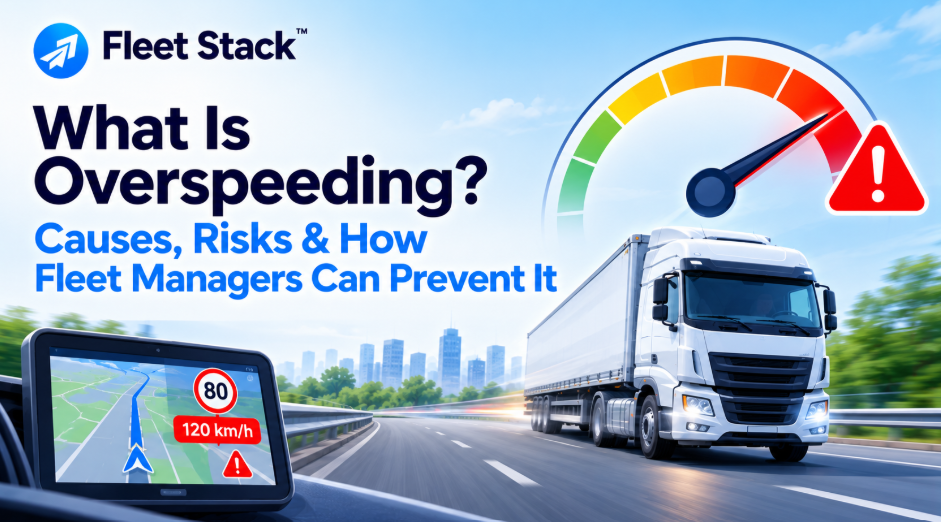
Overspeeding is operating a vehicle at a speed that is greater than the speed limit or at a speed faster than is reasonable on the highway and under the conditions. Overspeeding is a serious driver habit in fleet that can contribute to an increase of the risk of accidents, fuel usage, vehicle wear and operating expenses. The magnitude of the risk is well established: In India, overspeeding was found to be the cause of 71.2 percent of all road-accident fatalities in 2026, per the Ministry of Road Transport and Highways (MoRTH). When there are multiple vehicles in the fleet, speeding is a measurable safety and cost issue instead of a driver issue. It is also one of the most trackable behaviours: GPS tracking and fleet telematics can alert managers to speeding events, monitor driver behaviour and take corrective action by alerting drivers and coaching them. This guide provides some clarity on what overspeeding is, why it poses a risk and expense to fleets and how it can be limited using GPS tracking.
At a Glance
| Question | Quick answer |
| What is overspeeding? | Driving above the posted speed limit, or too fast for the road and conditions |
| Why is it dangerous? | It lengthens stopping distance and increases crash severity, leaving less time to react |
| What does it cost a fleet? | Higher fuel use, more wear, possible fines, and potential insurance and liability exposure |
| How is it detected? | GPS and telematics compare a vehicle's speed against a threshold or mapped limit and flag breaches |
| How do fleets prevent it? | Speed alerts, driver coaching, scorecards, realistic scheduling, and a clear policy |
| Is a bit of speeding harmless? | No; small, frequent speeding across a fleet adds up to real risk and cost |
Key Takeaways
- Overspeeding" refers to driving at a speed above the posted speed limit or for the conditions. This involves exceeding the speed limit and going too fast when it is raining, cars are on the road or a corner is sharp, even if the speed limit is complied with.
- Speed multiplies danger. As speed increases, the distance required to stop increases, and the effect of any accident will be more severe because speed increases the amount of energy involved in an accident at an accelerating rate.
- It is costly for fleets in several ways. Fines, insurance costs and liability exposure may be impacted depending on circumstances and local law, fuel usage and wear increase with speeding and it can be dangerous.
- It is highly measurable. Among high-risk behaviors, posted-limit speeding is easy to monitor: Using telematics, the GPS speed of each vehicle is compared to a speed limit or mapped limit and violations are logged.
- Prevention is not a slogan, it's a system. Combined with the implementation of a speed policy, real-time alerts, driver scorecards, coaching, realistic scheduling, and a speed policy all help to reduce speeding.
What Is Overspeeding? Meaning and Definition
Overspeeding, or speeding, is driving a vehicle at a speed that exceeds its designed speed. There are two meanings to overspeeding in driving and both are important for fleet safety.
The first is going over the speed in which you're driving: "driving above the legal speed for the road. The second is often overlooked: speeding up for the conditions – at or even below the speed limit, but still too fast in heavy rain, fog, heavy traffic, tight corner, loaded vehicle etc. A driver is travelling in a 100 km/h zone and is doing 90 km/h would be within the limit but they might be driving unsafely if the road is wet and busy.
For a fleet, it's the same: Both are dangerous, but not equivalent in terms of measurability. A posted speed limit is often be observed by comparing a posted speed limit with the GPS speed on a particular road. The reason why training is as important as technology is that it is the driver's judgement that would determine the safety of a speed in a given situation—one that is influenced by weather, traffic, and the road itself.
What are the reasons fleet drivers over speed?
Knowing the cause aids in repairing the issue and not only punishing it. Common reasons include:
- Time pressure. Drivers are pressed for time and busy schedules and are tempted to speed up to catch up.
- Habit and comfort. Some drivers will get into the habit of speeding because that's what it's just like for them.
- Not knowing the limit. Limits, new roads and changes in the road can cause drivers to speed without realising.
- No sense of being monitored. The force to respect the limits becomes less if drivers think nobody is monitoring them.
- Traffic flow. Frequently, drivers increase their speed to match the other cars on the road, even if that speed is excessive.
Most of these causes are more responsive to normal scheduling and accurate information and monitoring than to warnings that are issued just once, which is why prevention is best provided in a system.
Why Overspeeding is Dangerous?
Speeding is the most concerning behaviour for fleets because the impacts have been demonstrated and are significant.
The dangers are a matter of basic physics. The higher the speed of a vehicle, the more distance it will cover before the driver can react and brake to stop it, resulting in less time to react to a hazard. While speed does not affect reaction time, it does shorten reaction time by the ground and distance travelled, that is, the vehicle is travelling at speed. If a crash occurs, the faster the speed the more energy that is involved, the more injuries and damage.
This is reflected in the data. According to MoRTH's "Road Accidents in India 2026", overspeeding is the top cause of death in road accidents, accounting for 71.2 percent of all fatalities in the country. It includes all road users, not just fleets and is a key reason why speed is the most critical driver-behaviour risk, and why speed reduction per fleet is significant.
What is the connection between speeding and the cost of running a fleet?
In addition to safety, speeding costs the business:
- Fuel. Increasing a fleet's speed, particularly increasing speed to such an extent and rapidly, increases fuel use – one of the biggest expenses of running a fleet. Speed management goes hand-in-hand with eco driving.
- Wear and maintenance. The increased speed and subsequent harder braking accelerates tyre, brake and drivetrain wear.
- Fines and penalties. The fines and administrative time for speed tickets are a cost, and if the speeding tickets occur more than once, it could have consequences on the driver's licence and the operator's standing, depending on local law.
- Insurance and liability. Fleet speeding can also impact insurance premiums and if a speeding fleet vehicle is involved in an accident, the company could become liable, depending on the circumstances, and the law in the jurisdictions involved.
Speed typically is one of the most important considerations in almost any driver safety scorecard, due to the high risk and cost.
How is GPS tracking able to monitor overspeeding?
One of the more measurable riskiest behaviours is posted-limit speeding which is why it is manageable in fleet.
Each vehicle is fitted with a GPS system that sends reports to the recorder of its location and speed at regular intervals. Fleet software then compares that speed to a reference—typically in one of two ways:
- Against a fixed threshold. The easiest way is to activate a flag whenever the car reaches a speed over a certain limit, e.g. 100 km per hour on any road.
- Against the road's speed limit. In some systems the vehicle's GPS speed is compared to data about speed limits in the map for the road that the vehicle is on, and the infraction is determined based on the road's speed limit. This is dependent on map coverage and data quality, configuration and the capability of the product and is not available for all roads and not all systems.
There are two points to note about the data which are important for interpreting it fairly. Firstly, the accuracy of GPS speed may be limited, so events should be interpreted within reasonable bounds and with common sense in mind, and with the assumption that not every speed reading is accurate. Second, this type of detection detects posted limit violations, not whether a speed is safe for rain, fog, traffic or a bend – something only software can't provide.
Once a breach is identified, the software can generate an alert that is displayed in real time and the manager will know what it is, and will also record it for future reference. These logs feed coaching and scorecards, and create each driver's speeding record over time. Speed monitoring is just one facet of driver behaviour monitoring system that also includes harsh braking, quick acceleration and cornering. In addition, speed rules can be used in conjunction with geofencing to restrict speeds in certain areas like depot, school, or worksites even more.
What can fleet managers do to avoid overspeeding?
It's not helpful to be able to identify speeders unless it means they drive slower. The key to success with fleets includes seeing prevention as a multi-part system:
1. Establish a speed limit. State what is expected (this includes below the limit driving due to conditions, and ensure this is understood by all drivers).
2. Set up real time speed notifications. Immediate feedback to the driver (where possible) and to the manager, prevents a one-off lapse from becoming a habit.
3. Track trends using scorecards. A speeding history per driver is more effective than reacting to individual speeding events, to identify who needs support and to assess the effectiveness of coaching.
Do not "catch" Coaches. Address data collected in discussions to enhance, not just punish, driver behavior. Monitoring as a safety tool obtains more cooperation than if monitoring were only used to punish.
5. Address the root causes. The schedule will become the problem if it requires drivers to drive faster than is necessary to meet delivery windows. With realistic planning, the pressure to rush is eliminated right from the get go.
6. Reward good driving. Rewarding consistently safe drivers strengthens the safe driving behaviour throughout the fleet.
These combined collectively into a true speeding reduction. In our guide to fleet driver management, you'll learn more about speed management as part of the general monitoring and improving the fleet's driving practice.
How Fleet Managers Can Look At Overspeeding Data
This is just the beginning of the task. The true benefit is to look through the fleet speed data and identify trends and determine where to intervene. Review dimensions that are useful include:
- Event frequency. Frequency of speeding, by vehicle or driver, to determine whether speeding is a common problem or is committed by only a few repeat offenders.
- Event duration. If it's short bursts or longer duration – a longer duration is more of an issue than a short burst.
- Vehicle-wise patterns. What vehicles are seeing the most violations - can be a clue to specific routes, roles or even vehicle configuration.
- Driver-wise patterns. Identifying those drivers that speed up the most so that coaching can be directed where it will make the most difference.
- The direction and pattern of routes and locations. If there are speeding clusters (time of day or a specific road or route) that could warrant route/scheduling adjustments, not driver coaching.
- Coaching follow-up. Whether a driver's record improves after a coaching conversation, which will indicate if the approach is working.
This can be easily visualised as a summary a manager may look at per driver:
| Driver (illustrative) | Overspeed events (30 days) | Longest single event | Trend vs last month |
| Driver A | 3 | 40 seconds | Improving |
| Driver B | 18 | 6 minutes | Needs coaching |
| Driver C | 7 | 1 minute | Steady |
The numbers shown above are meant to be illustrative of the type of view a manager would have. These are not genuine FleetStack customer data and are not a true driver/ deployment. The exact measurements that are available will depend upon what it records or can be calculated.
FAQs
What is overspeeding?
Overspeeding occurs when a person is driving a vehicle at a speed higher than the speed limit, or at a speed that is above what is safe for the road and weather conditions. When used in a fleet, it typically refers to a driver speeds above their own speed limit or above the limit of the road being driven on, and also to driving above the speed limit for rain, traffic or a sharp bend even if the driver is operating within the speed limits.
What does the term “overspeed” mean in driving?
Overspeeding in driving is defined as driving at an unsafe or illegal speed. This includes two instances: exceeding the legal speed limit for the road, and driving too fast for the road conditions even if within the speed limit. Both are dangerous with regard to a car accident and that's why both Road-safety and Fleet-safety programmes take speed seriously.
What are the risks of speeding?
Speed contributes to the likelihood and the impact of a collision. A faster car translates to more distance to travel before the driver sees the hazard, requires more distance to stop and leaves less room to avoid it and, if a crash does occur, releases more energy that can result in more severe injuries. According to the Ministry of Road Transport and Highways, 71.2 percent of the fatalities in India's road accidents in 2026 were caused by overspeeding in the country.
So, what are the primary reasons for overspeeding?
Common causes are time pressure due to riding too quickly or having tight schedules, habit, not knowing or noticing the speed limit, believing that no one is checking, and following the speed of traffic. One of the most common reasons in fleets is unrealistic delivery timeframes which is why schedule correction will often have a greater impact on speeding than warnings alone.
What is the method that GPS tracking uses to determine if a vehicle is speeding?
The GPS tracker collects the speed of each vehicle at regular intervals and the fleet software compares the collected speed to a reference: a fixed speed limit set by the operator, or, if available, the speed limit of the road itself. If the vehicle goes over it, it is recorded in the software and can be sent as an alert. The accuracy limits of GPS readings may apply and therefore events should be determined based on sensible thresholds and good data quality.
How to stop fleet drivers from going too fast?
Treat it as a system: establish a speed policy, install speed cameras, record the speed history of each driver on a scorecard, use the scorecard data to coach drivers only for speeding, and adjust schedules that encourage drivers to speed. Being alert of consistently safe drivers also helps. Warning levels, coaching and realistic planning are highly effective in reducing speeding, more so when used in combination with alerts.
Does going above speed on the fuel consumption increase?
Yes. One of a fleet's biggest running costs is fuel, use of which is likely to be greater when car are driven at higher speeds, and at higher gears – and it is at higher gear that they are likely to be driven with greater acceleration. Speed management and eco-driving go hand-in-hand, as speeding tends to drive up fuel consumption as well as pose safety risks.
What does an overspeed alert mean?
An overspeed alert is a notification that a fleet system issues to when the recorded speed of a vehicle exceeds a vehicle-specific speed limit either a pre-set speed limit or (if available) the speed limit of the road being driven. The alert may be sent to the manager or in some systems to the driver so that a speeding event may be rectified quickly as opposed to merely discovered during the report.
In a nutshell, can GPS tracking prove to be an effective real-time system for monitoring driver speeding?
Yes, in many systems. A GPS tracker constantly reads the vehicle's speed, so the software can detect a violation and alert the driver or owner near the time of the infraction (depending on the speed at which the GPS communicates and location coverage). The extent of real-time visibility is dependent on the product and connectivity; be sure to check if the product you are looking at and another system you may be considering have this feature and how frequently it is updated.
What's the difference between speeding and going too fast for the conditions?
Typical speeding is speeding in excess of posted speed limits, which can be compared to limit data. Going too fast for conditions implies going too fast even when it is not at the limit (which is not a number, but rather judgment and context based). The limit is a maximum limit for suitable condition, not a target number to achieve in all conditions.
Monitoring vehicle speed is one of the many ways that Fleet Stack can help.
Overspeeding is not only one of the most common, but also one of the most dangerous and most costly driver behaviours, and it's one of the most measurable. A fleet equipped with the right tools can view speeding in real-time, identify who, what and where in their fleet and organization it impacts, and use that fact to make their drivers safer...and more cost-efficient. The key is that you have to pair this with a real system of policy, alerts, scorecards and coaching for prevention.
Fleet Stack is a self-hosted GPS tracking and fleet management solution to track vehicle speed and other driver behaviours, and retain data off the infrastructure you control. Need to see more details of speeding throughout your fleet? Sign up for Fleet Stack's GPS tracking and fleet management software to keep an eye on vehicles in your fleet, review driver behaviour, and help keep your fleet safer, or arrange a walkthrough to find out if Fleet Stack is a fit for your fleet. Find out the value of speed monitoring in driver behaviour management in general by reading our guides to harsh braking and driver safety scorecards.
Source
According to the Ministry of Road Transport and Highways (MoRTH) report on "Road Accidents in India 2026", overspeeding caused 71.2 per cent of the deaths in road accidents. If reported by India Environment Portal: https://indiaenvironmentportal.org.in/reports-and-documents/road-accidents-in-india-2026
0 Comments
No comments yet. Be the first to comment!
Please to post a comment