
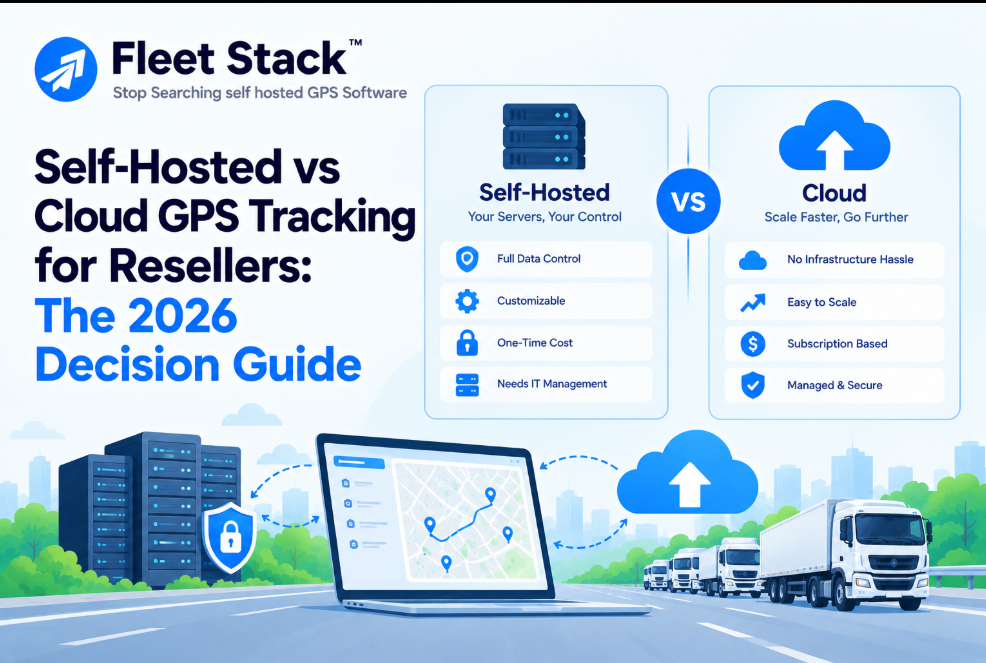
Self-hosted GPS tracking: software is installed on your server or a server you lease, and is licensed on a one-off basis, whereas cloud (hosted) GPS tracking is hosted on the vendor's server and it costs you a recurring fee per device or tier. For resellers, cloud can be a low starting cost solution, and self-hosted tends to be more economical after approximately 100-700 devices, and/or after you want to have your own domain, data location and no per-device fees.
On this page, Fleet Stack offers their white label GPS tracking software for sale. The maths is included in this guide and is shown for both models so that you can verify it with any vendor's quote, including ours.
Key takeaways
The choice is between one-off licence plus monthly running cost, versus monthly per-device licence x fleet.
With a $100 monthly server and $1 per device cloud charge, the cost of a $3,499 self-hosted licence level is even at around 200 devices over three years.
The server load is the number of devices divided by the reporting interval (in seconds): 1,000 trackers reporting every 30 seconds equals 33 messages per second.
The hosting model does not impact AIS-140 compliance, which is a hardware and state-registration issue.
Get point tracking from your own domain, from the start; it's not a trip to every car when you switch platforms.
The brief answer: which to choose?
Choose what is appropriate for your level and your technical ability, rather than the model that sounds more serious.
- Below 100 devices, demand validation continues – begin on a cloud (hosted) plan. No server work will be performed and you can switch later.
- More than 400 devices: use your own numbers to run the break-even table below. This is where most resellers' answer turns.
- If you have a 400+ device requirement, or if you need to keep your data or your brand on the domain, then usually self-hosted will be a cheaper option over the 3 years and you will have complete control of the domain, data and customer relationship.
- Lack of technical skills in-house, and no budget for an admin: begin cloud; the vendor is the one running the server, not you.
What's the difference between the Self Hosted GPS Tracking and Cloud GPS Tracking?
It's available in two versions. Cloud—The vendor hosts the servers on which you access them, typically paying a periodic charge per device, or per tier. Self-hosted: Purchase or license the software, store data in your own database, and operate the platform under your domain.
| Price (USD) | Free | Free (after 7 days free) |
| Optimal costing | Monthly fee (typically per device or per tier) | One-time licence + server cost |
| Arouses as they grow in size | Increases with size of device | Constant until server is outgrown |
| You have your own brand and domain | You can choose from a white-label add-on or a higher level | You have full control |
| Data location and ownership | Vendor's region and terms | Your selection of region; data in your own database |
| Upgrades | Manual | You are responsible for using them |
| Exit / lock-in | Data export relies on vendor | You already have the database |
| Best for | Testing a market, small fleets | Larger fleets, cost and control focus |
- Who is operating the server Vendor Vendor (You or a server house that you rented)
- It's up to the vendor to ensure that no data is lost between scheduled backups, or during downtime.
There are two things which are independent of this choice. The device hardware certification, like AIS-140 in India, is not about where your platform is hosted, it's about the tracker, and the state backend registration, and our AIS-140 compliance guide covers that. And just like any other model, a tracker will pass the data to a server address and you'll select whose server that is.
Which device is less expensive, before self-hosted? The break-even maths
Self-hosted does not lose out when the three-year cost is less than the per-device cost. The formula below is applied to the table below which shows a $3,499 one-time licence as listed on Fleet Stack's sales page on 2026.
Monthly running cost is the total cost to run the device during the month, excluding the licence fee. Cloud fee per device per month is the fee charged for using the device for the month in the cloud.
Monthly running cost is any cost you incur to keep the server up and running: server, backups, monitoring, administration etc. There are two models that are illustrated: one is a lean $100 per month; the other is a $250 per month if it is administered by someone else.
| Cloud fee per device / month | Break-even devices ($100/mo running cost) | Break-even devices ($250/mo running cost) |
| $0.50 | 394 | 694 |
| $1.00 | 197 | 347 |
| $2.00 | 99 | 174 |
The calculation is as follows: $100/month server charge plus $1 per device cloud charge becomes less expensive for self-hosting than the cloud charge, from approximately 200 devices up and beyond three years. It costs $2 per device, flipping at ~100 devices. At and beneath those points, cloud is likely to be the more affordable and straightforward option.
Flat-tier cloud plans are different. Certain vendors sell in tiers instead of per device. The pricing page for GPSWox, for instance, reveals a EUR 99 monthly pricing plan that has an item limit, and an "Unlimited" option (checked 2026). Third-party listings quote $99, $199 and $290 tiers. Three years of cloud would cost $5,400; the total cost of $7,099 with the $100 per-month self-hosted cost is higher. On flat tiers, the price point of cloud is just as low as you can get yourself to the next tier when you hit your device limit, and it's harder to argue the price point than the control and margin per customer.
The inputs are examples only. Use real quotes instead of the per-device fee and running cost when deciding and include your own revenue per device – what you charge end customers, not what you pay for software, is more important. For full margin and SIM-cost workings, see our white label GPS pricing guide.
How to calculate your own running expenses per month:
If you have never used a tracking server, the following line items are to add up, and your typical small fleet range to sanity check a quote against:
| Line Item Description | Description | Typical small fleet range/month |
| Front-end (Apache, PHP, MySQL, WordPress) | CPU, RAM, SSD for the front-end | $10 to $150 |
| Web server certificate | HTTPS on your web server | $0 (Let's Encrypt) to $75/yr |
- Database Backup and off-server storage – Daily Database backups taken offline, $5-$30
- New tools to monitor and alert on uptime; knowing before your customers know $0 to $25
- Admin time - Updates, incidents, growth - a few hours; $0 if you do it, $100+ if you hire
Single VPS owners with a reseller setup are usually in the $100/month price bracket. Both are included in the break-even table because you can pay someone to administer it and you move towards the $250 column.
How big a server does a reseller fleet need?
The number of messages per second is determined by the number of devices divided by the reporting interval (in seconds) and it is the number that sets the server load. A 1000 trackers reporting every 30 seconds send approximately 33 messages a second.
| A 1.0-liter bead (capacity) | 100 devices | 3,000 devices | 6,000 devices |
| 200 | 20 msg/s | 6.7 msg/s | 3.3 msg/s |
| 1,000 | 100 msg/s | 33 msg/s | 16.7 msg/s |
| 5,000 | 500 msg/s | 167 msg/s | 83 msg/s |
The inputs for storage grow as storage expands. A 30-second interval is used for a tracker that outputs 2,880 positions per day—around the clock. If these devices are the 1000 that is about 2.9 million rows a day or approximately 86 million a month. Assuming 150 bytes per row, this is approximately 13 GB a month without indexes, so consider two to three times that amount and establish a retention policy, such as 12 months of detailed history.
To load test and not to trust – rules of thumb:
The table is a maximum, not an average, as most real fleets report during the time they are moving.
The averages are not as significant as spikes: If a power cut reconnects 1,000 trackers at once, there is a burst of buffered history.
Use SSD storage for the database and do daily backup on an off-server basis.
Before selling a portion of your target fleet, do a load test with simulated devices at double that load.
Which reseller does which model fit?
You need support with the following: This will likely be a perfect solution for you:
| First 50 customers, unproven demand | Cloud | No up-front licence, no server to run, easy to stop. |
| 100 to 400 devices, one technical person | Self-hosted | Per-device fees start to exceed fixed costs |
| Those who require local data storage (government, transport, enterprise) | Self-hosted | Data centre selection and access rules are customer choice |
- A single server, multiple reseller and customer accounts under your domain name. Self-hosted with multi-tenant accounts.
If you're just beginning, read about How to Start a GPS Tracking Business. Before you decide to build your own platform or purchase one, check out white label vs custom development. See white label GPS features for feature checklist before choosing. The entire reseller model is available on our white label GPS tracking software page.
The hidden costs of pricing in for self-hosted: having a backup plan which you test, an SSL certificate, monitoring, and the price of having an outage if you are the only one who can fix it.
A worked example: 250 over 3 years
Compare a $1 per device cloud plan to $3,499 self-hosted licence on a $100 per month server with a reseller who charges end customers $4 per device per month.
| Over 3 years | Cloud ($1/device/mo) | Self-hosted ($3,499 + $100/mo) |
| Software / platform cost | 250 x $1 x 36 = $9,000 | $3,499 |
| Server and running cost | Included | $100 x 36 = $3,600 |
| Total cost | $9,000 | $7,099 |
| Revenue (250 x $4 x 36) | $36,000 | $36,000 |
| Gross profit | $27,000 | $28,901 |
In this scenario, the self-hosted model is about $1,900 ahead of the two models at 250 devices, with full control over the domain and data. After 500 devices, the difference becomes significant as the cloud fee is doubled but the licence remains the same. The cloud plan would be more cost-effective at 100 devices. This is the same crossover that the break-even table indicates, and the idea is to execute it with your own fee and fleet, not to take anything for granted.
Is GPS tracking in an application self-hosted secure and who's at fault?
The data resides in your database – in your region of choice – which is typically what regulated customers require. The downside is that security is no longer the responsibility of the vendor and you must take care of it yourself. The starting point we have to use as baseline:
- HTTPS on your domain that automatically renews certificates.
- A firewall that only allows the ports used by the app and tracker protocol.
- Daily encrypted backups off server and a restore that you have tested.
- Ensure that Operating System and application are updated promptly.
- Own customer accounts and roles, meaning that one customer will not be able to see other customers' vehicles.
Cloud takes care of this for the reseller, which works great for resellers who don't have a security team on staff, but you now have the vendor's region, retention and breach-handling terms. Both are not necessarily safer, they shift the responsibility. As described above, Data Residency and Data Certification are a hosting decision and certification for AIS-140 devices is not.
Is it possible to transfer to another platform later? Migration and lock-in
Yes, if you plan it on day one. The simplest thing to do is to have your trackers point to your own domain name, such as track.yourbrand.com, rather than the vendor's server address. Move platforms = repoint DNS = devices follow with no visits to devices.
If you are not sure of any platform, ask these questions in writing:
- Is it possible to export the whole device, vehicle, user and position history in an open format (CSV or dumps from the database)?
- 2. Do customers retain their logins and branding on my domain?
- 3. Whose address is the tracker server address (mine or vendor's)?
- 4. What happens to my data, my licence if the vendor ceases to trade?
- Will there be an export charge or a charge to transition from one plan to another?
A cloud-to-Self-hosted move requires both a data import and a maintenance time. A move from self-hosted to cloud is typically simpler since you own the database. Regardless, test it out on 10 devices prior to fleet migration.
What are the different platforms that provide hosting? (as of 2026)
Hosting options vary from vendor to vendor, and they can change from time to time; this table lists the hosting options currently available from the public sources listed in 2026. Not publicly stated" does not imply that it's not there, it means we didn't find it. Check with all vendors before purchasing. If you're looking for a broader ranking, check our best white label GPS platforms list.
Platform Options available for hosting it The pricing made public.
- GPSWOX
- Cloud plans; self-hosted is not listed on the pricing page; object limit 1-50 or "Unlimited" from EUR 99/month
- This time, it is Wialon Hosting (cloud) and Local (self-run) at Price on request.
- The pricing model for Navixy SaaS, on-premise and AWS is not clearly specified.
- The manufacturer did not specify GpsGate Cloud or OnSite.
- Traccar
- Hosted open-source software (free) Open-source software – free host and separate fee for hosting
- Our product Fleet Stack - $3,499 one time purchase (2026 listed price).
We have not used any of the third-party price quotes for GPSWOX (stating $2,440, $4,990 or $6,990) as the prices differ between sites. Get an estimate in writing from the vendor.
Frequently asked questions
Does self-hosted GPS tracking software come at a lower cost to using cloud?
After a break-even fleet size. Self-hosting costs $3,499 for a licence and $100 per month for running costs, so is better than cloud for about 200 devices over 3 years, at a $1 per device charge. If it's below that, it's likely to be cheaper.
Would you like to use a cloud-based GPS platform as a white label?
Yes, but higher tiers or add-on fees may include reseller accounts and/or custom domains/branding. Question if your domain, logo, login page and emails are all protected and if you can change the tracker server address.
What is the capacity of a single server?
This depends on the reporting interval and software. A sample of the devices is divided by the interval (in seconds) to obtain the number of messages per second, then the devices are loaded at twice that interval. Around 33 messages per second for 1000 devices and 30 seconds.
Is my data on a cloud platform my own?
Not automatically. The ownership and export rights are determined by the vendor's contract. Ask for an export process in writing prior to taking on customers.
Is AIS-140 cloud or self-hosted?
Yes, the tracking hardware must be certified by No. AIS-140 and compliance also requires registration with the appropriate state backend. The data can be sent to either hosting model.
Fleet Stack offers self-hosted, white label GPS tracking software. The information on prices and vendors in this article was accurate in 2026 and may be subject to change; check with each vendor for the latest information before ordering.
0 Comments
No comments yet. Be the first to comment!
Please to post a comment