
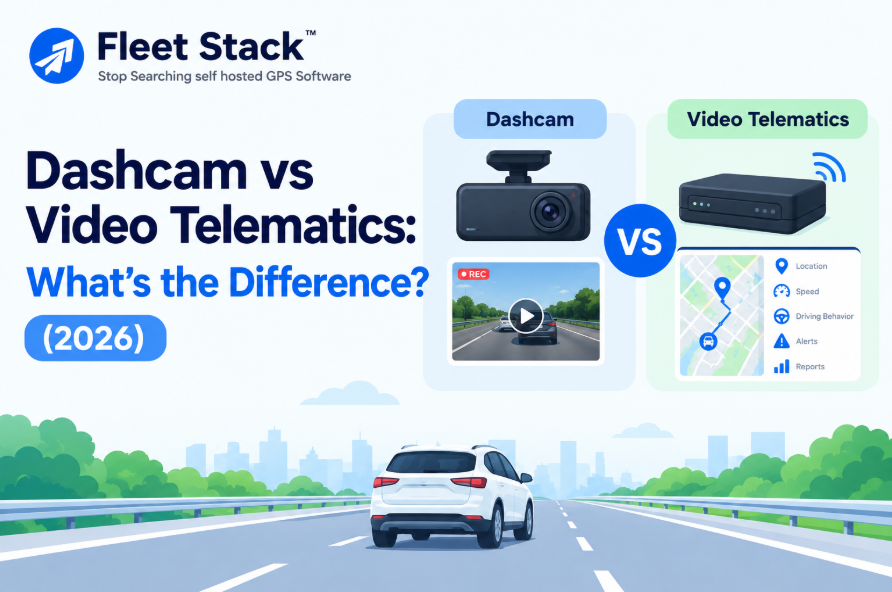
Dashcam is a video camera that captures footage of the road and, in some cases, the driver, which you then look at afterwards. Video telematics is a connected system that integrates that camera with GPS tracking, AI event detection and cloud access, meaning that video is tied to location and driving events, and can provide real time alerts. Put it simple: A dashcam records; video telematics records, connects, understands and acts. A dashcam will suffice for one vehicle but video telematics will provide a complete system for a fleet that requires more than just safety insights and real-time feedback.
At a Glance
| Dashcam | Video Telematics | |
| Data | Footage on device (SD card) | Footage that is geocoded and associated with events and reports, can be accessed remotely |
| Footage review | None — manually control the review of the footage | AI can identify events (harsh driving, drowsiness, distraction) |
- What it is: A camera that captures video, cameras linked to tracking, AI and the cloud.
- Real-time — Not reviewed in real time — reviewed after the fact — yes — can cause live alerts.
- Best for Basic evidence, single vehicle, fleets seeking safety insight and live response
What Is a Dashcam?
A dashcam is a small video camera that is attached to a car, which can record footage while driving. Most are oriented toward the road, some have a lens for a driver facing them. The video is recorded on an SD card, typically, and you look at it manually if there is a collision, a dispute, an incident, etc. It's simple to use: it's an objective record of what happened, which is helpful for claims on insurance policies and when trying to determine who was at fault in an argument.
A basic dashcam doesn't do is link that footage with something else. It has no sense of location to ask, has no comprehension of what it sees and cannot warn you in real time. It records, and you'll review it later. That's typically sufficient for one vehicle.
Video Telematics: What is it?
Video telematics is the camera and then links to the rest of the tracking system. It works with in-vehicle video, GPS tracking, event detection algorithms, and the cloud to turn the video into a comprehensive record of driving behavior — shared, remotely, with location, time, and driving events.
What that connection brings is the difference:
- Video associated with location and events. With the footage comes the event, and a place where it was, so you don't just see a number, and you see the context.
- AI event detection. It can automatically identify events, such as aggressive driving, as well as drowsiness and distraction by the driver, with driver-facing cameras, without needing to watch footage.
- Real-time alerts. Will alert you if something happens because it is connected, and in some systems will warn the driver at the time.
- Access and reporting from outside. Footage and data are not stored on an SD card in the vehicle, but are stored in the cloud in addition to the tracking data.
Video telematics, then, is a dashcam and the tracking, intelligence and connectivity that make video into fleet safety management. Most fleet camera-safety programmes depend on it, and much of what India's fledgling safety rules are directed towards.
The Key Differences
| Core function | Records video | Records, connects, analyses, and alerts video |
| Location aware | Not location aware but can be tracked | Video available for trips and GPS location |
| Audiences | Manual review | AI detects and flags events |
| Read/Write | Local SD card | Cloud (read/remote access, write/reports) |
| Scale | One vehicle at a time | Built to manage a fleet |
- The alerting area will be none and real-time alerts will be to the driver and/or manager.
- Lower, one-off Higher, but provides safety insight and live response
A dashcam is a piece of equipment, while video telematics is a system. One provides evidence; the other, evidence, insight, and action.
What type of system does a fleet need?
This will depend on what you're trying to accomplish:
If you're only interested in getting a basic video log for insurance and conflict on one or a handful of cars, then a dashcam will suffice and you are okay with manually reviewing the footage.
Video telematics is the right solution when you're operating a fleet that needs to proactively enhance driver safety, be notified of events in real-time, correlate video to location and trips, and manage everything remotely — or for fleet safety and camera compliance.
Most fleets (other than a few cars) will see a return on the investment in the connected system because of fewer incidents, reduced fuel usage, improved driving practices, and prevention of bogus claims. For more information on benefits and costs, check out the video telematics for fleets guide, and if you're looking to select a system, the AI dashcam buyer's guide.
India Compliance - A Note
For those who run in India, it is becoming a more regulated decision. Several states now have CCTV (with GPS) on school buses, and the national ADAS mandate calls for camera-based monitoring of driver drowsiness in buses and trucks — all of which is video-telematics-class technology, not a simple dashcam. For covered vehicles, therefore, a compliant, connected system makes for a more rational purchase. See the dashcam and CCTV compliance guide for what's required.
FAQs
So what is the difference between a dashcam and video telematics?
The dashcam shoots footage that you manually view on the camera's screen, which is stored on the camera. Video telematics ties video, GPS tracking, AI event detection and cloud together, which means video is synched to the location of the vehicle and driving event, automatically analysed and can send real-time alerts. So a dashcam records and video telematics records, connects, understands, and acts.
Is video telematics merely a "dashcam"?
No. A dashcam is a single camera while video telematics is a connected system with GPS tracking, AI event detection, real time alerts and cloud access, along with the camera. Video telematics isn't all about the camera.
Should I get video telematics or a dashcam?
For 1 or a few vehicles, a dashcam will do the job for simple video evidence. Video telematics works best for a fleet looking to enhance driver safety, get alerts as events happen, attach video to a location, and control cameras remotely — or for one that needs to comply with fleet camera guidelines.
Is a camera with a time stamp on the recording included in video telematics?
Yes – the camera in a video telematics system is essentially a connected dashcam. The film footage is not just stored for later review, but is also connected with tracking and processed by AI, and can also alert you in real time.
Dashcam vs video telematics: which is the better option for a fleet?
In fleets of more than a couple of vehicles, video telematics is the better option since it transforms video into real-time evidence and safety knowledge, rather than simply a post-fact post-mortem. A simple dashcam will be more appropriate for a car or lower budget.
Will a dashcam be sufficient in India for compliance?
Not necessarily, for covered vehicles. The school bus CCTV guidelines India (in multiple states) and the national connected ADAS regulations (camera-based driver monitoring on buses and trucks) require video telematics-class monitoring systems and not a simple recording dashcam. Verify the need for your vehicle type and state.
Video Telematics, Built In With Fleet Stack
Fleet Stack is a self-hosted video telematics solution that integrates video, GPS tracking, and driver-behaviour monitoring in the same platform, not as a standalone camera. From safety to incident protection to camera-compliance rules, the connected approach is transforming video into fleet management. Read the video telematics guide to see the benefits and costs in depth and review the supported devices list to plan hardware.
0 Comments
No comments yet. Be the first to comment!
Please to post a comment