
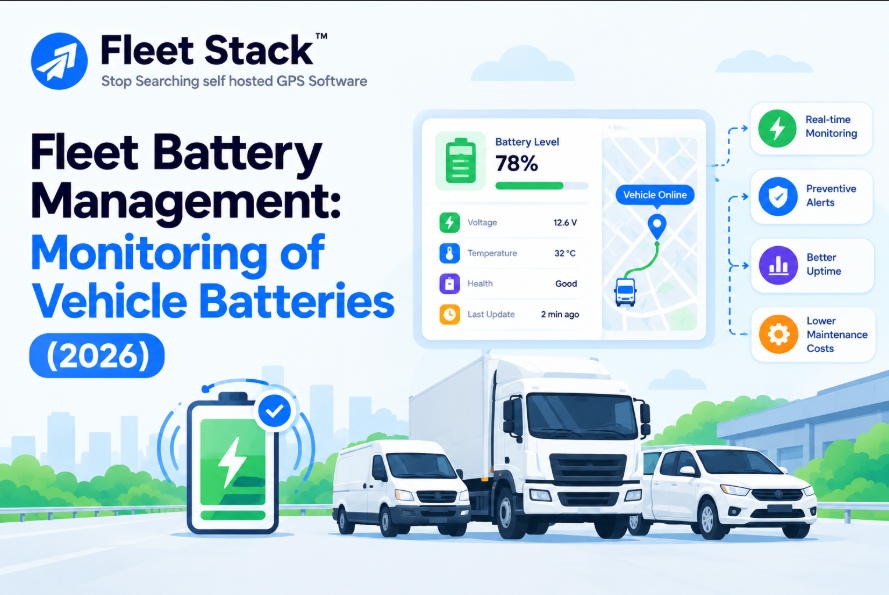
Fleet battery management monitors the battery health and voltage of vehicle batteries throughout a fleet, preventing a no start or breakdown by catching a weak or failing battery. One of the most frequent and disruptive vehicle breakdowns is a dead battery: it can leave you with a car that won't start, a delayed job and frequently happens without notice. Battery monitoring keeps an eye on the battery voltage and condition for every vehicle; it alerts the system when a battery is getting weaker or being drained and enables you to replace or service the batteries on a scheduled basis instead of when they fail on the road. This equates to less down time, less no-starting and replacement batteries that are replaced when they need to be, not too early or so late as to cause the fleet to have to replace more batteries.
At a Glance
| Question | Quick Answer |
| So, what is fleet battery management? | Keeping track of battery health and battery voltage throughout the fleet. |
| What is its purpose? | No starts and failure of batteries due to weakness or failure. |
| What does it track? | Battery voltage, health and battery draining or weakening indication |
| How does it avoid break downs? | It alerts you to a weak battery and takes action ahead of time |
| Does it save money? | Yes, through less downtime and replacing batteries on condition |
| Does this include EV batteries? | It is about vehicle starter batteries, wherein EV traction batteries is not addressed. |
Battery Monitoring is important for fleets because…
A flat battery is a small issue dealing with a big problem. If a vehicle fails to start, the assignment to which it was given is postponed or not completed, some sort of replacement vehicle must be arranged, and if it occurs on the road the vehicle ends up being stuck and needs to be towed. Another common symptom of battery failure is that it happens with very little warning and the first warning sign can be that the vehicle fails to start at the least convenient moment.
With the battery monitoring, there is no more surprise. It monitors the voltage and state of each battery, alerting to which batteries are healthy and which are failing, with a battery approaching the end of its life being replaced on a planned schedule, instead of being found dead at the depot gate. It also detects when a battery is being drained, such as by leaving an electrical appliance or equipment on, before it runs out of power. This is a part of keeping vehicles reliably on the road, and makes a vehicle failure that was once unpredictable, predictable.
What does Fleet Battery Management Monitor?
Battery monitoring will help to monitor the condition of each vehicle's battery, usually based on information from the GPS tracking device or a connected sensor. The things it is monitoring its core.
- Battery voltage. The voltage of the battery when it is connected to the load, or how far it is charged and how healthy it is. A large number of GPS tracking devices already report on the battery voltage of the vehicle.
- Battery health and weakening. Trends in voltage over time that show a battery losing capacity and approaching the end of its life, so it can be replaced before it fails.
- Draining and discharge. A faulty battery that is discharging when it shouldn't, such as when parking, that may indicate an issue or a vehicle that has something plugged in before the battery dies.
- Low-voltage alerts. An alert which warns you if the voltage dips below a safe level, and you are alerted early enough to take action, instead of when the vehicle will not start.
By monitoring these, you can change the invisible, failure-prone battery into a visible and manageable one.
How It Avoids Breakdowns and Saves Money
The primary advantage is the breakdown prevention. A weak battery can be detected in its voltage history and will alert you to replace it before it fails, which means you can do it during a planned down time, or when you're not on the road. If a battery is being drained, before it goes dead, the no-start is avoided. Reduce no-starting, reduce the disruption of jobs, reduce roadside call outs, and improve your scheduling.
The cost side comes next. Loss of time and roadside recovery can cost much more than the battery, and a breakdown can be extremely costly. Conditioned replacement follows a similar reasoning as above and involves replacing a battery when it is close to the end of its useful life as opposed to replacing batteries at a fixed time or using them until they are dead. Low voltage warnings will also prevent the silent expense of a battery that's flat and ruined due to over-charging.
As a battery owner, you will need to recognize a few things.
When reviewing this feature, verify that it provides you a meaningful warning and fits your fleet:
- Battery voltage monitoring, per vehicle, from the tracking device or a sensor.
- Low voltage and draining warnings – you'll be alerted before the battery runs out.
- Health usage over time: you can see the health of a battery and make plans to replace it.
- Integrated alert and maintenance – battery alerts are delivered to the right people and integrated into the scheduling process.
- Device compatibility, as the battery data is derived from tracker or sensor. Make sure that the list of supported devices includes your device.
- Included within a larger fleet platform, so battery data is not an isolated system, but seamlessly integrated into your tracking, maintenance and alerts.
FAQs
Fleet battery management: what does it mean?
It is the measurement of the condition of the battery in a fleet and the battery voltage, before a battery becomes weak or fails and results in a no-start or breakdown. It monitors each vehicle's battery voltage, identifies failing batteries or batteries being discharged and informs a fleet to replace or service batteries at scheduled times, not after a failure to the roadside.
How do battery monitoring systems help to avoid failures?
Typically, a failing battery will exhibit a downward trend beforehand before the battery fails, and battery monitoring systems will reveal that downward trend so that the battery can be replaced when a system is scheduled for down time. It can also detect battery discharge when it's not supposed to be, like when parked, so you can take appropriate action before it becomes flat and the car will not start.
What does a battery management software monitor?
Battery voltage (state of charge and battery health), battery trends (battery is deteriorating over time), abnormal drain or discharge, and low-voltage. Uses data from the GPS tracking device or a connected sensor and alerts when it drops below safe voltage.
Does fleet battery monitoring make money?
Yes. It prevents no starts reducing expensive downtime and roadside recovery, and it allows condition-based replacement so batteries can be replaced when they are at the end of their service life, and not sooner or later. It also helps to avoid the damage a deep discharge can produce on a battery that is left “flat”.
Are EV batteries included in battery management?
This is aimed at the conventional vehicle starter battery, monitoring the two important parameters: voltage and health, which will help prevent no-starts. While the starter-battery monitoring described here is a significant topic of its own, the monitoring of electric vehicle traction batteries is another and much larger one, and is handled by the vehicle's own battery management system.
What is the method in which a GPS tracker monitors the battery voltage?
Lots of GPS trackers are connected to the power and display the battery voltage they experience as part of their data. In many cases, battery monitoring can be integrated into a GPS tracking platform and alerts can be set for low battery voltage, as the software reads the voltage and monitors it over time. Check your device has voltage reporting.
Fleet Battery Management With Fleet Stack.
Fleet Stack is a self-hosted GPS tracking & fleet ERP solution with integrated battery monitoring and alerts, meaning battery voltage and health is monitored by vehicle and alerts are sent to the appropriate people on time to take action for maintenance. Battery data is provided by the tracking device - ensure your hardware reports voltage on the supported devices list. As with all the controllable factors that cause downtime and cost, battery monitoring is best managed in conjunction with the other elements listed in the wider fleet management guide – the maintenance approach and the tyre and parts approach. Your fleet data remains on infrastructure you control, since it's self-hosted.
0 Comments
No comments yet. Be the first to comment!
Please to post a comment