
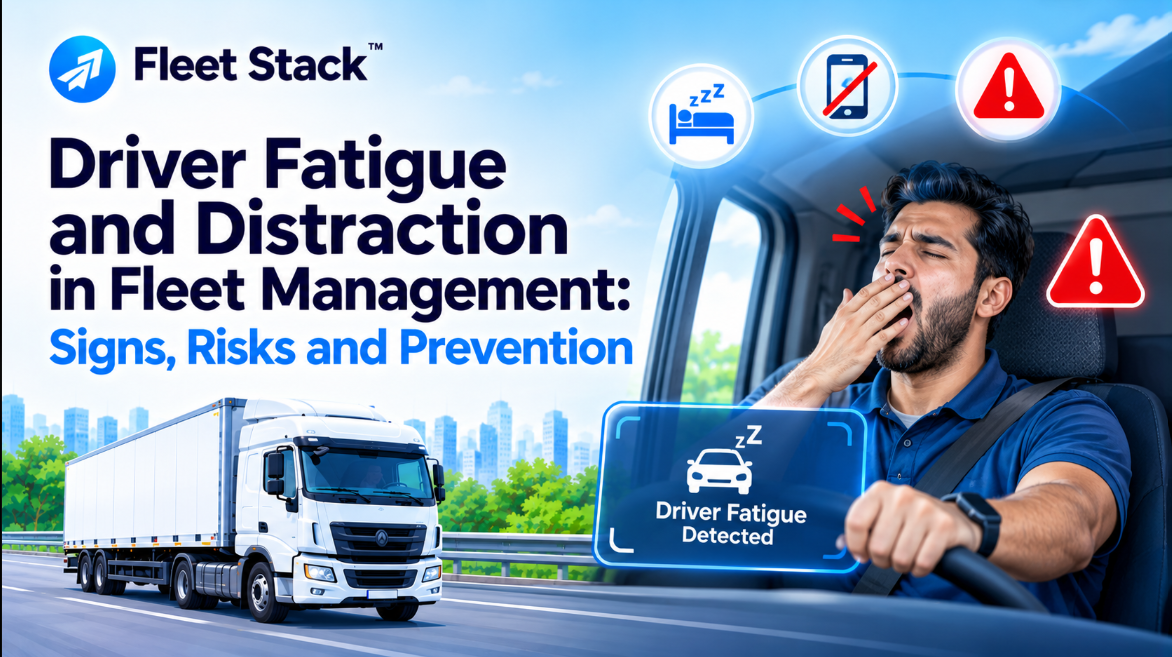
Driving fatigue and driver distraction are two big road-safety issues in fleet operations. Driver fatigue is caused by tiredness or lack of sleep that affects a driver's ability to drive a vehicle safely. Driver distraction happens when the driver's visual, manual and/or cognitive resources are not focused on driving. They both reduce hazard perception, affect decision making, and contribute to the risk of car accidents, and when the driver is not the only one in the fleet, it becomes a safety and cost issue. Occurring inside the cab and more difficult to observe than speeding or severe braking, fleet managers can minimize them through realistic schedule planning, working hours restrictions, driver training, effective safety policies and the right driver monitoring software. This guide covers the factors, symptoms and hazards of fatigue and distraction, as well as the measures fleets take to prevent them.
At a Glance
| Question | Quick answer |
| What does it mean to be “fatigued” as a driver? | Fatigue, long hours or sleep deprivation behind the wheel of a vehicle |
| What do you mean by "driver distraction"? | Anything that distracts sight, hands, mind or hearing from the task of driving |
| Why are they important to fleets? | Both slow reactions and cause errors, and are leading causes of serious crashes |
| What are the symptoms of tiredness? | Weakured, sleepy, drifting, missing signs, slow reactions |
| How do they manifest themselves? | Driver-facing AI cameras can alert to some signs, a pattern of behaviour can provide indirect clues |
| How can fleets avoid them? | Realistic scheduling, working-hours limits, clear policy, in-cab alerts, coaching and culture that is aware of fatigue |
| What are the different types of Distraction? | Visual, Manual, Cognitive, and sometimes Auditory; commonly 3; some with 4. |
Key Takeaways
- Fatigue and distraction are two different risks that have a similar effect. Distraction is caused by competing demands for attention; fatigue is caused by tiredness and inadequate sleep. Both slow down a driver's reaction time and ability to see a hazard.
- They are among the most serious causes of crashes. Distracted and drowsy driving are considered priority risks for fleets because they are among the top causes of crashes and fatalities for the nation's official road-safety organizations.
- They are difficult to see but are becoming more noticeable. While speeding is something that can only be seen by the radar, fatigue and distraction are things that can only be seen inside the cab, which are made visible by driver-facing AI cameras and behaviour patterns; both provide indicators but not proof.
- It is not gadgets, but scheduling and working hours that begin the prevention process. Realistic hours, legal rest limits and good scheduling are the biggest levers against fatigue; a clear phone and in-cab policy are the biggest levers against distraction. Technology is used to support these, but not to replace them.
- A culture that is fair and safety first is best. Fatigue and distraction programmes are more effective if they are associated with protection, rather than punishment, and if drivers can report to the system without fear of being punished for their fatigue.
What is Driver Fatigue?
Fatigue can be defined as a loss in driving ability due to tiredness, excessive driving or lack of good sleep. A tired driver is less alert, less attentive and, at worst, can suffer a microsleep: a brief unintentionally asleep period lasting a few seconds, sometimes without the driver being aware of it. Those few seconds are significant, as a car can go a long distance in that time when it's driving at speed, so if you become drowsy, stop somewhere safe and get some rest.
Drivers' fatigue in commercial vehicles is primarily structural, not personal. They may be due to long shifts, early morning working hours or night-time driving hours which disrupt the body's natural biorhythm, boring motorway journeys and inadequate sleep between shifts. It's not just about willpower - once a body is sleep deprived the only cure for that is sleep and that's why schedules, limits on working hours and rest breaks are more important than any in-cab trick.
The magnitude of the scale is important. According to the U.S. National Highway Traffic Safety Administration (NHTSA), drowsy driving contributes to thousands of accidents and hundreds of fatalities annually and that this number is likely underreported, as it is difficult to determine that someone was fatigued after a collision. Fatigue is one of the major, but under-identified, risk factors for safety.
What is Driver Distraction?
Any activity a driver engages in while driving that distracts him or her from the act of driving is considered driver distraction. Road-safety organisations typically identify three types of distraction, with some suggesting a fourth too, and you will find that there are many distractions that fit into more than one of the categories:
- Visual distraction: distraction by looking away from the road such as using a phone or a screen.
- Manual distraction: removing hands from the wheel, such as eating, drinking or using a device.
- Cognitive distraction: When the driver loses concentration on the driving task, such as daydreaming, or thinking about something while on a hands-free phone call.
- Auditory distraction: the ear is focused on a sound such as loud sound or a phone ring (the fourth type in the four-type model).
Common causes on a fleet are mobile phones, in-cab systems and apps, eating or drinking, paperwork and any out of-vehicle activity. The phone is a dangerous option because it can add any of these to the mix: eyes off the road, hand off the wheel and mind on the call. Distraction is a serious cause of crashes like fatigue because it lessens the driver's ability to see and respond to roadway conditions.
What's the Difference between Driver Fatigue and Driver Distraction?
Fatigue and distraction are talked about together, but they are two different issues requiring 2 different solutions and can occur simultaneously (i.e. a tired driver is more easily distracted).
| Question | Quick answer |
| What is driver fatigue? | Impaired driving caused by tiredness, long hours, or lack of sleep |
| What is driver distraction? | Anything that diverts visual, manual, cognitive, or auditory attention from driving |
| Why do they matter for fleets? | Both slow reactions and cause errors, and are leading causes of serious crashes |
| What are the signs of fatigue? | Yawning, heavy eyes, drifting, missed signs, slowed reactions |
| How are they detected? | Driver-facing AI cameras may flag some signs; patterns in behaviour data give indirect clues |
| How do fleets prevent them? | Realistic scheduling, working-hours limits, clear policy, in-cab alerts, coaching, and a fatigue-aware culture |
| How many types of distraction are there? | Commonly three (visual, manual, cognitive); some models add a fourth, auditory |
Technology rows are a description of what some systems are able to support; actual detection depends upon the features, configuration and operating conditions of the system.
Fatigue is primarily a matter of rest and scheduling, and distraction is primarily a matter of policy and attention. Both should be tackled in a fleet – they cannot be solved by reducing one without the other.
For Fleets, Fatigue and Distraction are Dangerous for what?
Both risks have the same impact, that is they take the driver's attention and slow down their reaction time at the very time a hazard challenges them.
A tired or distracted driver may not react in time to a situation that's developing, like traffic slowing down in front of them, and will take longer to react when it does happen. On the road, the time lag between the time the driver notices the situation and the time the vehicle makes any move can mean a long distance that is traveled until something occurs and turns what would otherwise be a very easy situation into a collision. The effects may be more serious than if the vehicle was an ordinary family car, as they are likely to be larger, heavier and spend a lot of time on the road.
For your fleet, these risks have more impact. They can lead to safety, cost and liability problems for the business; they are a duty of care and in many countries a legal and working hours compliance issue and are difficult to see in real time so can be overlooked unless a fleet actively seeks them out. This is why the aspect of fatigue and distraction has become the focus of modern driver behaviour and fleet driver safety programmes.
What is the purpose of the Working Hours Rules?
The main cause of fatigue is the accumulation of driving time, and insufficient rest, so many countries set limits on the driving time and rest for drivers. These working-hours/hours-of-service regulations are one of the most critical structural protections against fatigue that are required for most fleets; they are not something that can be chosen.
Details vary from region to region and vehicle to vehicle, and the rules must be followed depending on the fleet's operation:
EU drivers' hours rules: Limits on continuous driving, maximum daily and weekly driving, and minimum rest periods, which are enforced by the tachograph, are the EU rules.
In the United States, the Federal Motor Carrier Safety Administration (FMCSA) has established the hours-of-service rules that specify driving limits and rest periods, which are documented using electronic logging devices (ELDs).
In India, labour law contains working-hour restrictions for transport workers, which are applicable in conjunction with the road-safety regulations, depending on the type of operation.
There are many different exemptions, record keeping and limits that vary by region and type of vehicle for different fleets, so there is no universal rule to apply to all. The bottom line: Planning routes and schedules around legal driving/rest requirements, and keeping hours accurate is one of the best preventative measures to avoid fatigue from accumulating in the first place.
Do you know the warning signs of driver fatigue or driver distraction?
Familiarity with the warning signs enables drivers to monitor themselves and managers to look for patterns. Some of the most common symptoms of fatigue are:
- Frequent yawning, or heavy or closing eyelids
- Running outside or inside lane or meandering the pace
- Failure of exits or signals to be in place
- Reactions are slowed down and focus is impaired.
- The need to be constantly moving, or failure to remember the previous section of the road
Distraction is indicated by:
- Late reactions to traffic slowing or stopping ahead
- Failure to adhere to the speed limit on roads or driving in the same lane as traffic when there is no traffic reason
- Late look-up during braking or steering corrections due to harsh braking or steering corrections
- Using the phone or device while it is in view
Many of these can be seen in driving data as well. Unusual lane drift, speed inconsistencies and groups of unexpected brake monitoring events are some patterns that could be indirect indicators and worth looking at late in a shift, although they are not definitive. In other words, they're clues for a manager to investigate, not a sign or a diagnosis of fatigue or distraction – an important point when utilizing them fairly,
What are the strategies that Fleet Managers can use to identify driver fatigue and driver distraction?
Unlike speeding, fatigue and distraction are more difficult to measure because they occur in the cab but with the use of modern tools some signs of fatigue and distraction are more visible.
- Driver-facing AI cameras. A driver-facing camera with driver-monitoring technology that monitors for drowsy driving (e.g., eye closure or nodding head) and distracted driving (e.g., head down or away from the road and using a phone) can alert the driver at the time of the event is the most direct solution. These are all a part of video telematics and AI dashcam technology. These systems are capable of detecting many, but not all, of the items, depending on the hardware, software, configuration and lighting conditions, so check the capabilities of any particular system before you rely on it.
- Behaviour patterns. Indirect indicators like lane drift, inconsistent speed, or an increase in harsh braking at the end of a shift could all be indicators of a fatigued or distracted driver and are detectable through telematics data. These are signs to review, not evidence.
- Information about hours and scheduling. Records on driving time and rest can provide information on when a driver is likely to be tired to help plan their driving and, if relevant, working hours compliance.
There is no single solution and particularly camera monitoring poses privacy concerns. It is most effective when used as part of a clear and fair policy that explains the purpose of the footage, specifies its uses, restricts access to it, implements retention periods, and fulfills privacy and legal requirements applicable to it before it is utilized – and is not used as an instrument of covert surveillance. These signals are added to each driver's safety record and coaching over time along with other elements in a driver safety scorecards view.
AI Dashcams can play a crucial role in assessing driver fatigue and distraction.
While AI dashcams are usually the first equipment that springs to mind when it comes to fatigue and distraction detection, their capabilities can differ significantly based on the specific system. They can be general capabilities of camera systems, not necessarily the features of any individual product, and may encompass:
- A camera in front of the driver that allows the camera to track both the driver and the road.
- Eye-closure or head-position indicators that could be a sign of drowsiness.
- Phone-use/looking-away detection that could indicate distraction.
- The in-cab alerts alert the driver to when a sign appears, making a potentially risky moment a corrected one.
Each of these must be capable of performing well, but two systems that are identical in various respects may perform very differently, depending on the hardware, software, configuration, and lighting and other conditions. Don't assume that AI-dashcam detection is foolproof, it's simply a helpful tool that requires manual checks by humans.
What can do fleets do to avoid driver fatigue and driver distraction?
While detection helps, the biggest wins are in prevention – and most of it is about how the fleet is operated:
- Schedule realistically and within legal hours. There is no single most effective defence against fatigue, but reasonable hours, legal rest limits, adequate rest between shifts and routes taking account of rest are the biggest. The main reason technology can't solve is tight schedules that require long stints.
- Set a clear distraction and phone policy. Establish clear guidelines regarding phone and in-cab devices, and help drivers understand them. This is what driver distraction prevention is all about.
- Promote a stop when tired and breaks culture. Fatigued drivers should be able to take rests with no risk of being caught breaking the law. A culture of stopping is a culture of responsibility and not weakness; it saves lives.
- Utilize in-cab alerts as needed. Cameras and alerts that target the driver can provide a "cue" when they detect inattention or sleepiness, and help make a bad moment better.
- Use patterns, don't use one-offs. Support drivers that exhibit repeated signs with behaviour, camera data: but not blame, in the context of safety and assistance, rather than blame.
- Educate drivers. Remind drivers to recognize their own symptoms of fatigue, the statistics on the danger of driving while talking on a cell phone, and the steps they can take if they are feeling fatigued. Being aware is a true security measure.
Taken together, they help mitigate the two biggest risks that are difficult to detect but far more serious a fleet faces. Fatigue and distraction management is part of the broader driving behaviour monitoring and optimization of a fleet, which is detailed in our fleet driver management article.
What Does a Fleet Fatigue Management Programme Need to Contain?
It's not one-off actions, it's a simple written programme for the strongest fleets. There is a practical one on 5 aspects:
- Policy. Specific, written regulations regarding driving time, rest, using telephones and electronic devices, and when to slow down or stop when tired or distracted.
- Scheduling. Legal hours and realistic rest planned for routes and shifts; no risks are created.
- Training and awareness. Drivers were instructed on the dangers of driving tired, the stop-when-tired rule and the dangers of distraction.
- Monitoring. The agreed tools (driver-facing cameras, as used, behaviour data, hours tracking) were consistently and transparently used.
- Review and coaching. Review incidents & patterns regularly, coaching repeated incidents, recognition of safe drivers.
Creating a Driver Fatigue Management Policy
A specific and jurisdiction-aware policy is optimal for the centre of that programme. A good one will answer:
- Working-hour policy. Maximum driving hours and shift lengths (these comply with the working hours law applicable to your operation).
- Planning of rest and breaks. Time and duration of rest for drivers (e.g. minimum breaks and between shift rest).
- Night-shift considerations. Special attention for driving during the body's lowest points – night time and early morn.
- Driver self-reporting. A safe and non-threatening environment for drivers to let others know when they are tired to drive.
- Escalation. When there is a report of fatigue, what happens: the driver is removed from duty, not pushed to keep driving.
- Periodic review. Regular review of the policy and outcomes, adjusted to the changing regulations and fleet.
Ensure that each legal statement to be included in the policy is particular to the jurisdiction for which the policy applies and is based on the existing official rules and not on a general summary of the rules.
The way in which Fleet Stack helps monitor driver safety.
One of the most difficult fleet-safety problems to spot and one of the most serious are driver fatigue and distraction. It is because they occur within the cab that they require a mix of realistic working hours, legal working hours, robust policy, driver understanding and appropriate monitoring and a culture where safety is seen as a help rather than a hindrance.
Fleet Stack is a self-hosted GPS tracking and fleet management software for fleets to monitor driver behaviour and maintain control over information about infrastructure they manage. Looking to gain more insight into driver operating practices throughout your fleet? Take a look at Fleet Stack's GPS tracking and fleet management software to learn more about vehicle activity, driving habits, and use as a tool for safer fleet operations; or schedule a walkthrough to experience it firsthand. For a better understanding of fatigue and distraction in the context of the overall driver safety picture, be sure to check out our video telematics, AI dashcam tech, and driver safety scorecard guides.
Frequently Asked Questions
What do you mean by driver fatigue?
Fatigue is fatigued driving that results from tiredness, long hours or inadequate sleep. Fatigue affects a driver's reaction, focus and even causes them to experience short microsleep periods without knowing it. It gradually develops, is easy to underestimate and can only be resolved by rest – hence the importance of fleet scheduling and rest breaks.
What is driver distraction?
Driver distraction is anything that takes a driver's attention off driving. It's typically classified as visual (eyes off the road), manual (hands off the wheel), cognitive (mind off the task), and sometimes there's another, auditory (ears drawn away by a sound). Using a phone is particularly risky since it could include multiple parties. Popular distractions in fleets are cellphones, in-cab electronics, eating and paperwork.
What are some of the common symptoms of driver fatigue?
They include frequent yawning, closing or heavy eyes, drifting in the lane, wandering speed, missing sign or exit, delayed reaction time and no memory of last stretch of road. When a driver does see these, the prudent thing to do is to stop and rest; once the driver takes in a nap these symptoms will only get worse until the driver gets some sleep.
What are the 4 types of driver distraction?
There are three categories of distraction visual (eyes off the road), manual (hands off the wheel), cognitive (mind off the task) and some models add another distraction – auditory (ears drawn away by a sound). There are many real distractions that include several at once; such as using a phone, for instance, you can use all. The end result is the same in both versions—when the driver isn't focused on driving, so is the driver.
So, what is causing driver fatigue in commercial vehicles?
The primary causes relate to structure: long shifts, inadequate break between shifts, early starts and night driving, and boring routes. Inadequate sleep out of the office contributes to this. It is necessary to limit working hours and realistic scheduling is the most important factor in reducing it as the causes are mostly related to hours and rest.
What is the impact of driver fatigue on road safety?
Fatigue impairs reaction time, attention and judgment and can lead to microsleep (brief involuntary sleep). Fatigued drivers are not paying attention to traffic hazards and react slower, increasing the severity and risk of accidents. Official road-safety organisations consider drowsy driving a major cause of serious and fatal accidents and say they are under-represented.
What are the signs of driver fatigue in fleet?
Mostly by means of artificial intelligence cameras in the driver's line of sight that detect drowsiness indicators and alert the driver, supplemented by driver behaviour (lane drift and increased harsh braking for example) and driving time monitoring. They are indicators for review, not proof, and can raise privacy issues when using cameras for monitoring, therefore should best be used as part of a fair and well-explained safety programme rather than as a form of covert monitoring.
Will AI dashcams be able to detect fatigue?
Depending on the capability of the camera, driver-monitoring dashcams may be able to detect specific indicators of driver fatigue, including long periods of glazed eyes or nodding, among others. In-cab alerts are issued in some systems to alert the driver. The detection accuracy will vary based on the hardware, software, lighting conditions, and system configuration, so not all AI dashcams will give the same detection.
But how can fleet managers stop driver distraction?
The basic requirement is an unambiguous policy regarding phones and in-cab devices, with driver education about the dangers of distraction, and if the in-cab devices are used, training in how the device works and alerts drivers when they are becoming distracted. Removing the need to use a phone while driving (e.g. via stops) also helps. Like fatigue, the main thing with preventing injuries is the policy and culture, with the technology playing a supporting role.
Can people use a cell phone without any hands free devices while driving?
Less harmful than a hand-held cell phone, but not without risk. Even though the hands and eyes do not move from the steering wheel, a hands-free call still distracts the driver's mind, taking part of the road and car driver's attention away. Most fleet distraction policies, for example, restrict calls while driving — hands-free or not — and promote drivers stopping the vehicle for anything that requires real attention.
What is driver fatigue monitoring system?
A driver fatigue monitoring system is technology that checks for driver drowsiness and alerts the driver and/or fleet. Most have a driver-facing camera with artificial intelligence that can identify eye closure, head nodding, etc., and some have in-cab alerts. The level of detection depends on hardware, software and conditions, so check capabilities of any individual system before using.
So what is the meaning of a fatigue management programme?
A fatigue management programme is a documentable repeatable method that a fleet will employ to minimise fatigue risk. It will normally include policy (time, rest, and device policies), scheduling within the law, driver training and awareness, monitoring, and regular review and coaching. When written down and applied consistently, it becomes a process for safety, which regulators, insurers and courts are increasingly demanding.
About the author:Prerit Khera is CEO and Co-Founder of Fleet Stack (a brand of Quantumlogic Private Limited), with hands-on experience integrating GPS tracker protocols (GT06, Teltonika, Queclink and others) into fleet platforms. Before founding Fleet Stack, he worked at Tata Motors, and today he leads the company’s push to connect fleets worldwide through IoT telematics software. Connect on LinkedIn.
0 Comments
No comments yet. Be the first to comment!
Please to post a comment