





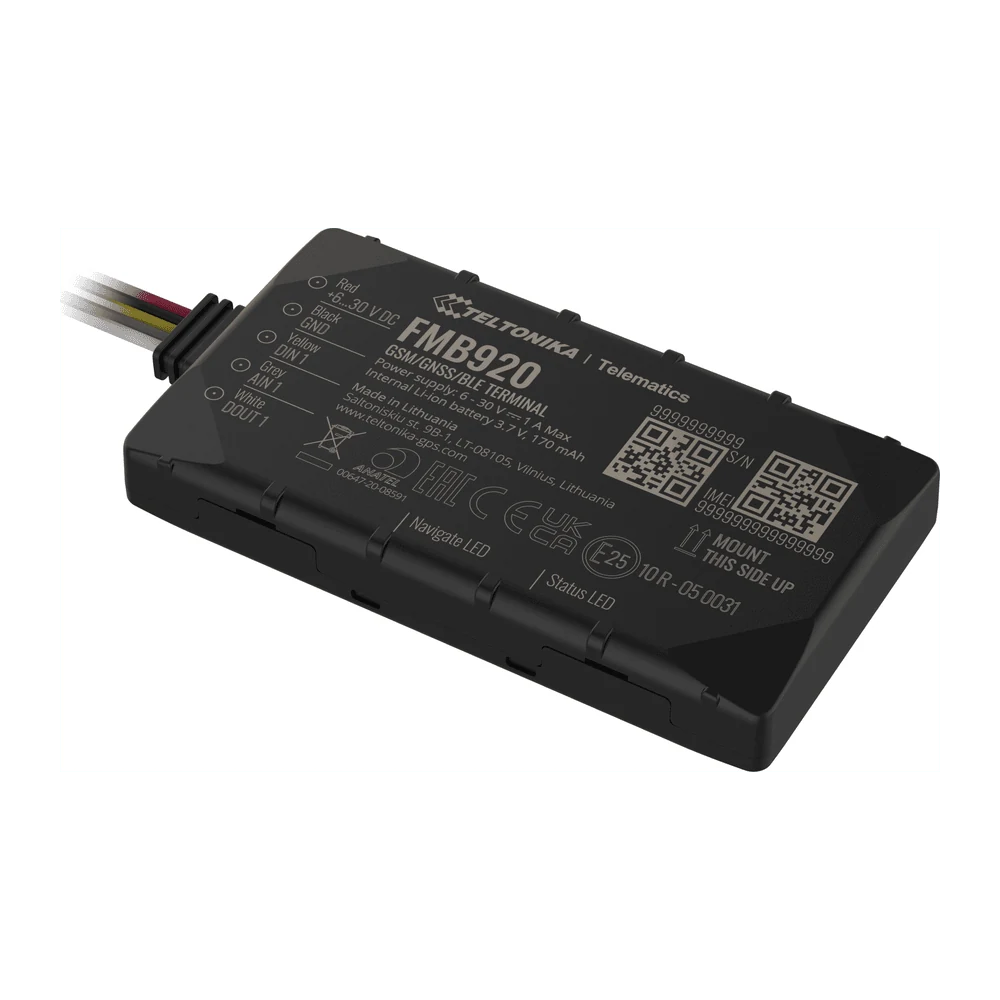
Teltonika FMB920 - GPS with Accelerometer
Teltonika FMB920 is a light, real-time tracking device with GNSS, GSM, and Bluetooth connectivity that is able to collect device coordinates and other useful data and transfer them via GSM network to server.
Product Details
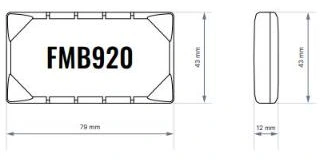
The FMB920 is a small and smart 2G tracker that is powered by Teltonika’s quad-band Teltonika TM2500 module with an integrated high gain GNSS antenna, integrated high gain cellular antenna and internal 170 mAh Li-Ion battery. With a 79 x 43 x 12 mm footprint and 54 g weight, it can easily go behind a dashboard or trim panel, making it one of the most popular trackers used in insurance telematics, rental and car sharing fleets, stolen vehicle recovery and delivery transport and taxi services. See every model we integrate with on supported devices.
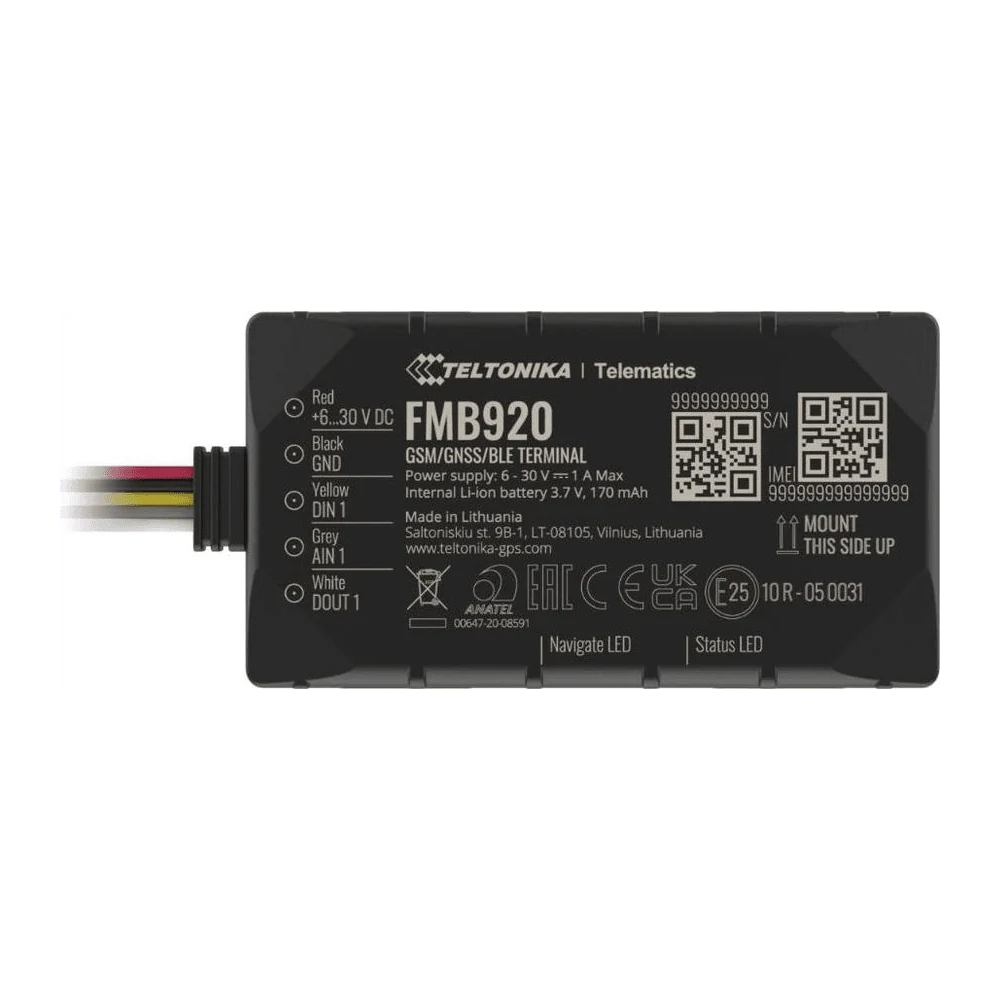
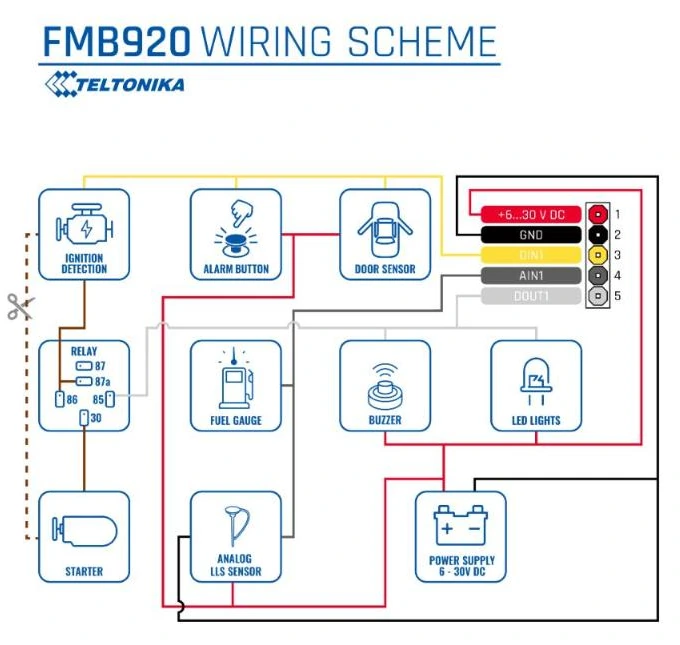
A single digital input, a single digital output and a single analog input are used for the common install (DIN1 = ignition sense, open circuit = relay or buzzer, AIN = fuel level sender). That’s expanded to wireless peripheral devices, such as temperature or humidity sensors, EYE beacons or an OBDII dongle for getting engine data, and even a barcode scanner, with no additional cabling.
On the fleetstack platform the FMB920 reports over the Teltonika protocol on port 5027 (Codec 8, 8 Extended or JSON). Onboard scenarios – Green Driving, over-speeding, crash detection, jamming detection, towing, unplug and excessive idling – are tested on the device itself and alerts are still triggered in GSM blackspots and sent after the link returns from the 128 MB internal flash buffer.
FleetStack Advantage
Get on-trip and off-trip vehicle distance covered
Monitor deviated distance, time, and number of vehicle trips
Analyse aggressive driving behaviour, including overspeeding, harsh braking, acceleration, and cornering
Detect towing events with alerts
Track driver performance, incident summary, top drivers, and much more
Prevent vehicle theft with geofencing
Manage the maintenance of the vehicles efficiently and on time
Create and manage trips on the move
Key Features
Small, lightweight housing fits bikes, cars, buses, and trucks.
Internal 170 mAh backup battery keeps reporting through external power cuts.
Built-in accelerometer powers harsh driving and towing detection.
Bluetooth support adds temperature, humidity, and OBDII dongle peripherals.
Digital and analog I/O support ignition detection, relay cutoff, and fuel sensors.
Vehicle ECU data via a Bluetooth OBDII dongle, with no native CAN port required.
General Information
- Product Type
- GPS Tracker
- Manufacturer
- Teltonika Telematics
- Country of Origin
- Lithuania
- Compatibility
- Bike, Car, Bus, Truck
- Number of SIMs
- 1 (Micro-SIM)
- Weight
- 54 g
- Dimensions (L x W x H)
- 79 x 43 x 12 mm
- Operating Temperature
- -40 °C to +85 °C
- IP Rating
- IP54 — dust and water resistance operating
- Internal Flash Memory
- 128 MB
- Warranty
- 2 years
Network and Connectivity
- Network
- 2G (GSM/GPRS)
- Connectivity
- GNSS, GSM, and Bluetooth
- CAN Bus
- Vehicle ECU data via Bluetooth OBDII dongle (no native CAN port)
Power
- Built-in Battery
- 170 mAh Li-Ion (0.63 Wh)
- Power Supply
- 10 - 30 V
- Working Voltage
- 6 V - 30 V DC with overvoltage protection
- Max Power Consumption
- 2 W
- Rated Current
- 250 mA
Operational Features
Sensors and Controls
- Motion Sensor
- Odometer
- Accelerometer
- Remote Outputs Control
- Security Key
Location and Tracking
- Real-time location tracking with Assisted GPS (A-GPS)
- Status LED: indicates GSM/GPRS mode
- Navigate LED: indicates GPS reception
- Displays GNSS signal level
- LBS location-tracking enabled
- Forced GNSS location update over GPRS enabled
- Forced GNSS location update over SMS enabled
Supported Peripherals
- Digital Input: Ignition Detection, AC, SOS Button, Door Sensor
- Digital Output: Relay, Buzzer, LED lights, Starter control, Engine Control, and other device controls
- Analog Input: Fuel Sensor, Other Analog Sensors
- Bluetooth: Temperature and Humidity sensor, Headset, OBDII dongle, Inateck Barcode Scanner
- Bluetooth: Teltonika EYE beacon and EYE sensor, Bluetooth LE beacons and sensors
Events Monitoring
Onboard Scenarios
- Green Driving
- Over Speeding detection
- Jamming detection
- GNSS Fuel Counter
- DOUT Control Via Call
- Excessive Idling detection
- Unplug detection
- Towing detection
- Crash detection
- Auto Geofence and Manual Geofence
- Trip
Power Saving and Management
- Sleep modes: GPS Sleep, Online Deep Sleep, Deep Sleep, Ultra Deep Sleep
- Configuration and firmware update over FOTA Web and FOTA
- Teltonika Configurator over USB or Bluetooth wireless technology
- FMBT mobile application for configuration
- Time synchronisation via GPS, NITZ and NTP
- Fuel monitoring via LLS (analog) sensor or OBDII dongle
- Ignition detection via Digital Input 1, accelerometer, external power voltage or engine RPM
Technical Specifications
Server Connection
- Server Host
- Issued with your FleetStack account credentials
- Server Port
- 5027
- Protocol
- Teltonika (Codec 8 / Codec 8 Extended / Codec JSON)
Module
- Name
- Teltonika TM2500
- Technology
- GSM / GPRS / GNSS / Bluetooth LE
GNSS
- GNSS
- GPS, GLONASS, GALILEO, BEIDOU, SBAS, QZSS, DGPS, AGPS
- Receiver
- 33 channel
- Tracking Sensitivity
- -165 dBm
- Position Accuracy
- < 2.5 m CEP
- Velocity Accuracy
- < 0.1 m/s (within ±15% error)
- Hot Start
- < 1 s
- Warm Start
- < 25 s
- Cold Start
- < 35 s
Cellular
- Technology
- GSM
- 2G Bands
- Quad-band 850 / 900 / 1800 / 1900 MHz
- Data Transfer
- GPRS Multi-Slot Class 12 (up to 240 kbps), GPRS Mobile Station Class B
- Data Support
- SMS (text / data)
Bluetooth Technology
- Specification
- 4.0 + LE
- Supported Peripherals
- EYE beacon and sensor, Headset, OBDII dongle, Inateck Barcode Scanner, Bluetooth LE beacons and sensors
Interfaces
- Digital Output
- 1 (open collector output for connecting external relays, LED, buzzers etc.)
- Analog Input
- 1
- Digital Input
- 1
- GNSS Antenna
- Internal High Gain
- Cellular Antenna
- Internal High Gain
- USB
- 2.0 Micro-USB
- LED Indication
- 2 status LED lights (Navigation, Modem)
- SIM
- Micro-SIM
- Memory
- 128 MB internal flash memory
Operating Environment
- Operating Temperature (without battery)
- -40 °C to +85 °C
- Storage Temperature (without battery)
- -40 °C to +85 °C
- Operating Humidity
- 5% to 95% non-condensing
- Ingress Protection Rating
- IP54
- Battery Charge Temperature
- 0 °C to +45 °C
- Battery Discharge Temperature
- -20 °C to +60 °C
- Battery Storage Temperature
- -20 °C to +35 °C for 1 month, -20 °C to +30 °C for 6 months
Power Consumption (at 12 V)
- GPRS
- Average 63.48 mA
- Nominal
- Average 24.40 mA
- GNSS Sleep
- Average 5.58 mA
- Online Deep Sleep
- Average 4.62 mA
- Deep Sleep
- Average 4.06 mA
- Ultra Deep Sleep
- Average 2.08 mA
- Battery Charge Current
- Average 140 mA
Electrical Characteristics
- Supply Voltage (recommended)
- 6 V to 30 V
- Digital Input Resistance (DIN1)
- 47 kΩ
- Digital Input Voltage Threshold (DIN1)
- 4 V typical
- Digital Output Drain Current (ON)
- 0.1 A to 0.5 A
- Digital Output Drain Current (OFF)
- Max 120 µA
- Analog Input Voltage
- 0 V to 30 V
- Analog Input Resistance
- 150 kΩ
- Analog Measurement Error
- 3% (±360 mV at 12 V, ±900 mV at 30 V)
- Absolute Maximum Supply Voltage
- -32 V to +32 V
- Overvoltage Protection Cut-off
- 34 V (device turns off)
Certification and Approvals
- Regulatory
- Anatel, CE/RED, E-Mark, EAC, ICASA, NTC, REACH, RoHS, SDPPI (POSTEL), SIRIM QAS
- UKCA
- Yes
- E-Mark
- 10 R - 05 0031
Inputs Fields
- AVL IO
- #1-100000
- Analog sensor
- #1
- BLE: Battery level
- #1-4
- BLE: Battery voltage
- #1-4
- BLE: Humidity sensor
- #1-4
- BLE: LLS frequency
- #1-4
- BLE: LLS level
- #1-4
- BLE: LLS temperature
- #1-4
- BLE: Luminosity
- #1-4
- BLE: Temperature sensor
- #1-4
- Battery current
- -
- Battery voltage
- -
- Board voltage
- -
- External temperature
- #1-4
- Impulse counter
- #1-2
- Mileage
- -
State Fields
- Event code
- -
- Hardware key
- -
- Magnetic bluetooth sensor
- #1-4
Supported Functions
Documents & Manual
Datasheet (v1.5)
Official Teltonika FMB920 datasheet — the source for the specifications on this page.
Quick Manual
Official installation and first-power-up guide from the Teltonika wiki.
Wiring Scheme
Pinout diagram for the FMB920 power and I/O harness.
SMS / GPRS Command List
Full SMS and GPRS command reference on the Teltonika wiki.
Parameter List
Complete configurable parameter list on the Teltonika wiki.
First Start Guide
Quick SMS configuration: APN, server domain, port and protocol.
Resources & Documentation
Official Teltonika Documentation
First-party manuals and drawings published by Teltonika Telematics for the FMB920.
- FMB920 Datasheet (PDF)Datasheet v1.5 — the source for every figure on this page.
- FMB920 Quick Manual (PDF)Installation and first-power-up guide.
- FMB920 Wiring SchemePinout diagram for the power and I/O harness.
- FMB920 Wiki HubTeltonika’s full documentation index for this model.
- FMB920 ManualComplete online manual.
- FMB920 General DescriptionElectrical characteristics, power consumption and battery data.
- FMB920 AccessoriesCompatible sensors, beacons and cabling.
Configuration, Commands and Firmware
Everything needed to commission an FMB920 and point it at a server.
- FMB920 First StartQuick SMS setup — APN, server domain, port and protocol.
- FMB920 ConfigurationTeltonika Configurator walkthrough.
- FMB920 SMS / GPRS CommandsFull command reference.
- FMB920 Parameter ListEvery configurable parameter ID.
- FMB920 Data Sending Parameters IDAVL IO element IDs for protocol decoding.
- FMB920 Sleep ModesGPS, Deep, Online Deep and Ultra Deep Sleep behaviour.
- FMB920 LED StatusDiagnosing the Navigation and Modem indicators.
- FMB920 Firmware ChangelogRelease notes for each firmware build.
- Teltonika Firmware VersionsFirmware downloads across the FMB range.
- Teltonika Configurator VersionsConfigurator downloads and version history.
Certifications and Compliance
Regulatory approvals held by the FMB920, published by the manufacturer.
Set Up Tracking on FleetStack
Connect the FMB920 to FleetStack and put its data to work.
- Device Port ListServer ports and protocols for every supported model.
- GPS Command ListSMS and GPRS commands across supported manufacturers.
- All Supported DevicesBrowse every tracker FleetStack integrates with.
- REST API DocumentationPull FMB920 telemetry into your own systems.
- DownloadsPlatform installers and client applications.
- Video TutorialsStep-by-step platform walkthroughs.
- Community ForumAsk other FleetStack operators about device integrations.
- Technical SupportGet help commissioning a device.
- Free GPS ToolsDistance, area and location utilities.
- Useful LinksCurated telematics references.
What You Can Build With FMB920 Data
Platform modules that consume the telemetry this tracker reports.
- GPS TrackingLive position, trails and playback.
- Vehicle Tracking SoftwareFleet-wide vehicle visibility.
- Fleet Management SoftwareThe full operations suite.
- GeofencingEntry and exit alerts — an FMB920 onboard scenario.
- Driver BehaviourGreen Driving, harsh braking, cornering and overspeed.
- Fuel ManagementAnalog LLS sender or OBDII dongle fuel data.
- Trip ManagementTrip detection and odometer reporting.
- Route ManagementPlan routes and measure deviation.
- MaintenanceService scheduling against reported mileage.
- Alert CenterRoute crash, tow, jamming and unplug events.
- White Label GPS SoftwareRun the platform under your own brand.
- Pricing and LicensingOne-time licence, no per-vehicle monthly fee.
Other Supported Devices


Frequently Asked Questions
Which server port does the Teltonika FMB920 use with FleetStack?
The FMB920 connects on port 5027 using the Teltonika protocol, with Codec 8, Codec 8 Extended and Codec JSON all supported. The server host is issued with your FleetStack account credentials. You can check the port for any other model on the device port list, or browse all supported devices.
Does the Teltonika FMB920 read CAN bus data?
Not directly. The FMB920 has no native CAN port — its wired interface is one digital input, one digital output and one analog input. Vehicle ECU data such as engine RPM reaches the tracker over Bluetooth from an OBDII dongle, which the device supports natively. Engine data then feeds fuel management and driver behaviour reporting.
Which satellite systems does the FMB920 support?
The FMB920 receives GPS, GLONASS, GALILEO, BEIDOU, SBAS, QZSS and DGPS, with AGPS assistance. It uses a 33 channel receiver with -165 dBm tracking sensitivity, position accuracy under 2.5 m CEP, and a hot start in under 1 second, warm start under 25 seconds and cold start under 35 seconds.
Is the Teltonika FMB920 waterproof?
The FMB920 carries an IP54 ingress protection rating, which covers dust ingress and splashing water — suitable for a protected in-cabin or behind-panel installation. It is not rated for submersion or direct high-pressure washing. Operating temperature is -40 °C to +85 °C at 5% to 95% non-condensing humidity.
Does the FMB920 work on 4G or LTE networks?
No. The FMB920 is a 2G device using quad-band GSM at 850, 900, 1800 and 1900 MHz with GPRS Multi-Slot Class 12. Where 2G networks have been switched off, Teltonika offers pin-compatible 4G models in the same 920 form factor — contact FleetStack and we will confirm which model suits your market.
How is the Teltonika FMB920 configured?
Configuration is done through the Teltonika Configurator over USB or Bluetooth, through the FMBT mobile application, or remotely over FOTA and FOTA Web. The device also accepts SMS and GPRS commands for configuration, DOUT control, events and debugging — see the GPS command list, the video tutorials, or ask technical support.
What does the internal battery do on the FMB920?
The 170 mAh Li-Ion battery (0.63 Wh) is a backup supply, not the primary power source — it keeps the tracker reporting through an external power cut and triggers an unplug alert, routed through the alert center. Current draw is roughly 63.48 mA average on GPRS, 24.40 mA nominal, and as little as 2.08 mA in Ultra Deep Sleep.
What can I connect to the FMB920 inputs and outputs?
The digital input handles ignition detection, an SOS button, a door sensor or air-conditioning status. The open-collector digital output drives a relay, buzzer, LED lights, starter or engine control at 0.1 to 0.5 A. The analog input accepts a fuel-level sender or other 0–30 V analog sensor, which drives fuel management reporting.
Get Started With Us
Tell us about your fleet and we will get back with pricing, availability, and an onboarding plan for the Teltonika FMB920. You can also book a meeting, read the REST API docs, or join the community forum.